|
Getting your Trinity Audio player ready...
|
By Shaban Makokha
KAKAMEGA, Kenya — When the rain comes to Rosterman, Janet Ingosi knows what it means before she even reaches the mining site. The pits will fill with water. The paths will turn into slippery stretches of mud. The stones she depends on for her livelihood will become impossible to reach.
For Janet, this means something painfully simple: no work, no income.
“When it rains heavily, we cannot go to the mining sites,” she says. “We cannot get the stones to process, and that means we have no income.”
For a woman raising a family on daily earnings, losing a day at the mine is not merely an interruption to work. It can mean food postponed, school fees delayed, or a debt pushed into another day.
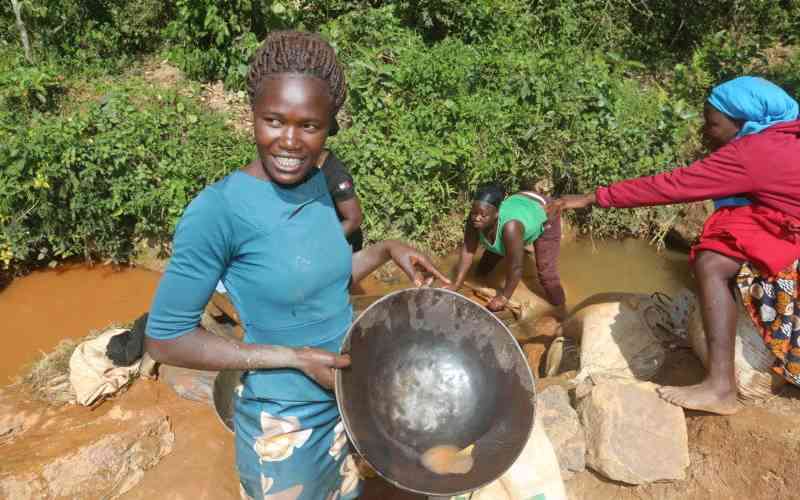
Then the rain stops. The sun returns, sometimes with punishing heat, and Janet goes back to work. She joins other women bending over stones and muddy water, crushing, washing, and processing ore in search of tiny flecks of gold. Their hands remain in water for hours. Their backs stay bent. Dust settles on their faces. There is little room to stop.
“Poverty does not wait for good weather,” says Patrick Ligami, chairman of the Kakamega County Miners Association.
His estimate is stark: women account for about 62 percent of the mining population in Kakamega, particularly in ore processing. Men generally extract the ore from underground shafts before women take over the crushing and washing.
For many of these women, mining offers something that casual farm work cannot. Ligami says women can earn between 1,000 and 3,000 Kenyan shillings a day from mining, compared with about 250 to 300 shillings from casual farm labor. “You will find that it is preferred by the women over going to the farm,” he says.
But the same livelihood that helps women feed their families is increasingly being squeezed between climate change, environmental degradation, and occupational hazards.
A Region of Riches and Risks
Gold mining in Kakamega is concentrated in areas including Ikolomani, Shinyalu, Lurambi, Khwisero, and Butere. The region has long been associated with significant gold deposits. Exploration by Acacia Mining in 2013 estimated that the Lirhanda corridor contained at least 1.31 million ounces of gold, with up to 60 percent believed to be concentrated in Kakamega. More recently, Shanta Gold Kenya Limited has reported a much larger estimated resource in the region.
For the women working on the ground, however, the value of the gold beneath their feet is less important than whether they can access it today. When the rains come, mining can stop. When the heat becomes intense, the work becomes harder. When water becomes scarce, processing becomes difficult. And when mining damages land and water sources, farming—the alternative livelihood for many families—can also become more difficult.
It is a cycle that leaves women exposed to several risks at once.
“The women who are doing the process, most of the day, their limbs- the legs and the hands- are constantly in water and in a bent position,” Ligami says.
For Marylyn Okwisa, a miner from Bushiangala in Ikolomani, the physical toll is something she feels in her own body. “At home, I feel healthy,” she says. “But when I get to the mining site and spend hours working under the heat, my body begins to give in.” She gets tired. She develops headaches. Her back hurts. Sometimes she takes a painkiller and returns to work. “I cannot afford to stop,” she says.
The Toxic Toll of Gold Mining
Some women in Kakamega’s gold fields handle chemicals used in processing, including mercury, sometimes with inadequate protection. The World Health Organization identifies heat and chemical exposure among occupational hazards in artisanal and small-scale gold mining, with particular concerns for women of reproductive age. WHO says mercury exposure can affect the nervous, digestive, and immune systems and damage the lungs, kidneys, skin, and eyes. Developing fetuses and young children are particularly vulnerable.
The Minamata Convention identifies artisanal and small-scale gold mining as the largest source of mercury emissions and releases globally and calls for countries to reduce, and where feasible eliminate, mercury use in the sector.
Isaac Maindi, a senior occupational safety and health officer with the Directorate of Occupational Safety and Health Services, says climate change is intensifying existing workplace hazards. Chemical exposure, extreme heat, heavy rainfall, disease risks, and poor working conditions can overlap, he says. His prescription includes better protective equipment, safer technologies, and measures to eliminate or reduce exposure to hazardous substances.
But for women surviving on what they earn each day, safety measures can compete with another urgent need: putting food on the table.
When Mining Waste Comes Home
In Shitoli village, the connection between mining, water, and climate change is impossible to ignore. Heavy rains can turn mining waste into a moving hazard, carrying wastewater, sludge, and chemical residues towards homes, farms, roads, and rivers.
Joyce Khakaba remembers one frightening incident. Water from a leaching plant overflowed, broke through a wall, and entered nearby homes. “The water overflowed and broke through the wall. It entered the homes,” she recalls.
The growth of leaching plants has added to community concerns. Some residents say poorly fenced sites leave stagnant pools exposed to people and livestock. “You can see the water is no longer normal. It changes color and remains there,” Joyce says. Then comes the rain and Joyce notes: “When the rains come, everything moves towards us.”
That movement of water can carry mining’s hidden hazards beyond the mining site and into the places where people live. UNEP has warned that poorly managed artisanal and small-scale mining can contribute to land degradation and contamination of soil and water. Mercury released into the environment can also enter aquatic food chains.
Peter Mathea, an environmental safeguards coordinator in Kakamega County, describes a troubling paradox: communities can experience too little usable water during dry periods and too much destructive or potentially contaminated water when heavy rains arrive. For women, water insecurity has another dimension. They are often responsible for securing water for cooking, washing, and other household needs. So when water becomes scarce or contaminated, the burden does not stop at the mining site. It follows them home.
A Failing Safety Net
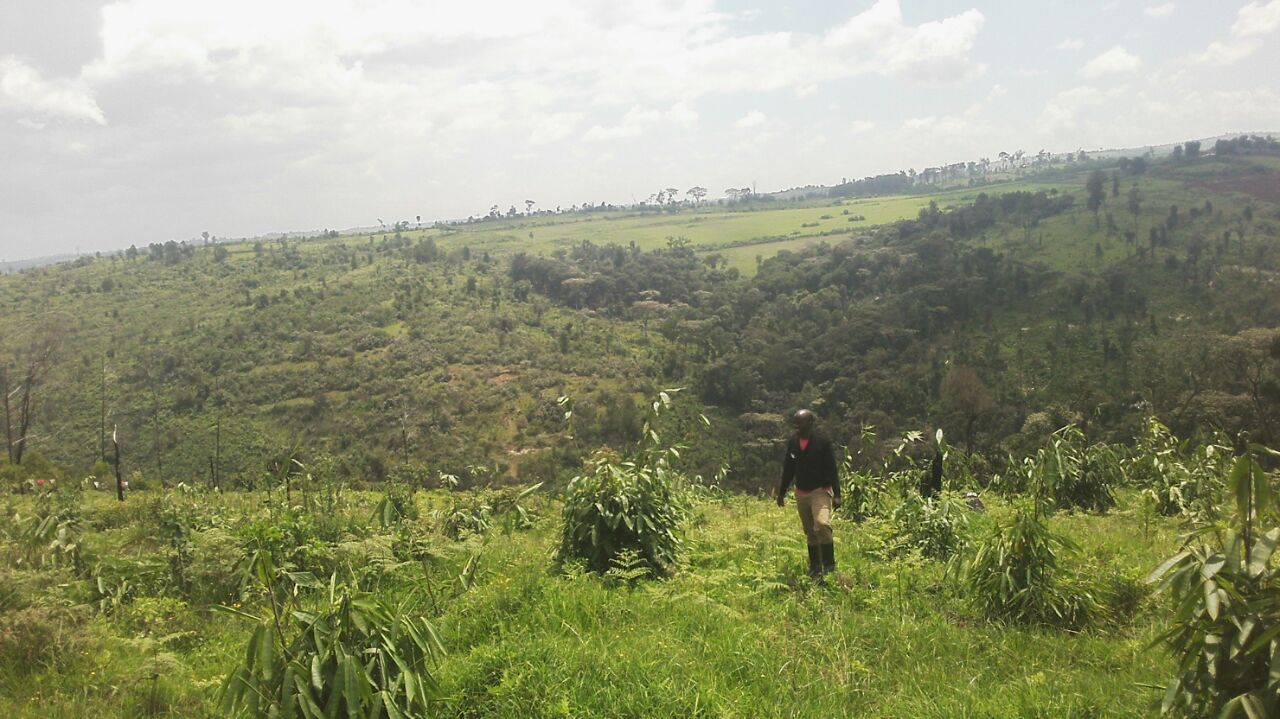
The damage caused by mining does not disappear when the gold is gone. Trees are cleared, soil is excavated, waste piles up, underground water pathways can be disturbed, and open and abandoned shafts can become dangerous, particularly during heavy rains.
Brilliant Mwavishi, a resident of Rosterman, says soil erosion and open pits have become part of the landscape around mining areas. In Ikolomani, Rehema Wekulo wants abandoned shafts backfilled and damaged land rehabilitated so that it can eventually return to agricultural use. She also wants more trees planted and agroforestry promoted to restore vegetation and protect water catchments.
Her concern is not simply environmental. For many families, farming is the safety net when mining stops. But if mining leaves farmland degraded or water sources affected, that safety net becomes weaker. And that is where climate change makes an already difficult situation even harder.
Rain can stop mining. Drought can undermine farming. Floods can destroy infrastructure. Extreme heat can make mining more dangerous. And environmental degradation can remove alternative sources of income. For women who depend on mining, the ability to absorb these shocks is often limited.
Women Propose Solutions
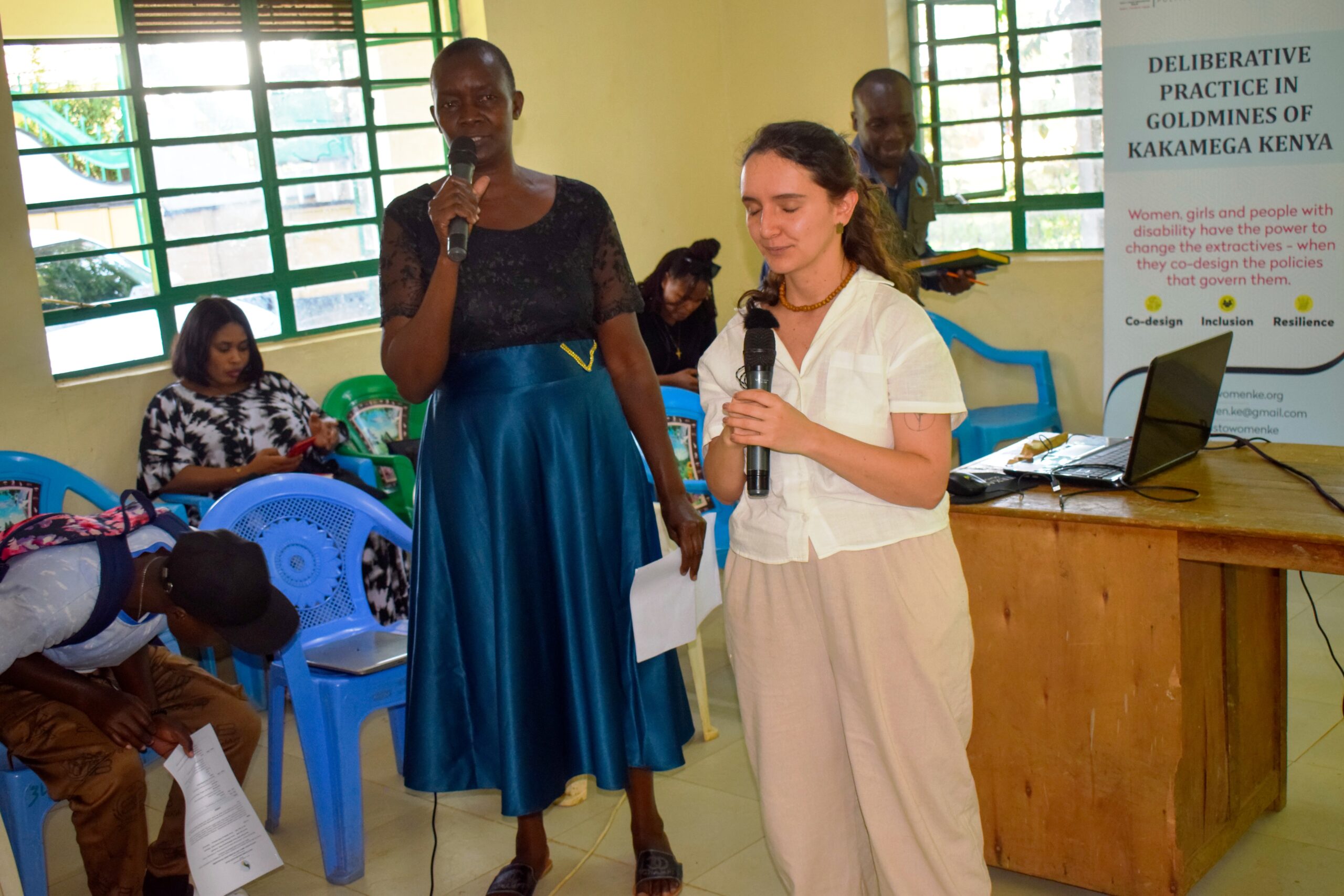
Yet the women are not simply describing problems. They are also proposing solutions. A deliberative process conducted by Girls to Women Organization (GtoW) in Lurambi, Shinyalu, and Ikolomani brought together women, girls, people with disabilities, community leaders, officials, and other stakeholders to discuss the challenges facing mining communities. The process included co-design sessions, mini-publics, and a Citizen Assembly.
According to GtoW programmes officer Audrey Bigeti, 120 people participated, including 108 women, 41 young people, and 10 people with disabilities. The process generated 34 recommendations, with 25 prioritized for consideration by the Citizen Assembly. Among the priorities were safer chemical management, tree planting, backfilling abandoned shafts, and access to safe water. Participants also called for leaching plants to be located away from homes and water sources.
GtoW director Mercy Kalemela says the inclusion of women and people with disabilities was deliberate because different groups experience mining risks differently.
For Florence Wambui Nguni, a collaborator and independent consultant involved in the mini-publics, climate change is not necessarily creating entirely new health problems. It is making existing ones harder to ignore. “Climate change is not producing new health challenges. It is actually exposing what we have been ignoring. It is an accelerator to the health risks that are already within the community,” she says.
She wants Kakamega County to move beyond one-off assessments and collect continuous data on miners’ age, sex, socioeconomic circumstances, health exposures, and access to healthcare. “For sustainability purposes, I would definitely ask the county government to collect data in a longitudinal format, not just a spot-on and move to the next thing,” she says.
Her message to policymakers is equally direct: “The communities have the solutions. The government has the financial muscle to implement some of the recommendations that have been given by the community, especially the women.”
The Push for Inclusive Policy
For Ama Yembe, a Demo Reset mentor supported by Colombia-based Instituto de Política Abierta, the women working in Kakamega’s gold fields occupy a difficult position. They are exposed to the risks of mining and climate change while also carrying responsibility for their families. “The women bear the brunt of gold mining. They are also the carers of their families and, in many cases, the main support system,” she says.
Yembe argues that climate and mining policies must involve the communities living with the consequences. “Wherever decision-making is going on, the people in the community should be at the table,” she argues.
The message coming from the women is not that mining should end. It is that it should become safer. “The women are not asking for mining to disappear,” Yembe says. “They are asking for a safer way to survive it.”
Melissa Velez Arias, project coordinator for Demo Reset at Instituto de Política Abierta, says the deliberations demonstrated the importance of allowing women and girls to bring their everyday experiences into policy discussions. “We think that women and girls are not only actors affected by these challenges. They also have daily life experiences that can help us understand how these problems are affecting the entire community,” she says. For her, participation should go beyond inviting residents to occasional public meetings. Their experiences, she says, should inform decisions.
Government Response
The Kakamega County Government says it is considering the recommendations emerging from the citizen process as it reviews its Climate Change Action Plan 2023–2027 and addresses environmental risks associated with gold mining.
Anthony Munanga, the county director of environment, says the recommendations from Shinyalu, Ikolomani, and Lurambi will provide useful information as the county engages with mining communities and other stakeholders. Chief Officer for Environment and Natural Resources Bill Silingi says the citizen forum highlighted concerns including mercury contamination, collapsing shafts, flooding, and loss of vegetation. Under the Mining Act, 2016, he says, the county government’s role includes public participation, making community engagement an important part of mining governance.
County Minister for Water, Environment, Natural Resources and Climate Change Peninah Mukabaneh says the county is already implementing its climate change action plan and could incorporate recommendations from the forum during future amendments. But she cautions that implementation will require additional funding and collaboration with national government agencies and development partners.
A Daily Choice
For Janet Ingosi, however, the policy discussions ultimately come down to something much more immediate. The next time dark clouds gather over Rosterman, she will have to decide whether it is safe to go to the mine.
If she stays home, there may be no money that day. If she goes, she risks working in rain, mud, contaminated water, or under an unforgiving sun.
Either way, climate change has already entered her workplace. And it is changing what it means to earn a living from gold.