|
Getting your Trinity Audio player ready...
|
By Mary Mwendwa
NAIROBI —From a Ksh 53.9 billion housing push with thousands of sites lacking land papers to a Hustlers’ Fund whose books don’t add up, the Auditor-General’s latest report on 63 national government funds exposes cracks in how public money is tracked.
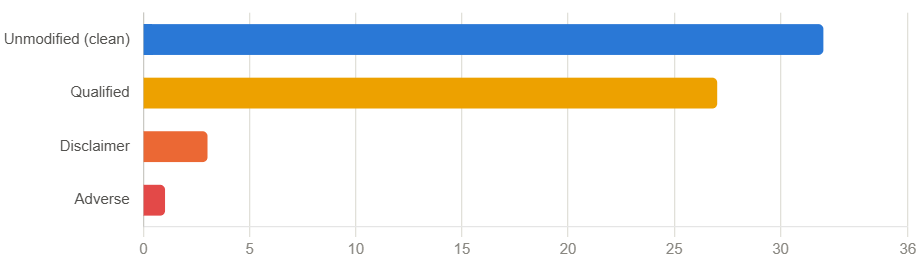
Kenya runs dozens of special-purpose public funds, each set up to do something the regular budget cannot. The Auditor-General has now examined 63 of them for the year to 30 June 2025, and just 32, or roughly half, came back with a clean opinion.
Another 27 funds got a qualified opinion, meaning the auditors found material problems. One fund received an adverse opinion, and three were given a disclaimer, the most serious verdict, which means auditors could not gather enough evidence to say anything about their books at all.
Findings from the report, signed off in January 2026, note that this was the first year all these funds moved to accrual-based accounting. That created fresh risks around opening balances, unrecorded bills and heavy manual adjustments. The Auditor-General also warns that repeated findings go unpunished, which allows the same problems to return year after year.
The Hustlers’ Fund: millions of loans, and gaps in the numbers
The report’s closest look at an everyday Kenyan programme is the Financial Inclusion Fund, better known as the Hustlers’ Fund. It disbursed Ksh 17.9 billion in loans during the year, and auditors say the paperwork has not kept pace.
Loans owed to the fund stand at Ksh 15.2 billion. Of that, Ksh 13.2 billion, or 87 percent, has been outstanding for more than a year, which casts doubt on recovery. Auditors say the fund has no credit policy or collection strategy for bad loans.
The audit also turned up some striking details:
- Unapproved product: A new “Bridge Loan” went out to 1,344,531 borrowers, worth Ksh 5.3 billion, but auditors saw no evidence it was approved by the fund’s board, the parent ministry or the National Treasury.
- Early loan closures: 386,735 loan accounts were marked closed even though Ksh 377.5 million in principal was unpaid, with no justification given.
- Overdrawn savings: 37,042 customers withdrew more than they had saved, leaving overdrawn balances of Ksh 24.4 million.
- Fresh loans on top of old ones: 26,117 loans went to 11,550 customers who already had active loans.
- Unconfirmed savings: Ksh 2.3 billion of clients’ savings was not backed by a bank certificate or reconciliation. The fund’s own statements also disagreed with its database by Ksh 232 million on customer contributions.
The fund also depends entirely on service providers to run disbursements, repayments and loan records, so it cannot independently check its own data.
Affordable housing: big spending, small output
The Affordable Housing Fund received a clean opinion on its accounts, but the audit still raised serious questions about delivery. It holds Ksh 53.9 billion in construction work in progress. Yet only 3,611 units had been completed, against a medium-term plan that envisions 200,000 affordable units built every year.
Land is another worry. Of the 317 housing projects reviewed, only 14 had title deeds. Nine had letters of allotment, and 23 had certificates of search. Two sat on community land, and 269 had no land documentation at all. Auditors cautioned that this could complicate the issuing of title deeds to future buyers.
On the revenue side, 6,390 taxpayers appear in the PAYE register but are missing from housing levy records. Ksh 459 million owed to county committees had also not been remitted since the fund began.
A railway levy and a Ksh 7.5 billion question
The Railway Development Levy Fund (Holding Account) transferred Ksh 32.5 billion to the National Treasury to repay the Standard Gauge Railway loan. Only Ksh 25 billion was budgeted for this, leaving Ksh 7.5 billion, or 23 percent, above the approved amount. Auditors found no evidence that the budget had been formally revised, so the regularity of that spending could not be confirmed.
Dormant funds that won’t die
Several old funds remain on the books long after they stopped working. The Treasury Main Clearance Fund, dormant for 14 years, is the only fund to receive an adverse opinion. It carries Ksh 12.5 billion in receivables and Ksh 12.49 billion in payables that auditors say have not been supported.
The Kenya Local Loans Support Fund has been dormant since June 2006, and the Government Clearing Agency Fund for more than 13 years. Both received a disclaimer of opinion. Cabinet approved plans to wind them up years ago, but the National Assembly has yet to pass the orders.
The third disclaimer went to the Stores and Services Fund. It reported sales of just Ksh 35,899 for the year, an unexplained Ksh 283.6 million overdraft from the Central Bank, and negative working capital of Ksh 161 million.
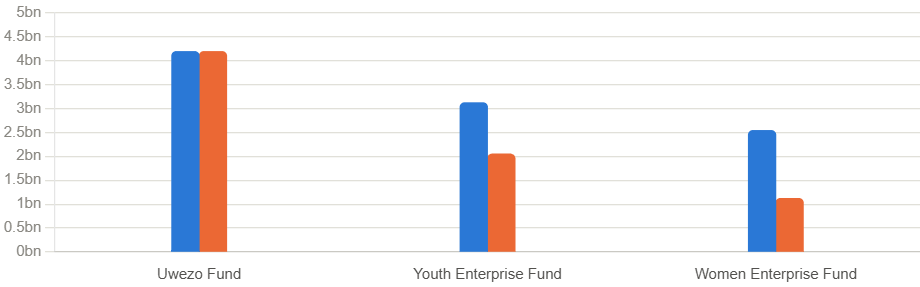
The report was also critical of the funds meant to back young people and women. The Uwezo Fund has Ksh 4.2 billion in loans outstanding for over three years, plus Ksh 127 million in bank receipts missing from its cash book, some dating back to 2018. It had filled only 29 of its 393 approved staff posts, about 7 percent.
At the Youth Enterprise Development Fund, Ksh 2 billion of its Ksh 3.1 billion in receivables had not been serviced for more than three years. The Women Enterprise Fund had Ksh 1.1 billion in constituency-level loans overdue by more than a year, and Ksh 696 million in digital loans issued to 15,234 groups in mid-2023 were still unpaid over two years later.
What it means
The report sets out the main problem plainly: funds that cannot fully account for their money are hard to hold to account for results. The Auditor-General’s office says that the Treasury has the power to sanction entities that ignore audit findings, but that this power is not being used, and that fiscal indiscipline, misallocation and wasted resources follow when there are no consequences. The office is also pushing for longer audit timelines and greater financial independence so it can scrutinise more of the system.
Some funds came through well, including the Contingencies Fund, the Public Service Superannuation Fund, the Equalisation Fund and the NG-CDF. Whether the rest improve will depend on whether Parliament and the Treasury act on the findings.