|
Getting your Trinity Audio player ready...
|
By Mercy Kachenge
Mt Elgon, Bungoma County: According to the 2022 Kenya Demographic and Health Survey (KDHS) as cited by the Ministry of Health, Kenya records 355 maternal deaths per 100,000 live births.
The leading killer is not a disease without a cure — it is a haemorrhage that begins minutes after delivery and can drain a woman’s life before anyone with the right skills arrives.
In one remote sub-county on the slopes of Mt. Elgon, a structured emergency network is changing that calculus. Suzan Ngomat was seven months pregnant when her first scan brought bad news: her baby’s umbilical cord had wrapped around its neck twice. By her second scan, the cord had loosened slightly, enough for her care team to proceed toward a normal delivery cautiously. She arrived at the facility that night with anxious hope. What followed shattered it. “I suffered a cervical tear, which caused heavy bleeding during delivery,” she recalls. “I was very tense because there was so much bleeding that I was not used to. My first delivery was normal.”
The nurses reached for cotton pads to slow the flow. It kept coming. Fifteen minutes passed before a doctor appeared, and when one finally did, he was not from Suzan’s hospital. The facility had no specialist on site that night. One was sourced from a private clinic nearby, but before he would come, her family had to pay.
“It took about 20 minutes because we had to make a down payment so that they could show up for the treatment,” she says quietly. Suzan survived. She is now the mother of two. But she knows precisely which failures nearly killed her: too few staff, no specialist on call, and a system that demanded money from a bleeding woman’s family before sending help. Her experience is not an outlier. It is the pattern that has made postpartum haemorrhage (PPH) Kenya’s deadliest complication of childbirth.
PPH is the loss of more than 500 millilitres of blood within 24 hours of delivery. According to Kenya’s Ministry of Health, it accounts for an estimated 34 to 40 percent of all maternal deaths in the country, which already records 355 deaths per 100,000 live births, nearly five times the Sustainable Development Goal target of 70 by 2030.
The Ministry estimates that 5,000 Kenyan women die in childbirth every year. Most of those deaths occur within the first two hours after delivery, in facilities that know what is happening but cannot stop it fast enough. The cruelty of PPH is that its treatments are neither expensive nor experimental. Oxytocin, misoprostol, and tranexamic acid cost very little. The Non-Pneumatic Anti-Shock Garment (NASG) that stabilises a woman in shock is reusable and field-deployable.

Uterine massage, clot removal, surgical repair — these are skills, not technologies. What kills women is not the absence of a solution. It is the distance — physical, logistical, financial — between when the bleeding starts and when the right response arrives.
In Mt. Elgon Sub-County in Bungoma, that distance has historically been vast. The sub-county sits on the slopes of an extinct volcano on the Uganda border, its communities scattered across steep terrain and connected by roads that become impassable in the rains. Until recently, a woman haemorrhaging at a peripheral clinic had one option: a long, rough journey to the main sub-county hospital, in shock, with no guarantee that what she needed would be there when she arrived.
In early 2025, Mt. Elgon introduced a structured PPH emergency model through a partnership with KMET. Rather than simply training more people inside the same broken referral chain, the programme restructured the chain itself. Mt. Elgon Sub-County Hospital became the Hub, a Comprehensive Emergency Obstetric Care facility with a theatre, transfusion capacity, and the ability to perform a hysterectomy if necessary.
Two health centres, Kaptama and Kamneru, became Spokes: stabilisation points that receive referrals from all smaller clinics in their wards before escalating to the hub. For the first time, a haemorrhaging woman in a remote community had a closer, equipped, and prepared destination.
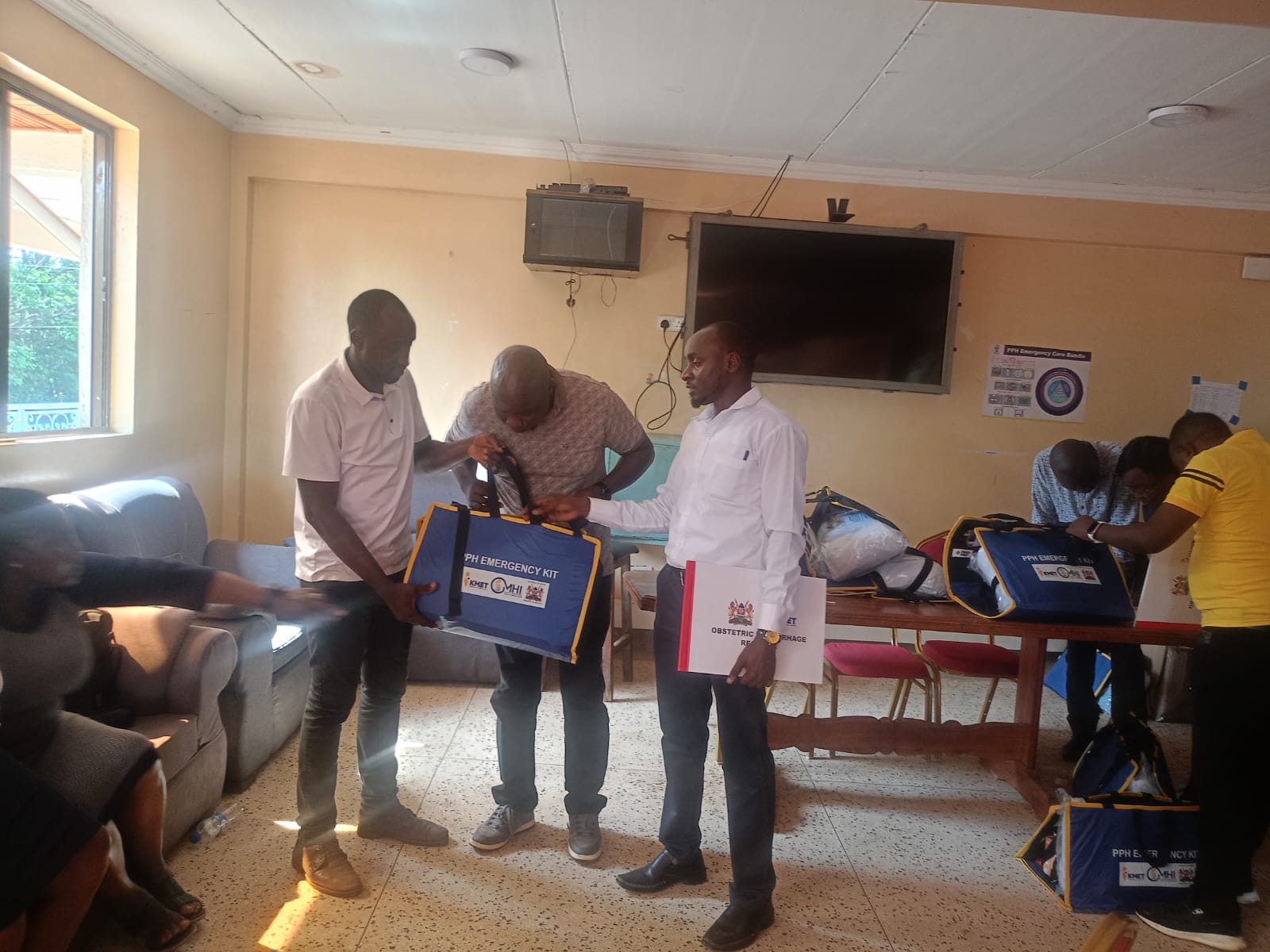
Each spoke was equipped with a standardized PPH emergency kit — uterotonic drugs, an NASG, and a step-by-step bundle protocol guiding nurses through the response sequence regardless of their experience level. “They use that kit to manage the PPH, then refer to the hub,” explains Juma Musa, Midwife at Mt. Elgon Sub-County Hospital. “Here, we are prepared in case the patient needs a transfusion, in case she needs theatre, in case she needs a hysterectomy.”
The protocol’s value lies in its standardization. Before the bundle, response quality depended entirely on who was on shift — a confident nurse managed well; an overwhelmed one improvised. Now the kit carries the knowledge even when experienced hands are absent. “The PPH kit has all the steps you follow when managing PPH,” says Dorcas Kinjo, Nursing Officer In-Charge at the sub-county hospital.
“It makes it easier for the nurse to respond step by step, and she knows at what point she is supposed to refer to the next level.” One clinician per hub was designated as a mentor, running Continuous Medical Education sessions twice a month at the hub and once monthly at each spoke. The impact has been measurable. “Since last month to this month, there has been a very significant drop in PPH referrals from the facility from three to even zero,” Musa says.
The Fractures That Remain
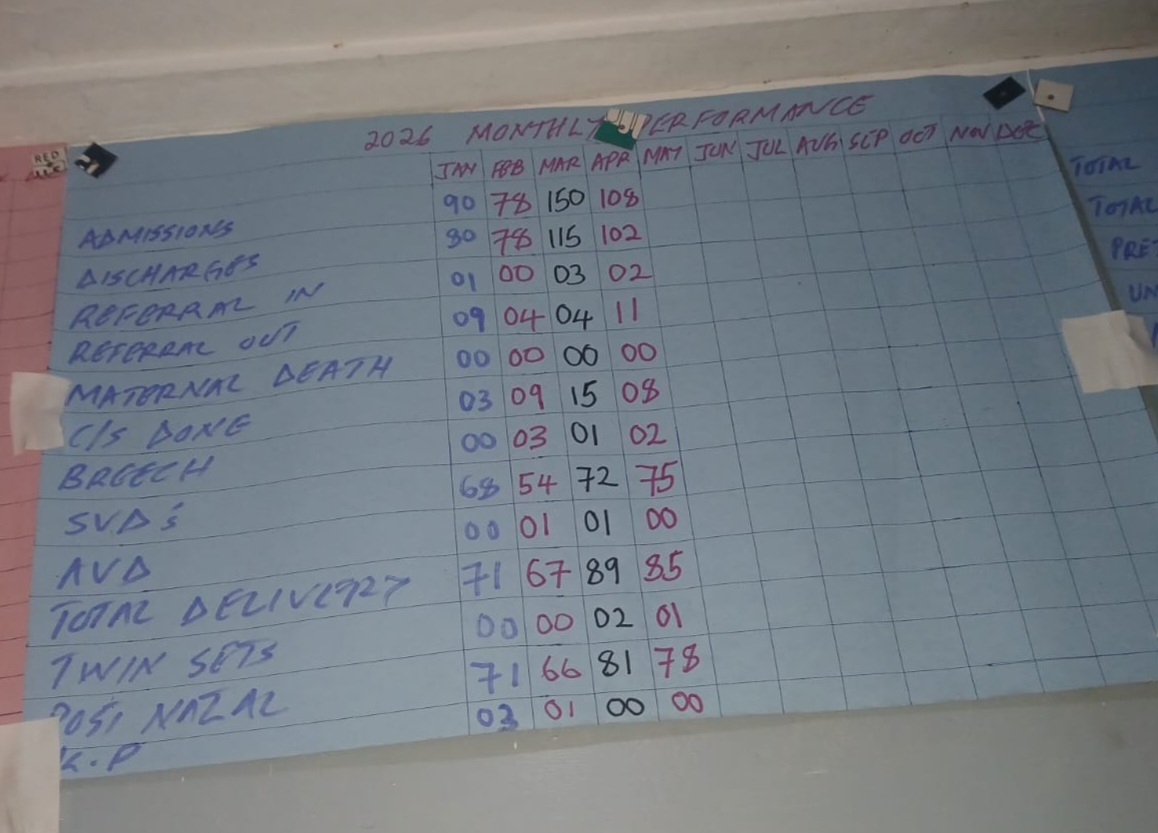
The evidence from Mt. Elgon is facility-level — not a published trial — and should be read as such. But it is consistent, and those reporting it are specific about what they are measuring. Gilbert Tugee, Reproductive Health Coordinator for Mt. Elgon Sub-County, is direct: “Since January this year, we have not had any maternal death, as compared to previous years. Even the number of PPH referrals out of Mt. Elgon has reduced.
Most cases are now handled at the facility and spoke level.” Kinjo tracks a parallel shift in neonatal outcomes. Since 2023, she has watched newborn deaths fall from roughly five per period to one or zero, attributed partly to Iron and Folic Acid Supplementation (IFAS) in antenatal care. “If this mama has taken IFAS antenatally, even if she loses blood during delivery, it cannot cause anaemia,” she says. “She arrives with a reserve.”
That preparation extends to anticipating high-risk mothers. “A mother with a history of PPH, we pick her early and monitor closely,” Kinjo says. “We equip the lab with blood, ready. We want everything available in case PPH follows.” This shift from reacting to anticipating is the model’s most meaningful change. Blood coordination runs through a WhatsApp network of facilities. When a blood type is needed, the lab manager posts to the group, and the nearest facility with stock responds.
“The ambulance goes, picks the blood, brings it here,” Musa explains. Informal by national standards but effective, because it was built around Mt. Elgon’s actual infrastructure, not the one someone imagined it had.
An honest account of Mt. Elgon’s model must reckon with its failures as carefully as its successes. The fractures are structural and almost certainly not unique to this sub-county. The most acute vulnerability is drug supply.
The sub-county depends on retrospective SHA reimbursements, Kenya’s universal health coverage scheme, but in the gap before payment arrives, basic supplies run short. “Your normal salines are over. You wait again for the reimbursement to buy other commodities,” Musa says. Kinjo adds: “Stock-outs are occasioned by the way funds flow, and it affects the whole system of stocking our drugs in the pharmacy.” At the patient level, the gap turns personal.
When stocks run dry, relatives pay out of pocket even for SHA-covered patients. “SHA caters for it, but at that moment, you need that drug at that moment,” Musa explains. Suzan lived this: a payment demanded while she bled. The model has not yet reached the financial exposure that precedes care. Staffing is the second fracture. The hospital currently handles up to 150 admissions, while the maternity ward holds only six beds. On the night Suzan delivered, two nurses managed an entire maternity ward.
“If three, four, five ladies are giving birth at the same time, you see there will be a lot of delay,” she says. “My cervix broke because of the delay in assistance during labour.” Transport is the third gap. A Memorandum of Understanding between the Ministry of Health and facility in-charges has created a dedicated ambulance fuel fund, and it has helped reduce delays. But fuel shortages still occur, and the roads between remote communities and their nearest spoke remain poor. Geography is the one problem no kit solves.
What Mt. Elgon has built is not a breakthrough technology. Oxytocin has been available for decades. The NASG is not new. A WhatsApp coordination group is, by any measure, a workaround. What is new is the architecture: the deliberate layering of stabilisation capacity across geography, so that a woman does not have to survive the entire referral journey in the same condition she began it.
Tugee is unambiguous about what other counties should take from Mt. Elgon’s experience — and about how straightforward the starting point is. “Invest more in MNH commodities and programmes. Budget for Uterine Balloon Tamponade, NASG, the uterotonics, so that once you have the case, you can handle it at the facility level. And have regular capacity building for healthcare workers. Not once. Regular refresher courses on management of emergencies such as PPH.” The model’s sustainability is an open question. When KMET’s support ends, whether the county government sustains the kits, CMEs, and coordination network will depend on commitments not yet made. Tugee is frank: “The county needs to allocate adequate funds towards health, and in particular MNH products, so that we cannot over-depend on partners.”
“I wish the leaders would add more workers at the public facility,” Suzan says. “When I gave birth, it was a night shift. The nurses working were only one person and an assistant nurse. My cervix broke because of the delay in assistance during labour. What I wish is to add more workers and also to improve their training.” She has named what the hub-and-spoke model was not designed to fix: the moment before the emergency begins.
The model catches the haemorrhage once it starts, stabilises it, and moves it through a prepared chain. But the cervical tear Suzan believes she could have been spared — caused by a labour without enough hands watching closely enough — belongs to a different intervention entirely. More nurses. Better trained. The distance between Kenya’s current 355 deaths per 100,000 and the SDG target of 70 is not closed by one model in one sub-county.
But Mt. Elgon clearly shows that the distance can be shortened systematically, measurably, on a public-facility budget when a chain of care is built around the geography women actually live in, not the geography health planners imagine. That is the lesson. And it begins with not making a woman pay before you stop her bleeding.