

|
Getting your Trinity Audio player ready...
|
By Shaban Makokha
Kakamega—As the sun dips behind the rolling hills of Matawa village in Mumias West, Kakamega County, Beatrice Otuma hoists a heavy sack of dry maize onto her head and begins her familiar trek. The mother of five has already spent her day tending crops, hauling water, preparing meals, and caring for her children. Yet, her work is far from finished.
Tonight’s supper hinges on one uncertain factor: whether the local posho mill is running.
Three kilometres away, the distant rumble of a diesel-powered grinder echoes through the village. If luck is on her side, the operator will have enough customers to justify firing up the fuel-hungry engine. If not, she will have to walk even farther, searching for a mill that is operational.
“My family cannot imagine a meal without ugali,” Beatrice says, her voice a mixture of resignation and resolve. “But sometimes I wait for hours before the machine starts. Other times, I walk several kilometers to find another mill that is working.”
For millions of Kenyan families, ugali is more than food; it is culture, comfort, and survival. But behind every steaming plate served at dinner lies a grueling story of long journeys, hidden health risks, and unrelenting labor—particularly for women.
Across rural Kenya, women bear the brunt of transforming harvested maize into flour. While diesel-powered mills have largely replaced the backbreaking hand-grinding methods of the past, they have introduced a new set of obstacles.
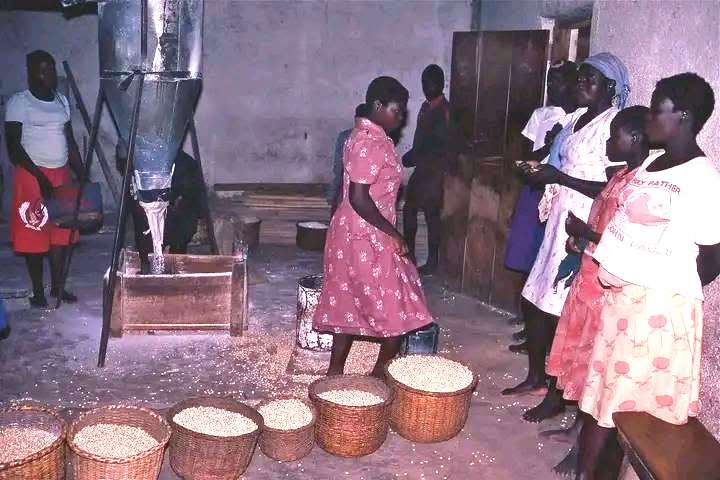
Many villages remain beyond the reach of reliable electricity, forcing residents to rely on diesel posho mills. These machines have become vital to rural food security, but their operation comes at a steep cost. Women often spend hours waiting in crowded queues, while volatile fuel prices drive up milling charges, straining already stretched household budgets. When global diesel prices spike, the ripple effects are felt immediately in villages where every shilling counts. Some women resort to bartering maize for milling services; others cut back on household essentials just to afford the grinding fee.
The burden, however, is not merely financial. At many mills, women and children are exposed to deafening noise, thick clouds of maize dust, and noxious diesel fumes.
Dr. Donald Musi of Yatta Clinics warns that the health implications can be severe. “Diesel engines release a toxic mixture of pollutants,” he explains. “These include microscopic soot particles that penetrate deep into the lungs and bloodstream, as well as gases that irritate the respiratory system and contribute to smog formation.”
The World Health Organization (WHO) and the International Agency for Research on Cancer classify diesel engine exhaust as a Group One carcinogen—a category reserved for substances with sufficient evidence of causing cancer in humans. Short-term exposure can trigger coughing, eye irritation, and asthma attacks, while long-term exposure is linked to chronic bronchitis, cardiovascular disease, and heightened risks of lung and bladder cancers.
For many rural families, however, diesel mills remain the only option. But that reality is slowly beginning to shift.
A new generation of solar-powered micro-mills is emerging across Kenya, offering cleaner, quieter, and more affordable alternatives for small-scale farmers. At the forefront of this transformation is Agsol Green Technology Solutions, a company developing portable solar-powered milling engines specifically designed for rural communities.
Speaking during the 2026 World Farmers’ Organization Summit in Nairobi, Agsol’s Grants and Impact Manager, Binagwaho Gakunja, said the innovation seeks to dismantle barriers that have long trapped women in expensive and hazardous food processing systems.
“The large diesel milling engines subject women to unnecessary suffering and deny them access to safe, clean flour,” he said. “Many households simply cannot afford the costs associated with diesel-powered milling.”
Powered by solar panels and battery energy storage systems, these compact mills operate without fuel, emit virtually no emissions, and generate minimal noise. Unlike conventional machines that require operators to gather a critical mass of customers before switching on costly engines, solar-powered units can be used immediately at the household level.
Capable of producing up to 50 kilograms of flour per hour, the portable mills can be mounted on tables, tripods, or other stable surfaces. Users simply pour grain into the hopper, switch on the machine, and collect fresh flour from the outlet chute. The system automatically shuts down when the grain runs out.
For farmers like Langat Kiptoo from Nandi County, the technology represents more than convenience. “The mill gives my family access to cleaner flour produced using renewable energy,” he says. “It is also an opportunity to earn income by offering milling services to neighbors and the wider community.”
For generations, rural women have shouldered the invisible burden of feeding their families. They have walked countless miles with heavy loads, waited endlessly at noisy diesel mills, and inhaled harmful fumes—all in pursuit of a simple meal.
As innovations like solar-powered milling gain momentum, the journey from farm to plate may finally become easier. For women like Beatrice, that means less time chasing flour and more time to invest in her family, her farm, and her future.
For the millions of Kenyan households where ugali remains the heartbeat of daily life, cleaner energy is not just transforming how grain is milled—it is transforming lives.