|
Getting your Trinity Audio player ready...
|
By Mercy Njoroge
Nairobi, Kenya: “I thought I was dying. I was shocked and worried that something was wrong with my body. Not knowing what to do, I stared blankly at the door in the small, smelly toilet. I thought it was abnormal. I was confused.”
Turi was in Class Eight when it happened. It was during break time when they felt an uneasiness that prompted them to run to the toilet. The discovery threw them into panic mode, leaving them disoriented. They remember scissor-gait-walking to the staffroom to seek help from the guidance and counselling teacher.
“When the teacher saw my posture, she knew what I was about to say, so she quickly picked a pad from her desk and sneaked it into my pocket before quickly whispering how I should secure it on my innerwear before going back to class,” says Turi.
Turi adds that they never shared with their teacher that they were intersex because of fear of stigmatization and possibly being expelled from school.
By afternoon, the discomfort was unbearable, and Turi sought permission to go home. Upon arrival, they opened up to their mother, who casually explained that menstruation was normal and promised to ensure Turi never missed her sanitary dignity kit.
“She never revisited the subject,” recalls Turi.
The months that followed were packed with panic and anxiety, and every cycle was punctuated with discomfort, risk of infections, and embarrassment due to the sanitary towels Turi used during their periods.
Experiencing the first menstrual period was definitely a defining moment for Turi, an intersex person – born with reproductive or sexual anatomy that doesn’t fit the typical binary definitions of male or female.
Turi was raised as a girl.
The 26-year-old now uses the pronouns they/them.
Not broken, don’t fix
Although menstruation is a natural biological process that marks an important stage in the reproductive health of girls and women, it is not exclusive to them; it is a shared reality for transgender men, non-binary individuals, and intersex persons.
According to the “Not Broken Do Not Fix” report by Jinsiangu and Amka Africa, intersex persons born with a functioning uterus, ovaries, and vaginas experience menstrual cycles. The research findings show that out of 100 intersex persons, 44 experience menstrual cycles. The research further states that out of the 44, 57% use pads, 9% use tampons, 9% use a piece of cloth, and 4% use cotton, tissues, or a menstrual cup, while 13% specified that they do not use pads or tampons.
In Kenya, there are 1,524 intersex persons as per the 2019 Kenya Population and Housing Census. According to the UN Office of Human Rights, 1.7 per cent of the world’s population is born with intersex characteristics.
Gloria Luhunga, an officer at the Kenya National Commission on Human Rights (KNCHR) who serves at the Intersex Persons Implementation Co-ordination Committee, says the recognition of intersex as a gender marker is no mean feat for the community in Kenya.
“In 2019, Kenya made global history by becoming the first country in the world to enumerate and count intersex persons as a distinct, standalone gender category during a national population census. This historic enumeration was the result of years of advocacy spearheaded by rights groups and the Kenya National Commission on Human Rights,” says Luhunga.
This milestone was a result of numerous efforts by the intersex persons in Kenya to get recognition, leading to landmark legal cases such as the 2013 “Baby ‘A'” court petition, which challenged the government to legally recognize intersex children, resulting in the amendment of the Births and Deaths Registration Act to include “Intersex” as a recognized sex marker on birth notifications.
As an intersex person, Luhunga shares his lived experience growing up. He says when he used to menstruate, he would seek permission from work because attaching a pad to a boxer proved impossible, and it affected his concentration at work.
“I feared losing my job because of constant absenteeism. This is a reality that faces many intersex persons who have to contend with the discomfort and sometimes embarrassment when they get soiled because they lack the right menstrual products for their anatomy. Many have been fired because no employer wants an employee who is perceived as unproductive,” says Luhunga.
This nightmare, Luhunga explains, started way back in high school, where he was taken to an all-girls school, presenting a myriad of challenges ranging from shame in freely enjoying his childhood, finding it difficult to share his experiences on body changes during puberty with the girls, and social interaction with fellow students.
“I was very good at sports, and every time I played football and scored for my team, the opponents would weave narratives about my gender. They would say that I am a boy disguising myself as a girl, and that is why I never missed whenever I aimed at the goal post,” says Luhunga.
He stopped playing football.
Stigma leads to discrimination and can sometimes stem from societal norms and beliefs. Many intersex persons live in isolation, and because of the fear of being accused of impersonation, their right to full enjoyment of life is highly compromised.
Luhunga says most specifically, there is little to no discourse around the sexual and reproductive health needs of intersex persons, adding that it is unfortunate that those who experience menstruation have been dehumanized by virtue of their biological makeup. For decades, many have been reduced to using unconventional items such as cotton wool during their menses because there are no products in the market that meet their needs.
It is this unconscious bias and discrimination against the intersex population by society that led the community to collectively put together ideas that led to the innovation of a product that addresses their needs and dignifies their identity.
Turning point
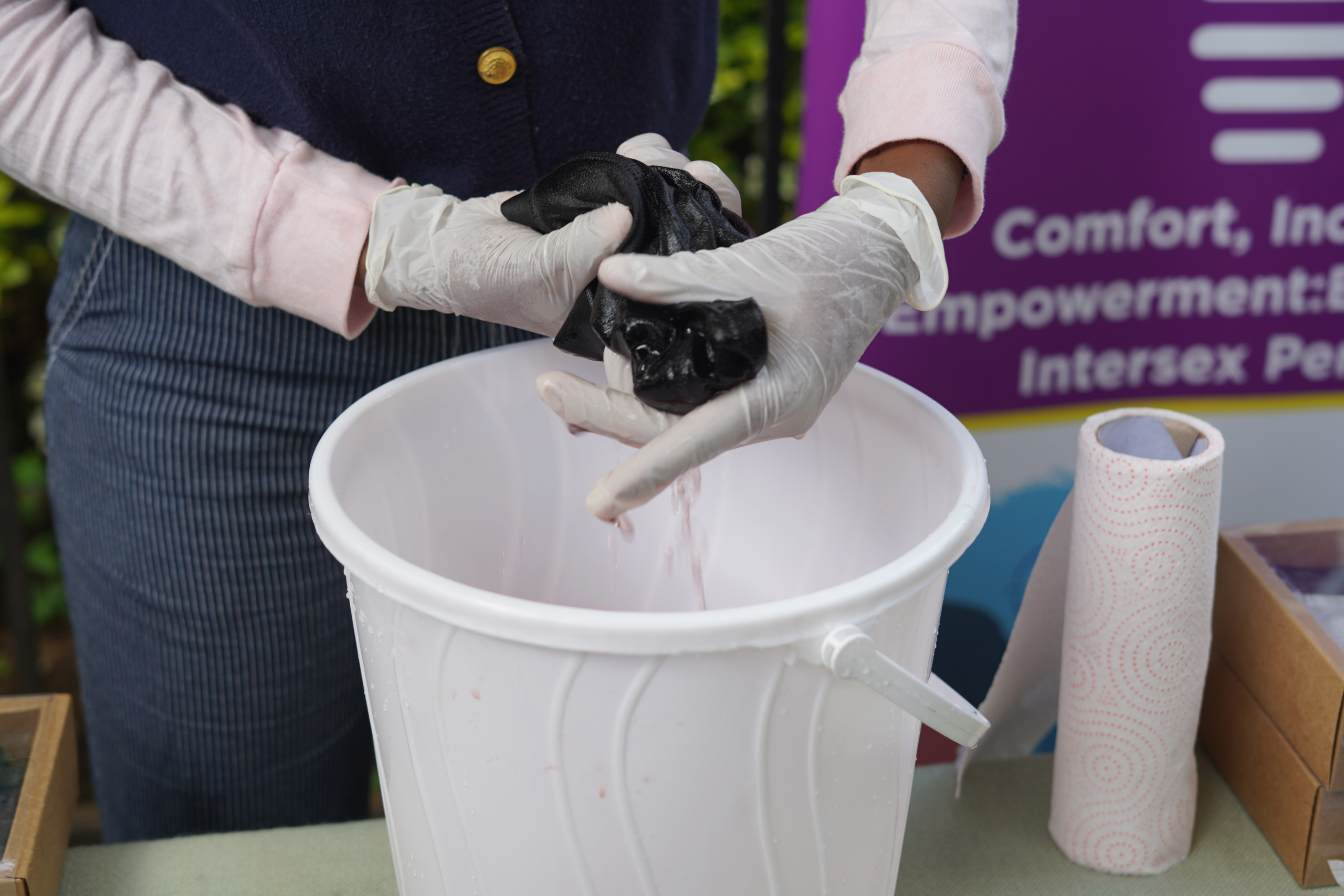
Through Jinsiangu – a rights-based community organization that advocates for the health, safety, and inclusion of intersex persons, transgender, and gender non-conforming individuals -InclusiFit, a menstrual boxer, was designed and officially launched two years ago.
“We started working on the menstrual boxer after intersex persons shared the challenges they face during menstruation. Therefore, in 2023/2024, the journey to designing a product that affirms the identity and dignity of intersex persons started,” says Frankie Kibagendi, Intersex Programs Director at Jinsiangu.
The product was locally designed with suggestions drawn from the intersex support groups, and a prototype was shared with a sample group that later provided feedback to improve it. The responses ranged from the fabric used, the layers of protection, the fitting design, and the comfort, leading to an improved and user-friendly product called InclusiFit.
Irene Nyambura, the Intersex Advocacy Officer at Jinsiangu, says the launch of the reusable product was the turning point in the lives of intersex persons who experience menstruation. This was demonstrated by the overwhelming acceptance of InclusiFit within the community, affirming the importance of community-led initiatives that seek to address shared challenges.
“InclusiFit is an intersex-led product created and designed by intersex persons in Kenya. We say it is ‘from intersex, for intersex, by intersex and therefore it affirms our collective existence, which sends a firm message to a society that has always viewed people from a binary lens,” explains Nyambura.
Historically, she says, menstrual hygiene products have been designed and marketed under the assumption that only women menstruate.
Explaining the practicability of the InclusiFit menstrual boxer, Nyambura says that, through extensive consultations and research, the product has been overwhelmingly received, and interestingly, she adds that it is worth noting that other non-gender-conforming individuals are also using the product.
“Pads and tampons are menstrual products that are generally affordable and easily accessible for intersex persons, but the downside is that they are not designed for their anatomy, and many encounter health-related issues such as rashes and infections. While carrying out a survey on their experiences using tampons and pads, many said the pads do not fit well,” emphasizes Nyambura, adding that the available products have failed to take into consideration the anatomy of intersex persons.
Mercyline Nyabuti, the Jinsiangu Sexual and Reproductive Health Rights (SRHR) Advocacy Officer, says, “InclusiFit is a pioneering, innovative product dedicated to advancing the rights of intersex persons by harnessing their menstrual hygiene, which represents a significant step towards ensuring the rights and dignity of intersex persons are protected. Although it was designed by the community locally, the materials are sourced from China, directly impacting the cost of the product.”
“One InclusiFit boxer costs upwards of KSh1,000, a cost that is prohibitive to the target population,” she adds.
Kibagendi attributes intersex recognition advocacy efforts to multi-stakeholder organizations such as the Judiciary, Parliament, the Intersex Persons Implementation Coordination Committee (IPICC), the Intersex Taskforce, the Kenya National Commission on Human Rights, and the private sector, with backing from the government.
“During the launch of InclusiFit in 2024, we received massive support from some allied legislators like Suba North MP Millie Odhiambo, who attended the event and has been supportive in pushing legislation that seeks to improve the lives of, among others, the intersex population. Millie is the sponsor of the Assisted Reproductive Technology Bill, which establishes Kenya’s first legal framework for fertility treatments like IVF and surrogacy, and this also seeks to address the reproductive health challenges some intersex persons encounter in their adult lives,” says Kibagendi, noting the vital support from other legislators such as nominated MP Gloria Orwoba.
Turi’s and Luhunga’s lived experiences reflect a wider and often overlooked consequence of menstruation, considering that intersex persons are caught in between in a society that is heavily gendered.
“The new product has restored my dignity and that of many other gender-non-conforming individuals,” affirms Turi.
On this Menstrual Hygiene Day, marked annually on May 28, Nyambura says that to achieve a period stigma-free world, efforts must be channeled towards deliberate efforts to include so as to break taboos and ensure that everyone manages their menstruation safely, regardless of their gender.
This year’s Menstrual Hygiene Day theme is “Together for a #PeriodFriendlyWorld.
Mercy Njoroge is a seasoned journalist who specialises in gender and human rights reporting.
mercymuthoni.wa.njoroge@gmail.com