|
Getting your Trinity Audio player ready...
|
By Lenah Bosibori
Kiambu, Kenya: The afternoon sun beats down on Kimunyu village in Ngenda Ward, Kiambu County, as we arrive at Dennis Muriithi’s homestead.
From the outside, the gated compound looks like any other home in the neighborhood. There is little to suggest that it is also home to a growing agricultural enterprise tackling one of Kenya’s biggest challenges: declining soil health.
Inside, sacks of black biochar are neatly arranged, ready to be sold to farmers. Made from what many would consider farm waste, including macadamia shells, avocado waste and rice husks, the biochar is at the centre of Muriithi’s effort to help farmers restore degraded soils.
“We focus on restoring degraded soils by turning recycled organic waste into biochar,” says Muriithi. “The biochar helps balance soil pH, improve aeration, and retain water and nutrients, creating healthier conditions for crops to grow.”
For Muriithi, however, the journey into agriculture started long before Pure Plant Organics. When he was a high school student, his agriculture teacher made a prediction that stayed with him. “The next generation of billionaires will be farmers.”
Years later, Muriithi, now an engineering graduate and the co-founder and CEO of Pure Plant Organics, is putting those words into practice. His business is turning agricultural waste into biochar, a charcoal-like soil amendment produced through pyrolysis, a process that heats organic material in an oxygen-limited environment.
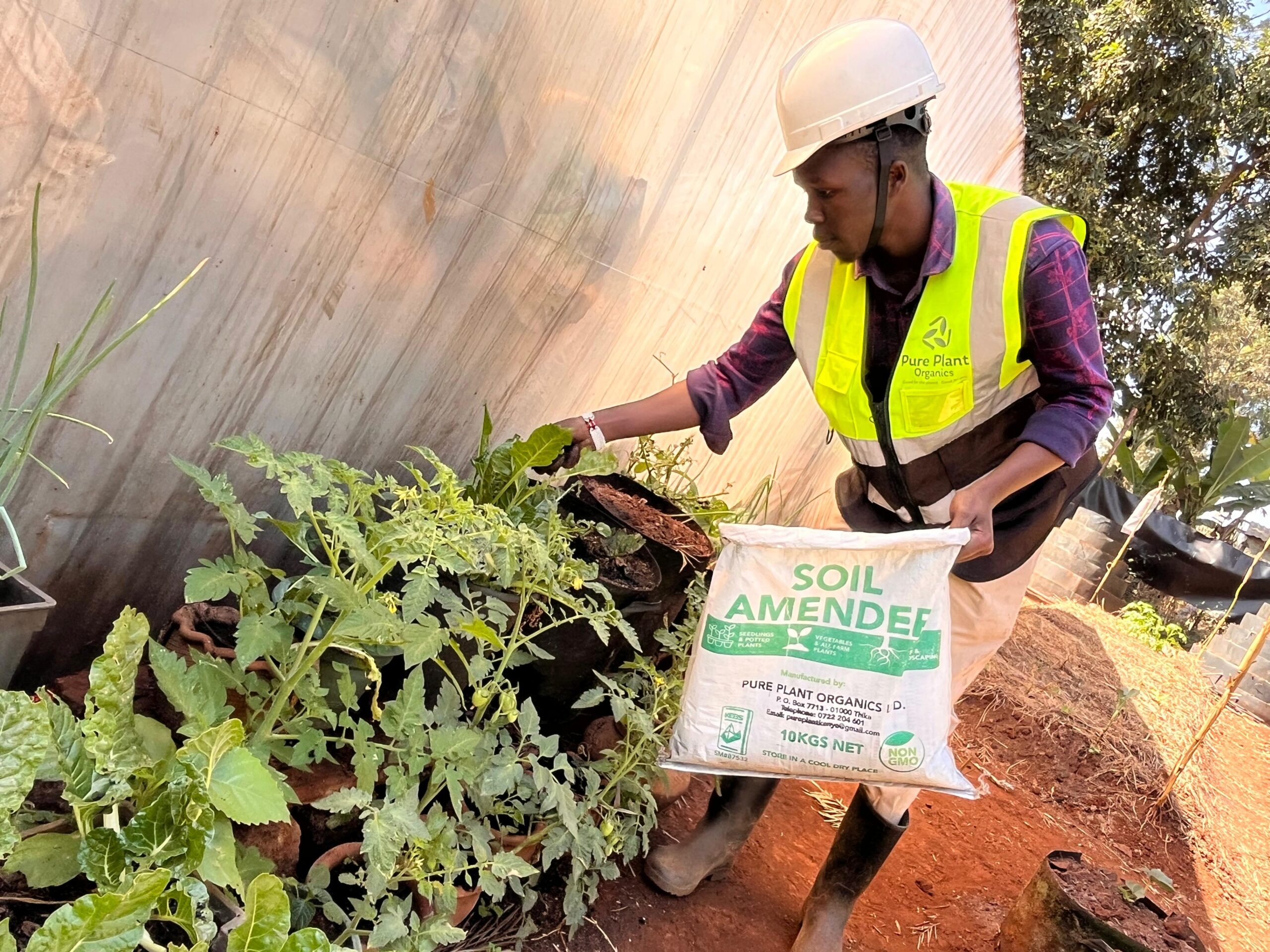
Muriithi gives farmers a better way to improve tired soils while turning waste that would otherwise be discarded into a useful agricultural product. He adds that one of the biggest challenges facing farmers is soil degradation.
“Our soils are degraded and no longer producing the way they used to,” he says. “Farmers face severe problems with soil acidity, poor aeration, and low water and nutrient retention. Pure Plant Organics uses biochar to address some of these challenges.”
According to Muriithi, the product helps balance soil pH, improve aeration, retain water and nutrients, while also adding stable carbon to the soil. The company works with farmers growing rice, avocado, horticultural crops and herbs, among others.
Muriithi says farmers working with the company have reported yield increases of between 30% and 60% after adopting the practices. “Farmers have been able to improve their yields, with a minimum increase of 30%,” he says. “We work with a diverse range of farmers, including rice, avocado, horticulture, and herb growers.”
Turning Waste into a Resource
At the heart of Pure Plant Organics is a simple idea: agricultural waste does not have to remain waste. The company collects organic material from rice millers, macadamia processors, avocado processors and farmers.
It also works with farmers growing export crops such as rosemary and thyme. When some of the produce fails to meet export market specifications, the company can collect the rejected produce and convert it into biochar and other soil improvement products.
The finished products can then return to farms. “We are creating a closed loop where we manage post-harvest losses for farmers,” Muriithi says. “Produce that would otherwise end up as waste becomes the exact input they need to restore their soil.”
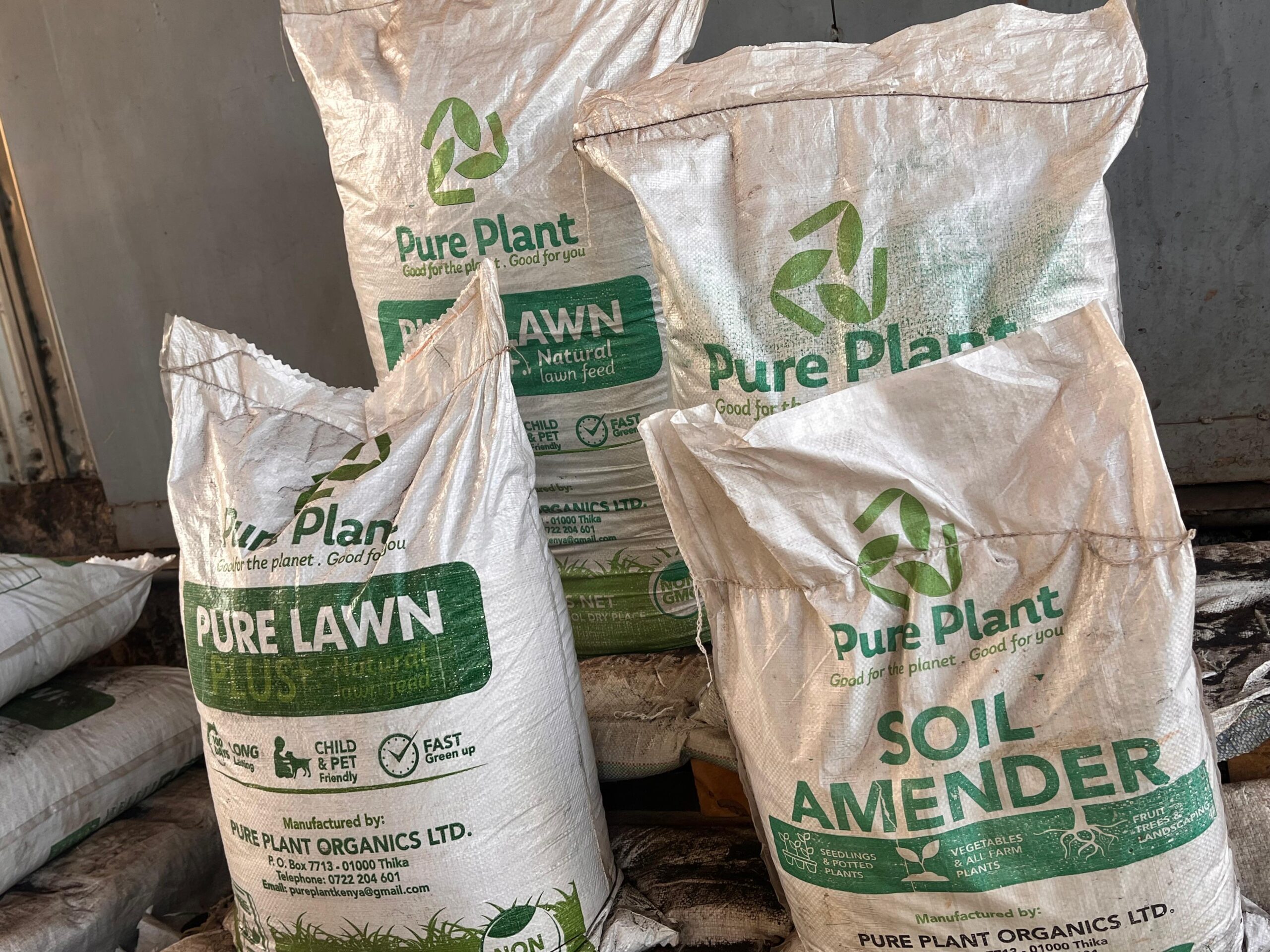
The company sells its products in different quantities. A 10-kilogram bag costs KSh 700, a 25-kilogram bag costs KSh 1,300, while a 50-kilogram bag goes for KSh 2,500.
The products are used by both small-scale and large-scale farmers.
Small-scale farmers often buy through groups, including women’s groups that receive training before purchasing the products. Larger farms can buy directly.
Rather than simply selling farmers an input, Muriithi says the company first encourages them to understand the condition of their soil.
The process begins with soil testing. “We always, encourage farmers to test their soil first so we understand its exact condition,” he says. The results help the team advise farmers on how much biochar to apply and how frequently it should be used, depending on the condition of the soil.
Muriithi says continued use of organic inputs can gradually improve soil health and reduce farmers’ dependence on conventional fertilizers. For the company, the transition to organic farming is not something that happens overnight.
Farmers are trained and encouraged to gradually change their practices as they learn more about the importance of soil health.
From One Production Turn to More Than 10
The idea behind Pure Plant Organics emerged from Muriithi’s experience providing agricultural extension services and helping farmers set up farms.
He and his co-founder began working together as freelance extension service providers. As they interacted with farmers, they repeatedly encountered problems linked to poor soil health.
His co-founder, who had a background in soil testing and analysis, helped the team focus on soil health as an area that needed a solution. Their research eventually led them to biochar.
Financial Challenges
But turning the idea into a business was not easy. Financing was one of the biggest challenges because producing biochar requires processing equipment and significant capital.
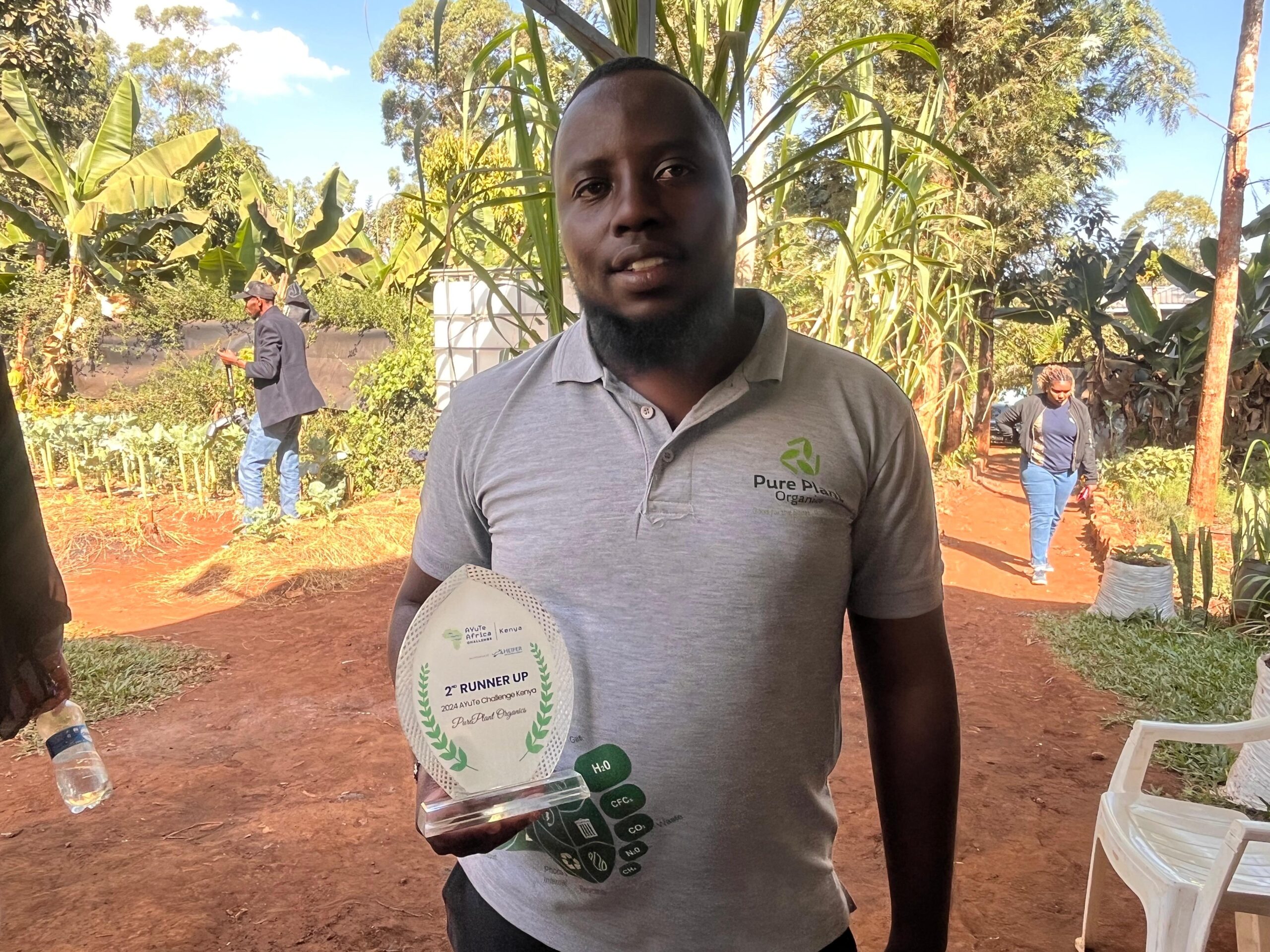
Support from the Agriculture, Youth and Technology (AYuTe Africa Challenge), an initiative of Heifer International that supports youth-led agritech businesses across Africa, became a major turning point for Pure Plant Organics.
The funding helped the company improve its production capacity, acquire essential equipment, and reach more farmers. It also provided systems to strengthen the business, as well as a dryer and crusher.
“Before the support, the company could manage only one production turn a day,” says Muriithi. Today, it can manage 10 turns a day or more.” The increased capacity has allowed the company to reach more farmers, expand production, and create employment.
The company has so far reached more than 3,000 farmers and created employment for 15 young people now involved in waste aggregation, processing and other activities
Pure Plant Organics is entirely youth-led, with its directors and employees drawn from young people. “Our business is about more than selling biochar; I see soil restoration as part of a wider effort to strengthen food security and make agriculture more sustainable,” he adds.
He believes farmers are increasingly recognizing that the health of their farms begins with the health of their soil. “The future is organic,” he says, adding that farmers need to invest more in rebuilding their soils.
“No matter how small, start. Be confident in what you are doing. And this might lead to something big in the future,” he reiterates. “Let us promote agriculture, invest in our soils. And by investing in our soils, we are investing in our future.”