
|
Getting your Trinity Audio player ready...
|
By Victoria Musimbi
Nairobi, Kenya: Running a small business offers a crucial source of income for many young women in low-income communities. However, their growth is often constrained by a lack of access to markets, information, and digital resources.
In Mathare, Jane Kanyiva is actively addressing this challenge by uplifting local young mothers and introducing innovative approaches to enhance their economic stability.
She established the Young Her Initiative, a community-based group dedicated to uniting and empowering teen mothers. Today, the initiative supports 25 young women through a holistic approach that fosters their financial, social, and spiritual growth.
Her commitment to supporting young mothers is rooted in her own experience. Having become a mother as a teenager, Kanyiva experienced discrimination, stigma and a lack of information and support.
“I don’t want any other woman to experience what I experienced,” Kanyiva says.

Through the initiative, the teen mothers participate in table banking, allowing them to save together and access small loans to start or expand their businesses. Some use the loans to buy products such as tomatoes and onions from markets, which they then sell to support themselves and their children.
Alongside her community work, Kanyiva is also a businesswoman who has run a second-hand ladies’ clothing business for the past eight years.
“The journey has not been smooth, but every day I wake up and push myself and trust in God that things will be okay,” she says.
Now, digital skills are giving Kanyiva another way to strengthen her business and help other women in her community do the same. Through KICTANet’s EmpowerHer programme, she has learned how smartphones and digital platforms can be used to market products, reach customers and manage business finances.
Turning Digital Skills into Business Opportunities
Kanyiva has learned to use WhatsApp Business to create catalogues with photographs, descriptions and prices of her products. She can also use Facebook Marketplace to reach potential customers, while TikTok allows her to showcase products through live sessions and interact with potential buyers.
The training also introduced her to Pochi la Biashara, which allows business owners to receive payments separately from their personal mobile money accounts.
“KICTANet has made everything very simple. They have simplified every topic that we are talking about,” she says.
Kanyiva’s experience is part of the CARE-funded EmpowerHer programme, which KICTANet is implementing to equip women in Nairobi, Tana River and Nyandarua counties with digital skills and confidence to use technology for economic empowerment.

The programme aims to reach 15,000 women while creating supportive community environments for technology use.
Taking Digital Knowledge Back to Her Community
For Kanyiva, the greatest value of the training goes beyond her own business. Participants are expected to share what they have learned with other women in their communities.
She is expected to mobilise and train at least 50 women, but hopes to reach many more.
“I was telling myself from the first day that I may want to mobilise more than 50, maybe 150 or 200,” she says.
Her plan is to begin with the young mothers in Young Her Initiative, equipping them with digital skills to market their businesses, reach customers and increase their income.
She believes the knowledge can spread further if the women she trains share it with others.
“If I mobilise 100 women, I believe those 100 women will train another 100 women,” she says.
Kanyiva hopes to see women in Mathare who run small businesses use social media and other digital platforms to market their goods, reach more customers and grow their income.
“I can’t wait to see women in Mathare using the digital tools we have learned about to showcase and market their businesses,” she says.
She believes the training comes at an important time as the world embraces digital technology.
“Everything is going digital because that is the way the world is moving, and it is a good thing. We should all embrace it and empower ourselves as women and as a community,” she says.
Expanding Business Opportunities Beyond Physical Spaces
Jane Gachure, Director of Gender and Inclusivity at Nairobi City County, said the training was aimed at equipping women with digital skills to support entrepreneurship.
Gachure said participants were trained as Trainers of Trainers (ToTs), who would share the knowledge with other women in their communities.
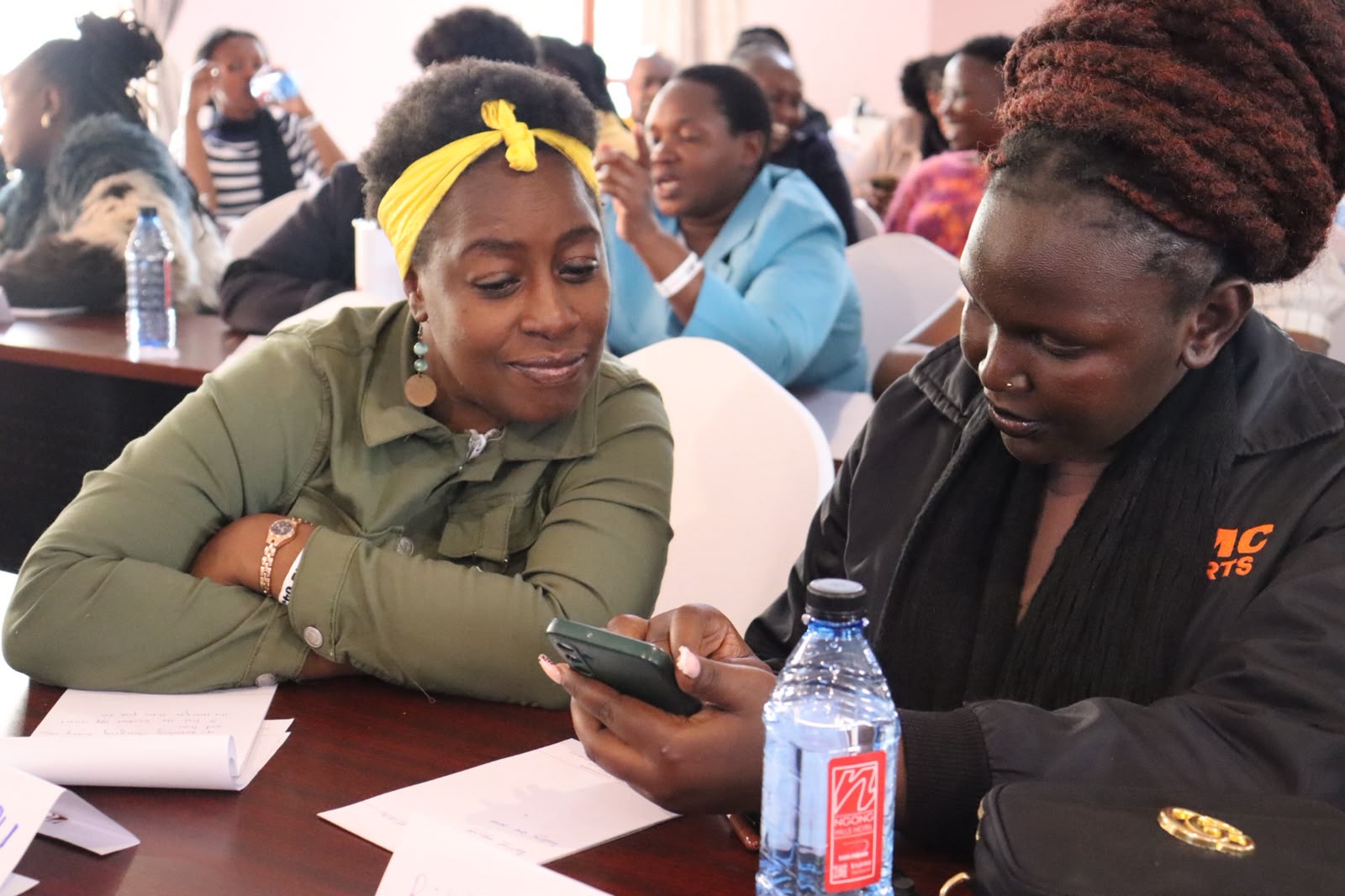
She said the programme aligns with the county government’s mandate to support vulnerable groups, including women, persons with disabilities and young people.
“Our Governor’s manifesto talks about supporting vulnerable groups. This is why we emphasise inclusivity. We do not want to leave anyone behind when it comes to development or the county’s programmes,” she said.
Gachure noted that many women operate informal businesses but struggle to access physical business spaces because of high rental costs.
“Physical spaces are not always enough, and some women, particularly those who are vulnerable, cannot afford to rent business premises. It would therefore be good to expand their spaces digitally so that they can use their smartphones to sell their goods and reach customers,” she said.
Building Businesses While Staying Safe Online
Dr. Grace Githaiga, CEO of KICTANet, said the training was informed by the growing number of women engaged in small businesses who are yet to fully utilise technology to expand their enterprises. As a multi-stakeholder think tank, the organisation works on ICT policy and regulation through research, policy advocacy, capacity building and stakeholder engagement.
“Many women are doing small businesses, but they are not growing, and they are also not utilising technology in ways that can enhance their businesses,” she said.
The training covers digital and financial skills, including mobile-money services, savings, loans, financial management and separating business capital from personal income.
Githaiga said business earnings are often redirected to household needs such as school fees, medical expenses and contributions to savings groups, leaving some entrepreneurs without enough capital to restock or expand.
The programme therefore encourages women to track their capital, income and expenditure and make informed decisions about profits.
Githaiga said the programme also addresses digital safety, including cyberbullying and online abuse. Participants are introduced to cyber hygiene, such as using strong passwords, changing them regularly and exercising caution online.
“Even freedom on the internet has limitations. The same things you can’t do offline, you should not do them online,” she said.
She urged participants to use digital platforms responsibly and respect other people’s rights online.
“Most important is just to be a good human being,” she said.
The programme will continue beyond the initial training, with KICTANet monitoring participants’ progress and providing support as they apply and share the skills within their communities.