

|
Getting your Trinity Audio player ready...
|
By Omboki Monayo
Nairobi– Diabetes is emerging as a significant public-health challenge in Kenya, affecting hundreds of thousands of people and putting growing pressure on the healthcare system. Beyond blood sugar control, the condition raises concerns about heart health, nutrition, reproductive health, dementia, and patients’ overall quality of life.
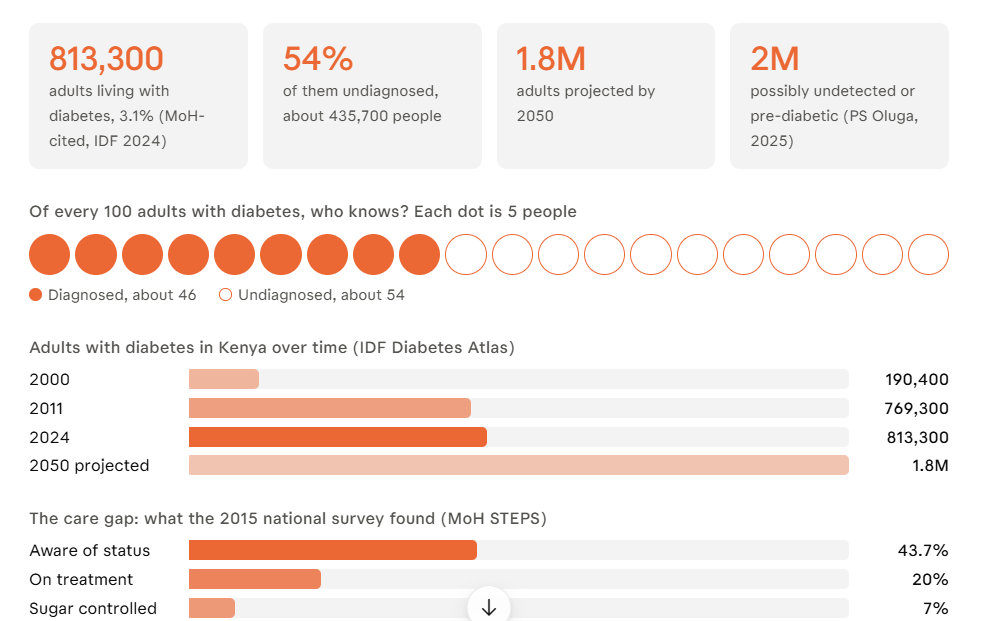
According to the International Diabetes Federation (IDF) Diabetes Atlas, 11th Edition (2025), about 813,300 Kenyan adults aged 20–79 are living with diabetes, a prevalence of 3.1 per cent. An estimated 440,000 adults may not know they have the condition, which underscores the need for more screening and early diagnosis.
The risk rises with age and other metabolic factors. The condition takes several forms, including Type 1, Type 2, and gestational diabetes. The 2025 Type 1 Diabetes Index estimates that 22,063 people of all ages in Kenya live with Type 1 diabetes, while Type 2 accounts for the majority of cases.
For Dr Prisca Mungla, a consultant physician, diabetes specialist and endocrinologist, addressing this burden takes more than prescriptions. Patients need personalised treatment, practical lifestyle advice and consistent physician follow-up.
“Diabetes management is not just about prescribing medication. We need to understand the patient, their lifestyle, their preferences and the challenges they face,” she says.
Dr Mungla was speaking at a World Diabetes Day Symposium Series webinar organised by Kenyatta National Hospital and the University of Nairobi.
Exercise: Building Strength and Preventing Complications
Dr Mungla advocates starting physical activity early. Exercise, she says, is essential for maintaining muscle strength, improving cardiovascular health and supporting blood sugar control.
“Start exercising early to build muscle strength. We should not wait until people are older or begin experiencing complications before encouraging them to exercise.”
She particularly encourages older people to take up resistance training, even through simple seated exercises.
“Encourage the elderly to do weight-training exercises. They can even do some while sitting. The important thing is to keep their muscles active and maintain their strength.”
Strength matters because falls can cause serious injuries, and these are more likely when low blood sugar (hypoglycaemia) brings on dizziness and confusion.
Dr Mungla recommends 30–45 minutes of physical activity five days a week, combining aerobic exercise such as walking or swimming with strength training.
“Even if you can only manage 10–15 minutes of exercise regularly, it is still a win. The more consistently you exercise, the better the benefits.”

Patients taking medication that can lower blood sugar should monitor their glucose levels and carry a suitable snack when exercising.
While medication is central to diabetes management, Dr Mungla cautions against giving everyone the same treatment.
“Some patients are already struggling with their weight, so we need to be careful about prescribing medication that could cause further weight loss. Where appropriate, we should consider weight-neutral medicines.”
She also urges healthcare professionals to take patients’ complaints about side effects seriously.
“If patients say they are experiencing side effects, please believe them. We have a whole array of medicines. If one medication is not working for a patient, we should consider changing it until we find one they can tolerate.”
Metformin, commonly prescribed for Type 2 diabetes, can cause nausea, vomiting and other gastrointestinal problems.
“I prefer starting with 500mg and increasing the dose gradually, depending on how the patient responds,” she explains. Taking metformin with meals, or using an extended-release formulation, may also improve tolerability for some patients, she adds.
Ozempic: Understanding the Growing Interest
Ozempic’s popularity has drawn interest from people seeking weight loss, including those without diabetes. Dr Mungla says treatment must be guided by the patient’s diagnosis, clinical markers and individual needs.
“Diabetes is not one condition. We have Type 1, Type 2 and gestational diabetes, among other forms. We classify and manage these conditions based on the patient’s clinical presentation and relevant markers.”
Ozempic contains semaglutide, a GLP-1 receptor agonist that helps regulate blood sugar and appetite. Oral semaglutide is sold as Rybelsus, and the wider treatment family includes dual GIP/GLP-1 receptor agonists. The injectable is taken once a week, while the oral form has specific daily administration requirements. Both can cause gastrointestinal side effects.
“Some patients are comfortable with injections, while others prefer tablets. We need to talk to patients about what they prefer rather than forcing treatment options down their throats,” she says.
“Treatment decisions should consider safety, affordability, clinical suitability and patient preference,” she adds. Semaglutide may also be prescribed for weight management in eligible people without diabetes, using an approved formulation under medical supervision.
Food and Alcohol: Making Realistic Lifestyle Choices
Food and alcohol can be difficult subjects for people with diabetes, especially with more social gatherings expected during the festive season. Dr Mungla believes patients need practical advice, not blanket bans.
“Alcohol is one of the interesting conversations we have with patients. We need to understand their circumstances, how well controlled their diabetes is and whether they are taking medication that could cause hypoglycaemia.”
She cautions against binge drinking and says the subject needs careful handling, particularly for patients whose blood sugar is poorly controlled. For patients who struggle with alcohol use, her advice is firm: “In such a case, I will recommend cutting it out completely.”
Beer contains carbohydrates from malted grains, and cocktails often contain added sugar. Alcohol can also cause delayed hypoglycaemia, particularly in people taking insulin or certain other diabetes medications.
On fruit, she urges moderation rather than elimination.
“Most of the fruits available here are the tropical variety and naturally quite sweet. But does that mean we should tell patients not to eat fruit? No. We need to be practical and consider what is available, what is affordable, and what the patient can manage.”
She recommends controlling portions and eating one fruit at a time rather than large servings of mixed fruit salad. Thorn melon, strawberries, and blueberries are options where accessible.
Diabetes care also means protecting the brain and the cardiovascular system. People with diabetes face a higher risk of cardiovascular complications, including stroke, which can contribute to cognitive impairment.
“People living with diabetes can have an increased risk of cardiovascular complications. These vascular problems can also affect the brain. Small strokes, for instance, can contribute to cognitive impairment,” Dr Mungla explains.
She is particularly concerned about dementia care in Kenya, where families often carry the burden of round-the-clock caregiving. As the condition progresses, patients become increasingly dependent on others for everyday activities, placing heavy emotional and physical demands on caregivers.
“In our African culture, when you take an elderly person to a retirement home or specialised care facility, people may assume that you have abandoned them. But that is not necessarily the case.
“Sometimes these patients need specialised care that the family may not be able to provide at home. Taking them somewhere they can receive proper attention should not be interpreted as abandoning them.”
She believes Kenya needs greater awareness, stronger dementia services and better support for families and caregivers.
Pregnancy and Diabetes: The Importance of Specialist Care
Dr Mungla also stresses careful management for women planning pregnancy, particularly those with pre-existing diabetes or a history of gestational diabetes.
“Gestational diabetes is something we should not ignore after delivery. A woman who develops diabetes during pregnancy has an increased risk of developing Type 2 diabetes later in life.”
Children exposed to gestational diabetes in the womb may also face higher metabolic risks later, so follow-up matters for both mother and child.
For women with pre-existing diabetes who are considering pregnancy or in-vitro fertilisation (IVF), she recommends thorough preparation, including assessment of blood sugar, insulin requirements, blood pressure and cholesterol.
“We need to review the medication she is taking and make sure everything is appropriate before she conceives.”
The HbA1c test, which measures average blood sugar over the previous three months, is especially important for IVF, because poorly controlled glucose can reduce egg quality and embryo implantation and raise the risk of miscarriage.
“Where safely achievable, an HbA1c below 6.5 per cent is a common preconception target for fertility specialists. This will provide the best chance of a successful cycle and healthy pregnancy,” she says. “Appropriate folic acid supplementation and medication reviews are also essential.”
IVF can add hormonal changes that complicate glucose management, which makes coordinated specialist care vital.
“We need teamwork. The gynaecologist, endocrinologist and nutritionist must work together to monitor the patient and follow her throughout the process.”
Continuous glucose monitoring and insulin pumps may also help eligible patients where available and affordable.
Ultimately, Dr Mungla believes successful diabetes management must be built around the individual, not the disease alone.
“Diabetes management is not simply about telling people what they cannot eat or giving them medication. We need to understand their lives and help them make choices they can sustain.”
For Kenya, that means better access to screening, affordable treatment, nutritional guidance and specialised care, along with tackling the cultural barriers around chronic illness.
“A patient who cannot afford imported fruits needs realistic dietary advice. An elderly person who struggles to walk needs an exercise programme suited to their abilities. Someone experiencing medication side effects needs a doctor who listens,” says the physician.
Families caring for relatives with dementia, she adds, need support rather than judgement when they seek professional help. “This is because the process can often be physically and emotionally draining,” she says.