|
Getting your Trinity Audio player ready...
|
By Roseleen Nzioka
Nairobi, Kenya: The World Bank has sent a strong anti-graft message to the government of Kenya, saying that deep-seated governance issues and corruption continue to act as severe anchors against its long-term economic potential.
According to the 34th Kenya Economic Update released by the World Bank Group on November 4, 2026, in Nairobi, the country’s real Gross Domestic Product (GDP) accelerated to 5.2% year-on-year in the first half of 2026. However, the international financial institution expects this growth to moderate to 4.6% for the full year, matching the exact pace recorded in 2025.
While the report acknowledges robust macroeconomic stability—underpinned by cooling inflation, strong foreign exchange buffers, and recovering private sector credit—it delivers a stark warning: Kenya cannot rely on resilience alone to create the millions of high-quality jobs its young population desperately demands.
“Kenya’s resilience gives it a strong foundation, but resilience alone will not deliver the growth and jobs Kenyans need. Better governance is an economic imperative. Improving governance can support fiscal sustainability, attract investment and enable faster growth and more and better jobs”, said Qimiao Fan, World Bank Division Director for Kenya, Rwanda, Somalia and Uganda.
Under the special theme Governance, Growth and Jobs, the World Bank report notes that structural changes and aggressive anti-graft overhauls could unlock a massive 20% increase in total economic output by 2035, fundamentally transforming the national employment landscape.
The Report says that corruption and collusion within public finance management cost Kenya an estimated 2% of its GDP every single year. This leakage directly widens annual deficits and drives the state into an aggressive cycle of expensive borrowing.
As of August 2026, Kenya’s public debt hovered at 72.3% of GDP. Alarmingly, interest payments alone now swallow up approximately one-third of all government revenues, severely starving essential public services, health systems, and infrastructure development of vital funding.
“Governance challenges are increasingly limiting Kenya’s prospects for shared growth, with corruption as the key binding constraint,” the World Bank noted, urging the state to implement absolute transparency in public procurement and beneficial ownership reporting.
This sentiment was shared at the event by the Executive Director of Transparency International, Ms. Sheila Masinde, who said the Conflict of Interest Act, 2025, must be prioritized by the Ethics and Anti-Corruption Commission as per Section 5 of the Act, and supported by all arms of government.
Ms. Masinde said EACC must act decisively and proactively and respond to persistent public allegations of bribery, impropriety, and gross misconduct by duty bearers to safeguard the sovereign interests and resources of the Kenyan people. Otherwise, recommendations by the World Bank and other entities risk remaining mere rhetoric rather than genuine accountability.
Ms. Masinde said that the full implementation and public accessibility of the Beneficial Ownership Register, as required under the Companies Act, Beneficial Ownership Information (BOI) amendment regulations, 2022, and the Companies (Beneficial Ownership Information) Regulations, 2020, is essential for detecting hidden interests by public officials in companies receiving state contracts.
The World Bank report noted that governance failures are actively hurting local businesses and suppressing wages. The report reveals that 39% of Kenyan firms identify corruption as a major hurdle to basic operations. Medium-sized enterprises—the key drivers for formal job creation—are hit hardest, with 48% stating they are routinely forced to give gifts or bribes to “get things done”.
Furthermore, non-transparent contracts, heavy-handed bureaucratic regulations, and deep integrity gaps in land administration have dramatically driven up the operational costs of baseline utilities like electricity and logistics.
For ordinary citizens, the reality is equally challenging. While overall employment expanded by 4%, a staggering 83.8% of all Kenyan jobs remain rooted in the informal economy, defined by low productivity and poor pay. The World Bank highlights that informal workers face constant threats of arbitrary inspections, harassment, and bribe demands from municipal officials and local police, directly depressing household incomes.
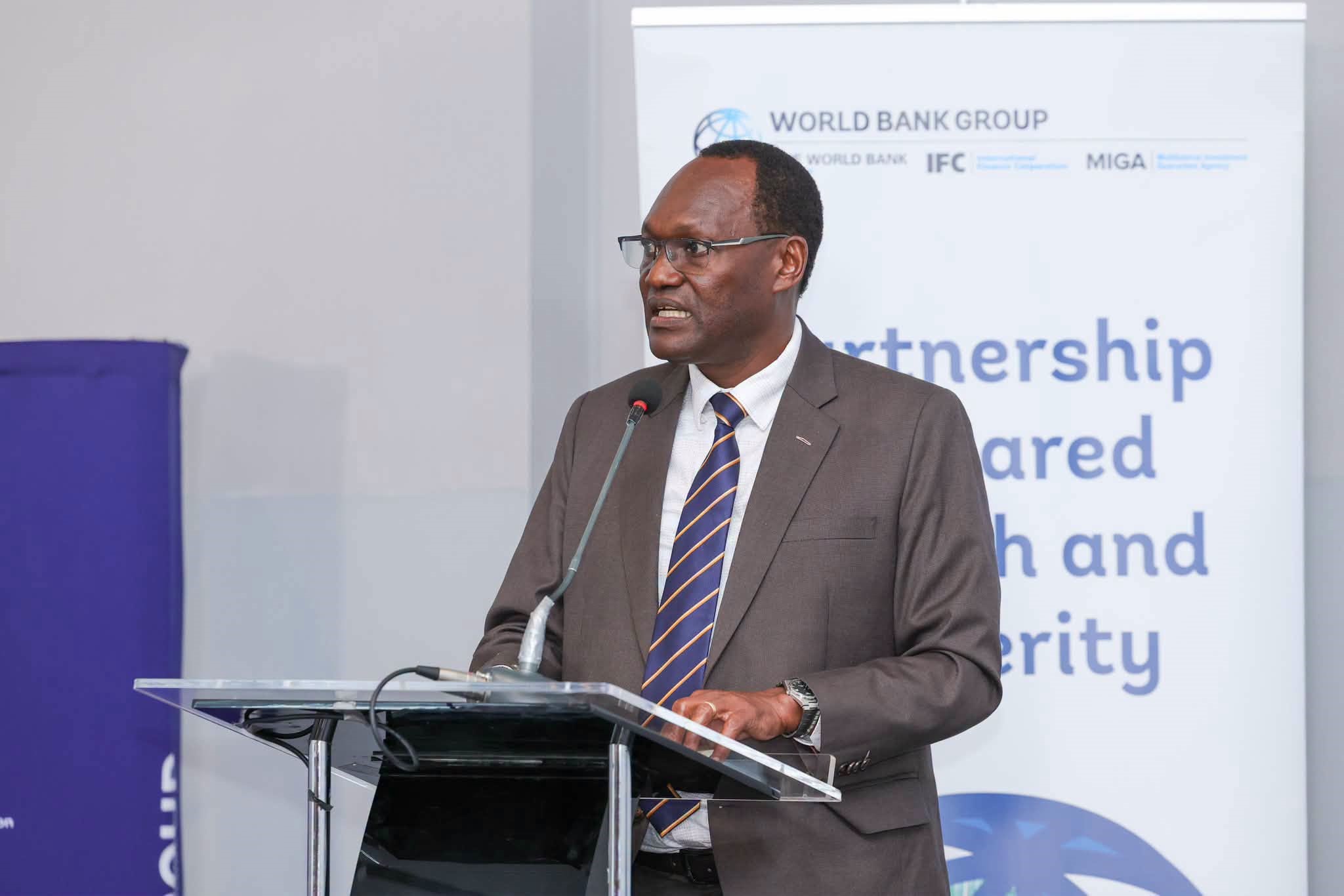
Responding to the findings at the Nairobi launch event, National Treasury Principal Secretary Dr. Chris Kiptoo defended the state’s efforts, noting that the government is actively implementing digitalization in procurement and establishing predictable contractor payment timelines. “Good governance is not separate from our development agenda it is the foundation,” Dr. Kiptoo stated
On a positive note, the report says that Kenya’s economy has demonstrated strong short-term resilience and acknowledges robust macroeconomic stability—underpinned by cooling inflation, strong foreign exchange buffers, and recovering private sector credit.
The stronger-than-expected economic activity in the first six months of 2026 was largely driven by a resurgence in the industrial and services sectors. Industrial growth accelerated to 4.9%, pushed forward by a massive 6.3% leap in construction alongside steady manufacturing gains.
Simultaneously, the services sector maintained a robust 5.2% expansion, propelled by tourism-related hospitality, formal education, and financial innovations. Accommodation and food service activities alone grew by an impressive 11.1%.
Investor sentiment has also actively bounced back. Foreign Direct Investment (FDI) inflows surged by 170.5% to reach a record $2.74 billion in the 12 months leading up to September 2026. This influx of capital has left the country with solid external defenses, including $14.7 billion in foreign exchange reserves, equivalent to roughly 5.9 months of import cover.
However, this bright picture is contrasted by a distinct slowdown in agriculture, the historical backbone of the Kenyan economy. Dampened by weather anomalies, including the early cessation of crucial long rains, agricultural expansion softened to 3.5%.
Because a majority of ordinary citizens remain dependent on farming, this agricultural drag has slowed down the rate of poverty reduction nationwide, leaving 43% of the population living below the $3.00-a-day threshold.