|
Getting your Trinity Audio player ready...
|
By Melisa Mong’ina
Nairobi, Kenya: When 23-year-old Lucky Kitonyi joined the African Girls Can Code Initiative (AGCCI) in 2025, she was interested in technology but unsure about which path to pursue. She had explored cybersecurity, data analytics, blockchain and artificial intelligence (AI), but had not settled on a career.
During the two-week boot camp, Kitonyi learnt digital and AI-related skills, including coding, machine learning and prompt engineering. She chose AI as her preferred path.
“When I completed the boot camp, I told myself that even though I was not an expert, I would start applying for tech-related job opportunities,” she narrates.
After the programme, Kitonyi co-founded Smart Education with her sister, to teach digital literacy to children from underserved communities. She was also hired by AI Mashinani as an AI app developer and community engagement associate.
Among the apps she has worked on are Mwalimu Na Shule Connect, which helps private schools connect with teachers, and AI Business Compass, which supports small businesses in creating profiles and marketing materials. Kitonyi has also taught AI technology at two polytechnics.
Programmes like AGCCI, a joint initiative of UN Women, the African Union Commission and the International Telecommunication Union (ITU), supported by Siemens AG and GIZ, aim to equip girls with digital skills, including coding and AI, while building their confidence and preparing them for opportunities in the digital economy.
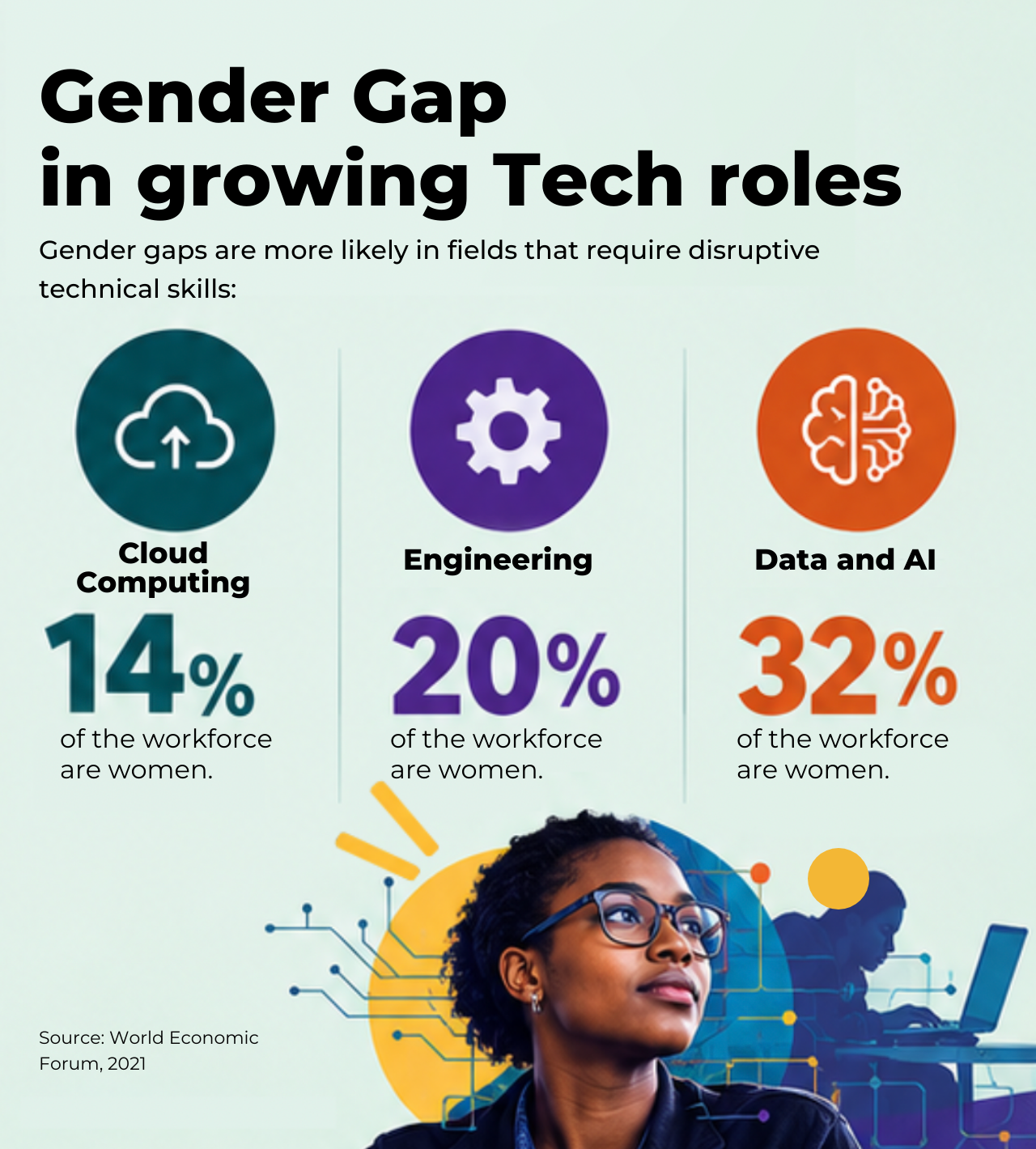
Despite this, women remain underrepresented in technology. A 2021 report by the World Economic Forum showed that women accounted for 32% of the global workforce in data and AI.
In Africa, women occupy fewer than 30% of ICT roles, according to UN Women.
In Kenya, a 2024 report by Genesis Analytics showed that data science and analytics was the fourth largest employment category in the ICT sector, with men accounting for 75% of workers in the field, compared with 25% of women. This reflects the gender imbalance in the wider industry.
 While there are programmes to equip young women with the skills needed to pursue careers in technology, not every participant moves into paid work easily.
Sandra Mukami has struggled to secure an opportunity after attending the AGCCI boot camp.
Mukami initially planned to pursue hospitality after high school, but a former teacher who had noticed her interest in computer classes encouraged her to apply for AGCCI.
She was 18 when she joined the programme. At the time, she says, coding was still widely seen as a male-dominated field, with the belief that one had to be very good in mathematics to succeed.
After the boot camp, she continued receiving support through mentorship circles and the SieMent EmpowerHer Mentorship Programme.
“It provided basic job-readiness skills, such as writing your own CV, as well as scholarships for cybersecurity courses.”
However, she says, some companies ask for two to three years of experience even for entry-level roles, while internships may be unpaid or also require previous experience.
“You spend months learning a skill, then you apply for 50 jobs and get no reply because you don’t have ‘proven experience.’ You start to doubt if the skill is even worth it,” she says.
“You can’t afford to take unpaid internships that would make you stand out, because you need income first,” she adds.
Dr. Grace Githaiga, CEO of KICTANet, an ICT think tank, explains that AI could make it harder for young people to secure their first technology jobs by automating some of the basic tasks traditionally used to gain entry-level experience.
“AI is removing some of the starting steps of the career ladder,” she says.
Eric Muchogo, Country Matching Lead at BrighterMonday, says there’s a gap between training and real recruitment processes.
“I would particularly emphasise employer engagement before training is completed. There is a need to help young people understand how the labour market actually works,” he says.
He adds that AI is changing what employers expect from entry-level candidates, underscoring the importance of digital skills training.
“Employers increasingly expect a junior employee to use AI tools to become more productive, while still demonstrating judgement, problem-solving and the ability to validate the output they receive,” Muchogo explains.
For Hawo Nimo, who joined AGCCI in 2025, AI-assisted coding skills offered a way to develop practical skills while learning.
When she joined the boot camp, she had some knowledge of graphic design, digital marketing and programming, but knew little about software engineering, coding and robotics.
During the programme, she learnt how to use Claude to generate code from prompts, explain programming concepts, identify and fix errors, and suggest improvements. Nimo reviewed, edited and customised the code rather than simply using what the tool produced.
AI helped her build some features more quickly and confidently while also helping her learn new coding skills. The experience taught her that AI could help her do things that would have taken much longer to develop on her own.
“It made me feel that I can code, I can become a software engineer,” she shares.
After the programme, Nimo joined DigiConnect Digital Hub as an instructor and later moved to another instructor role at a resource centre, where she is currently working.
Persistent Barriers
While digital skills training can build confidence and open doors for young women, research by the Brookings Institution notes that barriers such as inadequate infrastructure, gendered social norms, and a lack of role models and career guidance continue to hinder the participation of women and girls in technology.
Dr. Githaiga says AI could lower some of the barriers by giving young women access to tools that can help them learn coding, build websites and prepare job applications without paying for expensive classes.
“AI can act like a personal tutor,” she explains. “However, the cost of laptops and smartphones, internet access and paid AI tools could leave young women from lower-income families and rural areas behind.”
An analytical report by the Communications Authority of Kenya and the Kenya National Bureau of Statistics showed that while 59% of Kenyan youth aged 18-34 use the internet, usage is higher among youth in urban areas (79%) than in rural areas (47%). Young men report higher usage of the internet than women, at 62% and 55% respectively.
Beyond Short-Term Programmes
For young women learning to code, having access to a computer, reliable internet and electricity and opportunities to practice is important, but so is an early start. Dr. Githaiga says early exposure to digital and AI skills helps girls become early adopters rather than late entrants into the digital economy.
Mercy Gichengi, a gender and education expert at the Elimu Bora Working Group is keen on an education system that ensures that girls are not left behind. She says these skills should be treated as part of mainstream education so that more girls can access the core skills.
“If you’re serious about preparing girls and young women for the future, then tech, AI and digital skills cannot be treated as optional or a privilege for the few that can afford to go to colleges or are well-resourced. It should actually be for everyone,” she says.
This would require policy and funding.
“The issue is making a policy that ensures the government puts in place structures and systems to ensure that all girls are getting this kind of education,” she says.
 She adds that digital literacy, coding and AI-related skills should also be viewed as a progression, with learners moving from using technology to understanding and creating it.
“Digital literacy is a foundation because it helps girls understand how to access, evaluate, and use information and tools. Coding then takes her from being a user to becoming a creator. Then she begins to understand how technology works and how she can build it for herself and AI takes that even further,” she explains.
Beyond Training
UN Women says it has trained 213 girls and young women as part of the African Girls Can Code Initiative (AGCCI) since 2022.
Participants from secondary schools, universities, colleges and TVET institutions are selected through an open call and introduced to programming, artificial intelligence and other digital skills, alongside mentorship, leadership and online safety, during two-week boot camps. Each cohort concludes with a hackathon where learners apply their skills to community challenges.
According to UN Women Kenya Representative Antonia N’Gabala-Sodonon some AGCCI graduates have gone on to secure employment with organisations including Siemens, Safaricom, CYBER RANGES, the Kenya School of Government and Zone 01.
Some have also worked as junior trainers for later AGCCI cohorts and as trainers of trainers under the Digital Platforms Kenya programme.
However, the programme did not provide a consolidated figure showing how many of its 213 graduates have moved into employment, paid internships, entrepreneurship or further education.
N’Gabala-Sodonon acknowledges that training alone cannot guarantee lasting impact.
“The camps are a starting point rather than an endpoint,” says N’Gabala-Sodonon. “Skills training alone is not sufficient for long-term impact. Stronger pathways are needed to connect training with continued learning, professional networks, employment and entrepreneurship.”
To make digital skills programmes more effective, Dr. Githaiga recommends follow-up and continued support for learners after formal training ends.
“When designing digital skilling projects, sustainability must be built in through mentorship and having trainers from the ground,” she says.
Kenya’s National Artificial Intelligence Strategy 2025-2030 identifies digital skills and talent development as important areas for building the country’s AI capacity. The challenge lies in translating policy ambitions into meaningful access to equipment, connectivity, training and opportunities, particularly for girls in under-resourced schools and communities.
Kitonyi, Mukami, and Nimo show what is possible when young women have access to digital skills. But translating those skills into lasting careers depends on whether young women have resources and opportunities to apply their skills after training.
This article was produced as part of the Gender+AI Reporting Fellowship, with support from the Africa Women’s Journalism Project (AWJP) in partnership with DW Akademie. The journalist used AI-assisted research tools to review and summarise relevant policy and research documents, identify patterns, surface data points for independent verification, and extract key statistics. All reporting, analysis, editorial decisions, fact-checking and final wording were done by the reporter, in line with Talk Africa’s editorial standards.