

|
Getting your Trinity Audio player ready...
|
By Winnie Kamau
Nairobi, Kenya: With a single corporate entity managing upwards of 10,000 satellites in orbit, a critical question confronts Africa: as world powers scramble to deploy next-generation space-based internet networks, where does the continent stand, and how can it avoid becoming a passive consumer of foreign technologies?
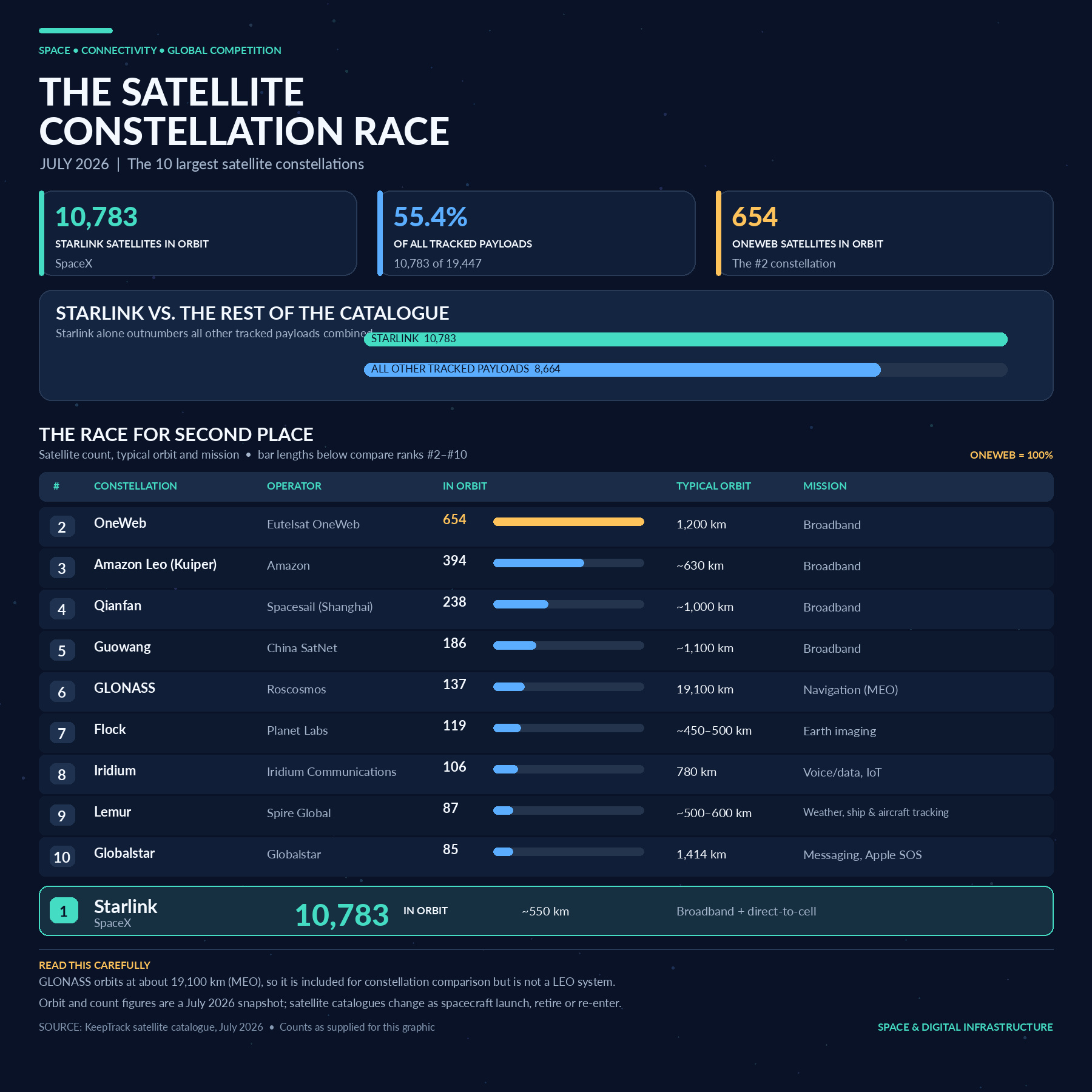
The sheer magnitude of this international race is remarkable. According to data from KeepTrack’s satellite catalogue reveals that by July 2026, Starlink operated 10,783 satellites out of 19,447 tracked orbital payloads worldwide meaning a single network comprising roughly 55 percent of all active payloads. Since 2019, SpaceX has launched a total of 12,444 Starlink units, with the remaining balance having completed their operational lifecycles and re-entered Earth’s atmosphere.
The scale of the global competition is striking.
According to KeepTrack’s satellite catalogue, SpaceX’s Starlink had 10,783 satellites in orbit as of July 2026, out of 19,447 tracked payloads in Earth orbit. The constellation alone accounted for approximately 55 per cent of the catalogue’s recorded payloads.
SpaceX had launched 12,444 Starlink satellites since 2019, with the difference accounted for largely by satellites that had already re-entered the atmosphere.
The gap between Starlink and its competitors illustrates the concentration of infrastructure in the emerging low-Earth-orbit (LEO) satellite economy.
OneWeb, operated by Eutelsat OneWeb, had 654 satellites in orbit, followed by Amazon Leo, previously known as Project Kuiper, with 394. China’s Qianfan, also known as Thousand Sails, had 238, while its Guowang network had 186.
Both Chinese networks are planned as large-scale broadband constellations, with ambitions extending into the tens of thousands of satellites.
These networks are competing for a central role in global communications, using satellites flying relatively close to Earth to deliver broadband services, including in places where conventional telecommunications infrastructure is difficult to deploy.
For Africa, the implications go beyond satellite numbers. They concern who owns the infrastructure, who determines the terms of access, where the economic benefits accrue and whether the continent can secure reliable connectivity on affordable terms.
Africa Is A Growing Market, But What Does It Own?
Africa is increasingly participating in the satellite economy, although its progress in developing satellites does not yet match the scale of the commercial broadband networks being deployed by global technology companies.
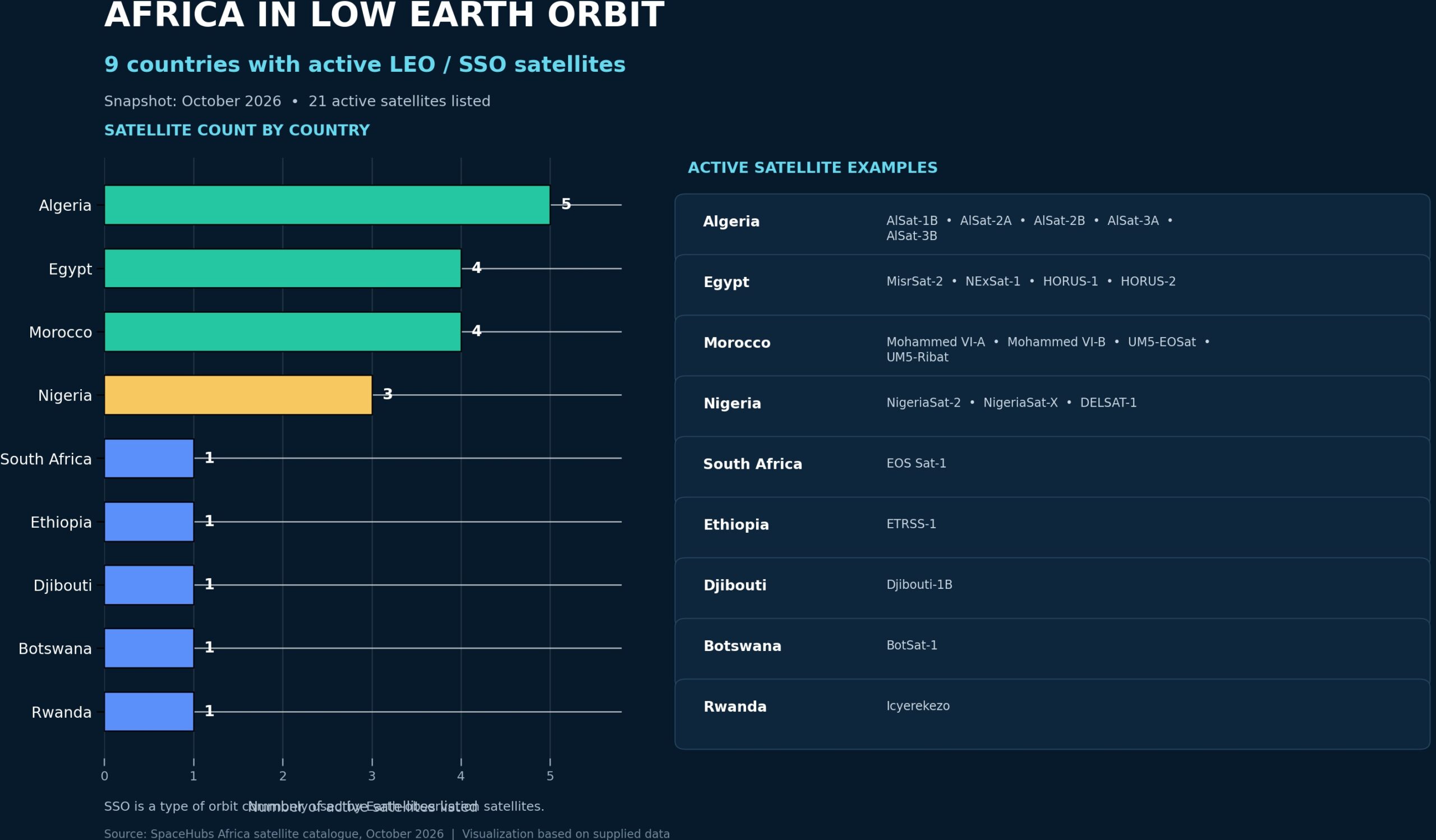
The SpaceHubs Africa satellite inventory recorded 69 African satellites as of October 27, 2026, of which 30 were active.
Nine African countries had at least one active satellite in low Earth orbit or sun-synchronous orbit, a type of orbit commonly used for Earth observation. These were Algeria, Botswana, Djibouti, Egypt, Ethiopia, Morocco, Nigeria, Rwanda and South Africa.
Their satellite programmes demonstrate that African countries have developed capabilities in satellite operations, Earth observation, research and related applications. However, these spacecraft should not be confused with large commercial broadband constellations.
The continent does not yet operate an African-owned LEO broadband constellation at a scale comparable to Starlink.
This distinction is important. A country can operate an Earth-observation satellite without having the capacity to deliver broadband internet to its population. Satellite ownership, satellite manufacturing, launch capabilities, ground infrastructure and commercial internet services are related but different parts of the space economy.
Africa already has experience with communications satellites in geostationary orbit, including regional and national systems. Yet the fast-growing LEO market introduces a different competitive environment, requiring sustained investment, advanced engineering, ground infrastructure and the ability to deploy and replace satellites at scale.
The challenge, therefore, is not simply to place more African satellites into orbit. It is to determine how space technology can become part of a dependable, affordable and locally beneficial internet ecosystem.
The Connectivity Gap Makes The Race Consequential
The stakes are particularly high because millions of Africans remain offline despite the expansion of mobile networks and international fibre-optic infrastructure.
The International Telecommunication Union’s Facts and Figures 2025 estimated that only 36% of Africa’s population used the internet in 2025, the lowest proportion among the ITU’s world regions.
The problem is not limited to whether a network exists. Affordability, digital skills, device costs, unreliable service and unequal access between urban and rural communities all influence whether people can actually use the internet.
The ITU’s 2025 report on digital development in Africa also highlighted gaps in mobile broadband coverage, particularly in rural areas.
LEO satellite networks offer one possible response.
Because they do not depend on a continuous network of terrestrial cables to reach every customer, satellite services can help connect remote settlements, schools, health facilities, businesses and communities that conventional networks struggle to serve economically.
They can also provide backhaul connectivity for mobile network operators, extending the reach of terrestrial networks into underserved areas.
In June 2026, Starlink was available in 26 African markets, with approximately 300,000 customers across the continent, according to Space in Africa.
However, adoption was uneven. Nigeria, Zimbabwe and Zambia accounted for approximately 64% of the continent’s Starlink subscribers, showing that demand and market conditions differ considerably across countries.
These figures illustrate the opportunity presented by satellite broadband, but also the limitations of treating the arrival of a global provider as a complete solution to Africa’s connectivity challenges.
Equipment prices, subscription fees, regulatory requirements and network capacity can influence who benefits. Satellite internet may expand the choices available to consumers without necessarily making connectivity affordable to everyone.
The central question is therefore whether Africa can use the expansion of LEO services to close its digital divide while strengthening its own technological capabilities.
Building Internet Infrastructure Beyond Satellites
One of the risks in the current debate is treating satellite constellations as a substitute for investment in terrestrial infrastructure.
A resilient internet ecosystem requires several interconnected layers: submarine cables, national and cross-border fibre networks, mobile infrastructure, internet exchange points, data centres, satellite gateways, reliable electricity and international connectivity.
Submarine cables bring enormous amounts of international data capacity to African shores. Yet that capacity must still travel from cable landing stations to cities, businesses, institutions and rural communities.
The African Finance Corporation’s State of Africa’s Infrastructure Report 2025 identifies the expansion of terrestrial fibre, internet exchange points and regional data centres as important priorities for turning submarine cable capacity into stronger digital economies.
Without adequate domestic and regional networks, additional international bandwidth does not automatically translate into cheaper or more reliable internet for end users.
Internet exchange points allow networks to exchange traffic locally rather than routing all traffic through overseas hubs. Local data centres can support hosting, cloud services and digital applications closer to their users. Fibre networks provide the backhaul needed to connect these facilities to homes, businesses and mobile towers.
LEO satellites should complement these systems by providing alternative routes, serving difficult-to-reach locations and adding resilience when terrestrial infrastructure is unavailable or disrupted.
For policymakers, the task is to design an integrated system in which satellites, fibre, mobile networks and local internet infrastructure reinforce one another.
How Can Africa Build Credible And Resilient Infrastructure?
The first priority should be a coordinated regional connectivity strategy.
African governments, regional economic communities, telecommunications regulators and the African Union can work towards common approaches to satellite licensing, spectrum coordination, gateway infrastructure, cross-border connectivity and infrastructure sharing.
A more coordinated approach could also improve the continent’s negotiating position when dealing with global satellite providers. Countries could explore shared ground stations, pooled procurement for public institutions and regional connectivity arrangements, where technically and commercially feasible.
Such cooperation would not eliminate national regulatory responsibilities. It would help reduce unnecessary fragmentation and create opportunities to lower costs, improve interoperability and extend services across borders.
Second, African countries need to strengthen the terrestrial infrastructure supporting satellite connectivity.
Investment should prioritise national and cross-border fibre, redundant routes, local internet exchange points, regional data centres and reliable electricity. Networks need alternative paths so that a single cable cut, equipment failure or service disruption does not isolate communities or essential services.
Third, governments and regulators should establish clear, transparent rules for satellite operators. These should address licensing, competition, consumer protection, service quality, cybersecurity, spectrum use and applicable data protection obligations.
Public procurement and partnerships with satellite companies should also be assessed against measurable public benefits, including service availability, affordability and connectivity for underserved communities.
Fourth, Africa Should Invest in its Own Space Capabilities. The African Union’s Africa Outer Space Strategy identifies satellite communications, Earth observation, navigation, disaster management, climate forecasting and other applications as important areas for development.
Implementing these ambitions will require sustained funding, research partnerships, technical training and stronger links between African universities, space agencies, telecommunications companies and local technology businesses.
Rather than trying to match Starlink satellite for satellite in the immediate future, African countries could identify practical areas in which they can build capacity, including satellite design, ground equipment, software, satellite data services, systems integration and specialised manufacturing.
Regional collaboration could help spread development costs and allow countries to share technical expertise and infrastructure.
Finally, connectivity policies must measure success by who actually benefits. Satellite deployment figures and kilometres of fibre laid are important, but they do not show whether a rural school can afford broadband, whether a small business can remain connected or whether a household can reliably access online services.
Governments should therefore track affordability, service reliability, rural coverage, network resilience and meaningful internet use alongside infrastructure investment.
From Consumers To Participants In The Global Space Economy
Africa does not necessarily need to own every satellite or independently manufacture every component of its internet infrastructure to exercise greater technological agency.
International partnerships and access to global satellite systems can be important tools for expanding connectivity. The challenge is to ensure those partnerships complement local investment, strengthen African expertise and create opportunities for domestic businesses.
The continent can also use its growing demand for connectivity to negotiate better service arrangements, develop local technical industries and establish regional approaches to digital infrastructure.
The expansion of Starlink, OneWeb, Amazon Leo and China’s competing networks means that the architecture of global internet connectivity is changing. The companies able to deploy satellites at scale will influence how services are delivered across increasingly remote and underserved areas.
For Africa, the question is whether this transformation will simply expand access to foreign-owned networks or help create a more resilient and competitive digital ecosystem.
The continent’s future internet cannot depend on satellite numbers alone. It will depend on the strength of its fibre networks, the reliability of its power supply, the capacity of its data infrastructure, the quality of its regulation and the skills of the people developing and maintaining its systems.
The real measure of Africa’s progress in the LEO race will not be how many satellites it can count in orbit, but whether it can turn space technology into affordable connectivity, resilient infrastructure and a stronger position in the global digital economy.