|
Getting your Trinity Audio player ready...
|
By Pauline Achieng Tom
Malindi, Kenya: Less than a month after Kenya announced its first ever Ebola case, players in the tourism industry are already reporting disruptions in bookings, adding to pressure in an industry that is already facing stiff competition from neighboring destinations prompted by high park fees, Visa fees and rising travel costs.
In Malindi, Kilifi County, John Kenga, a resort manager and tour operator, says fears of the disease have started disrupting safari bookings, with some of their visitors opting for neighboring Tanzania.
Kenga, who runs Mama Savannah Travel, said his company has experienced several cancellations and changes to itineraries involving tourists travelling between Kenya and neighboring Tanzania.
“One visitor from China, who had booked a combined safari through the two countries, cancelled the return leg to Kenya and opted to fly home from Tanzania instead.” He said.
This happened shortly after the Ministry of Health announced the first imported case of Ebola, the visitor had been advised that returning to Kenya would mean undergoing a 21-day quarantine back in their home country.

“The original itinerary included an overnight stay in Amboseli National Park before the visitor flew home to China.” Kenga explained.
Another Tour operator, Tuda Clarkson, from Tuda Tailormade Tours and Travel, warns that consequences could extend beyond the tour companies and hotels to other businesses that benefit from tourists spending.
“Tourism money is important in this country. If a visitor visits Kenya, they will spend money in hotels, and that feeds more than just the tour operator,” Tuda said.
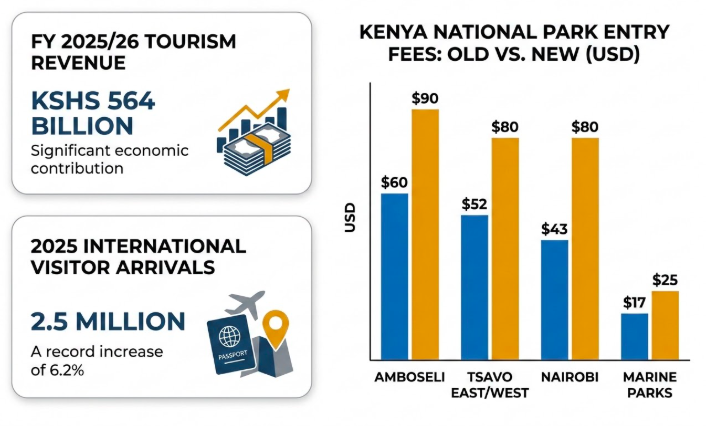
Data from the Ministry of Tourism and Wildlife shows that the Tourism industry contributes significantly to the country’s economy. In the Financial Year 2025/26 tourism brought in Kshs 564 billion a rise from previous years.
The reported disruptions come ahead of the December tourism boom. For Kenga this has translated into direct financial losses. The cancelled booking left them liable for costs under nonrefundable contracts.
“We had already paid accommodation providers, but as per our contract we had to pay back all his money because it’s a problem which we should understand and we don’t want to ruin the image of our company,” he said.
These cancellations come as Kenya’s tourism industry faces other pressures including airfares, park fees and the cost of visa entry into the country. Kenga said the combined expenses could make alternative destinations more attractive to travelers.
“The quotation comes very high and the guests choose other destinations like Tanzania, Uganda, Zimbabwe and South Africa,” he said.
In September of 2025, Kenya Wildlife Service (KWS) increased national park entry fees. For non-resident adults at Amboseli National Park, the fees rose from USD 60 to USD 90, while fees for Tsavo East and Tsavo West increased from USD 52 to USD 80. Entry to Nairobi National Park rose from USD 43 to USD 80, while fees for marine parks, including Watamu and Malindi, increased from USD 17 to USD 25.
The increases were meant to support financial sustainability of wildlife conservation however people in the tourism industry say that these high fees and the threat of Ebola can make tourists choose other destinations.
This change comes as the tourism industry reported an immense growth, according to the Kenya National Bureau of Statistics (KNBS) 2026 Economic Survey, international visitor arrivals hit a record 2.5 million in 2025, a 6.2% increase from the previous year.
The country also recorded approximately 3.95 million visits to national parks and game reserves, an increase of 5.7%.
On his part Mr. Clarkson called for the government and general public alike to make a collective effort to speak positively about the country and stop sensationalizing Ebola.
“It is up to us to show the world that despite there being reported cases, that’s not the reason not to visit.” He said.
Meanwhile, Kenya has since reported a second Ebola case, the person was already in quarantine. The ministry of Health says that they are continuing in their efforts in contact tracing.
As of 13th October 2026, 128 contacts related to the first case have been listed, so far,113 have been traced, and 108 are quarantined in Kenya, with the other five outside the country.
Speaking to Journalists during a press conference the Director General of Health Dr. Patrick Amoth said that the country was stepping up its response to the Ebola outbreak and health precautions were being taken in regard to the movement of people across Kenyan borders.
“Diseases know no boundaries and therefore we continue to collaborate with our immediate neighbours, so that we can be able to ensure that the global community is informed.” He said.
Adding, “it is important that we are able to put in place measures for us to be able to detect, you cannot put a wall between Uganda and the DRC or Kenya and Uganda to prevent the entry of a pathogen, therefore we continue to maintain a high level of alert.
In the meantime, The World Health Organisation and The Kenyan Ministry of Health maintains that the country does not have an active Ebola outbreak.
For tourism operators, the concern is whether the outbreak will add another deterrent for visitors prompting them to choose other destinations over Kenya.