
|
Getting your Trinity Audio player ready...
|
By Melisa Mong’ina
Nairobi, Kenya: Alcohol intake among young adults is raising public health concerns in the country, with university students recording higher levels of consumption and addiction than the general population.
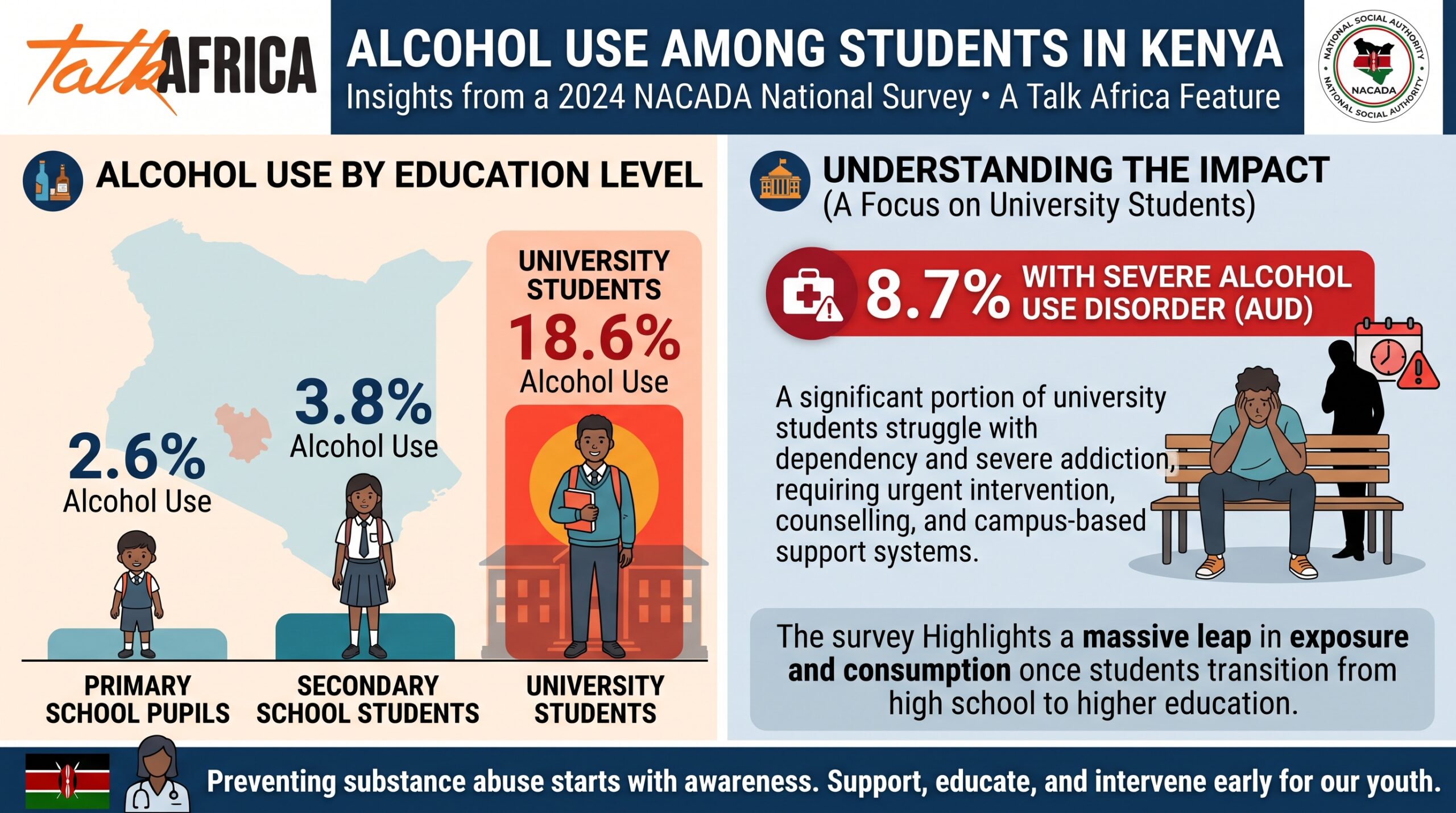
A 2024 study by the National Authority for the Campaign Against Alcohol and Drug Abuse (NACADA) found that alcohol use was higher among university students, at 18.6%, compared with 3.8% among secondary school students and 2.6% among primary school pupils. The study also found that 8.7% of university students had severe alcohol use disorder.
Speaking during a virtual discussion on alcohol control legislation organised by NCD Alliance Kenya, NACADA, Students Campaign Against Drugs (SCAD) and the International Institute for Legislative Affairs (IILA), Adrian Njenga of NACADA warned that early exposure to alcohol could increase the risk of addiction and the use of other substances.
“Alcohol and tobacco are referred to as the gatekeepers or the initiators into the drug world for young people,” said Njenga.
Dr. Catherine Karekezi from NCD Alliance Kenya highlighted that alcohol is a major risk factor for non-communicable diseases, including heart conditions and certain cancers, as well as mental health problems.
“Alcohol is toxic. It is a psychoactive agent. It is a dependence-producing substance that has been classified as a Group One carcinogen by the International Agency for Research on Cancer,” Dr. Karekezi said.
She also warned about the effects of alcohol on young people, saying their developing brains make them particularly vulnerable to its long-term effects.
“If we have adolescents and young adults exposed to alcohol consumption, this increases the likelihood of dependency on alcohol,” she added.
Dr. Karekezi underscored that alcohol dependence can also push Kenyan households into poverty, affecting families and the country’s economic development.
Benjamin Odhiambo, a public health expert at the Students Campaign Against Drugs (SCAD) also supported raising the minimum drinking age to 21, arguing that delaying exposure to alcohol could reduce the risk of addiction.
“The earlier an individual is introduced or initiated into substance use, the more likely they are to graduate into problematic alcohol use and then alcohol use disorder,” he said.
Odhiambo added that raising the legal age for drinking and handling alcohol would help protect young people.

He also raised concerns about young people’s exposure to alcohol advertising on social media platforms, stressing that stronger controls on advertising and better tracking of alcoholic products could help protect them and other consumers.
“This shows that we do not have sufficient protections for young people in terms of exposure to these particular products, especially alcohol,” said Odhiambo.
According to Caleb Mbugua of the International Institute for Legislative Affairs (IILA), the proposed Alcoholic Drinks and Drugs Control Laws (Amendment) Bill, 2026, seeks to raise the minimum legal drinking age from 18 to 21 to protect the health of young people.
He explained that the proposed changes would also prevent people below the new legal age from obtaining alcohol licences or working in places where alcoholic drinks are sold or handled.
The bill would also restrict their access to areas where alcohol is manufactured, stored or consumed, and prohibit the sale of alcoholic drinks to them or to anyone accompanied by people below the new legal age.
“There will be warning signs and notices reflecting the new age limit and alcohol outlets will not be allowed to admit underage customers, whether they are alone or accompanied,” said Mbugua.