
|
Getting your Trinity Audio player ready...
|
By Omboki Monayo
Nairobi -Civil society advocates and public health watchdogs are raising alarm over the Pest Control Products Bill (National Assembly Bill No. 48 of 2025). The Bill would overhaul Kenya’s 1982 Pest Control Products Act (Cap. 346), and critics warn it could put corporate profits ahead of food safety, smallholder farmers, and the environment.
It aims to establish a modern, science-driven Pest Control Products Authority (PCPA), but critics say its board makeup, regulatory approach and exposure to banned or hazardous chemicals undermine those goals.
State agencies, scientific bodies and county governments are pushing back too. Rather than uniting behind a seamless reform, key regulators warn that the Bill in its current form could spark turf wars, duplicate existing laws, raise compliance and trade risks, and roll back constitutional devolution.
Industry capture and double standards
Dr Daniel Maingi, director of Growth Partners Africa, says the National Assembly Departmental Committee on Agriculture’s decision to reject civil society proposals on the Bill “should alarm anyone who eats food grown in Kenya”.
“In throwing out amendments meant to clean up the proposed regulator’s Board of Directors, MPs have opted to preserve a guaranteed seat for the Agrochemicals Association of Kenya (AAK), which is the chief lobby group for pesticide manufacturers and importers,” he says. “Put plainly, Parliament is about to pass a law where the very companies selling toxic chemicals sit inside the regulator’s boardroom to approve their own products, set residue limits, and vote on whether their most profitable brands should be banned.”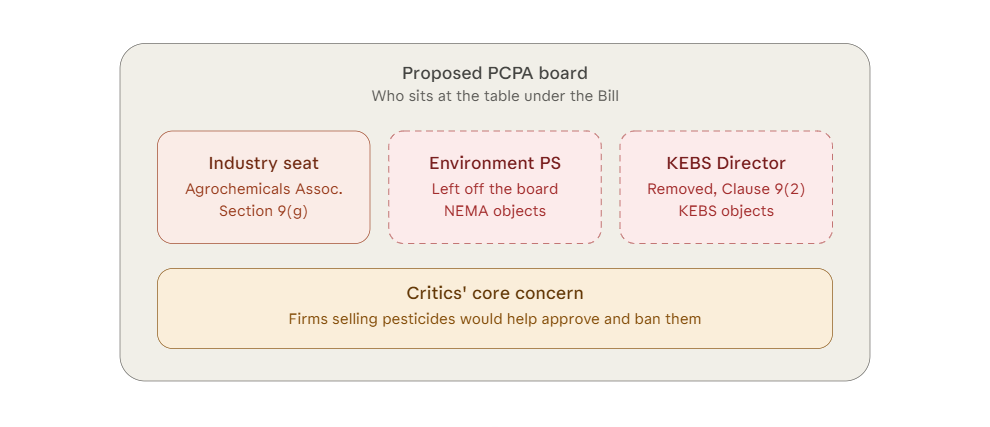
The organic farming consultant calls it a dangerous slide toward state capture of agriculture and public health regulation by commercial interests. “We have seen where this road leads. When regulated industries capture their regulators, public health always loses,” he says.
Christine Gatwiri, Route to Food International (RTFI) project coordinator at the Heinrich Böll Stiftung (HBS) Kenya, Uganda and Tanzania office in Nairobi, says the Bill opens a regulatory gap even as it claims to strengthen pesticide rules:
“Section 9 (g) of the Bill, which covers the board composition, proposes that one person representing the AAK is to be included in the board. As RTFI, we felt that this is a conflict of interest because the board’s role is to regulate the entire pesticide product lifecycle in a way that is meant to safeguard public health and the environment. Would this person from the AAK be aligned with that objective, or would their agenda be more about furthering their private or profit interest within the board?”

She adds that although some issues will be settled at the regulation stage, they should be raised while the Bill is still at the drafting stage, “because it’s what forms the regulations. If we have a strong bill or skeleton that considers as many perspectives and aspects as possible, then it leads to a law with enough meat, or regulations that are broad and also cover as many perspectives as possible.”
Harun Warui, Lead Programme Coordinator for the Agroecology and Food Rights Programme at the same HBS office, points to double standards in Kenya’s use of pesticides:
“Double standard is a scenario whereby we have a product that is banned or restricted in the country of origin, but is allowed as usable in another country. Some products have been banned, withdrawn, or removed from the market entirely in other countries, for instance in Europe, but are allowed here. There is no moral basis for that country exporting the product to Kenya, yet it’s withdrawn from its domestic market.”
Dr Maingi also criticises Kenya’s risk-based approach for placing an “unmanageable and unaffordable burden of safety and personal protection on smallholder farmers”. According to Pesticide Action Network UK, a hazard-based approach bans or restricts chemicals based solely on their inherent toxic properties, whereas a risk-based approach assesses whether a pesticide can be used safely under real-world exposure conditions.
Using the analogy of crossing a snake-infested part of a forest armed with a protective weapon versus avoiding it altogether, he says: “We have chosen to adopt the risk-based approach that allows smallholder farmers to get exposed to dangerous chemicals, often without the benefit of personal protective equipment (PPE). There are numerous publicly reported cases of individuals taking pesticide manufacturers to court in the Global North after developing diseases like non-Hodgkin’s lymphoma as a result of exposure to the active ingredients in the products.” He advocates integrated pest management and stronger environmental safeguards instead.
State agencies: turf wars, trade risks and rollbacks
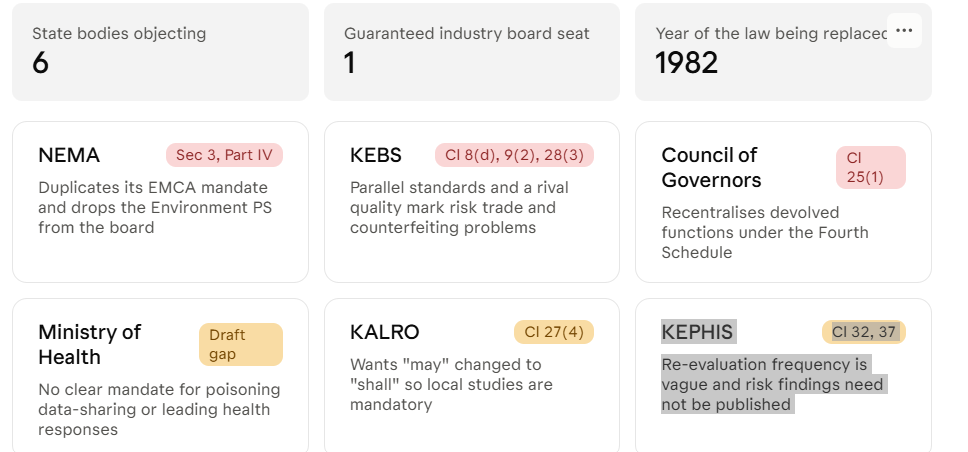
The sharpest institutional criticism comes from the National Environment Management Authority (NEMA), which says the Bill “deviates from the regulation of pesticides…and expands its scope to regulating certain aspects of the environment.”
NEMA warns that Section 3 “duplicates its function under Section 94 of the Environmental Management and Coordination Act 1999 (EMCA), Cap 387, by stripping the Authority of its pre-existing mandate in the registration of pesticides and toxic substances,” while Part IV “usurps the role of the Cabinet Secretary responsible for the Environment under Section 100 of EMCA.”
It also notes that the Principal Secretary responsible for the Environment is left off the Board: “Environment is missing, which seems deliberate as the Bill assumes a mandate in the environment.” NEMA further flags a missing Regulatory Impact Statement, and says Clauses 48(2)(g) and 69(2)(s) duplicate waste rules under EMCA and the Sustainable Waste Management Act, causing “duplication and confusion of mandate in the public” and “a potential for double charges.”
Gatwiri echoes the concern: “What would be the role of the ministry of environment because it’s not proposed for membership on the board?” She notes that pesticides affect air, rivers, soil, bees, birds and fish, and adds: “There seems to be a gap when it comes to who should handle pesticide residue, whether it’s NEMA or another agency, but it’s something we need to look at further.”
The Kenya Bureau of Standards (KEBS) warns that Clause 8(d) lets the new Authority set technical standards independently of the Standards Act, risking “two parallel and potentially inconsistent sets of technical requirements”. That could mean higher compliance costs, enforcement confusion and non-compliance with the World Trade Organization (WTO) Agreement on Technical Barriers to Trade.

KEBS also objects to the removal of its Director from the Board under Clause 9(2), which it says erodes “the whole of government and coordinated regulatory approach”. It warns that a separate quality mark under Clause 28(3) would aid counterfeiters: “Two competing quality marks for the same product category would confuse consumers and traders, weaken confidence in either mark, and undermine the Bureau’s role as the single national quality-marking body.”
The Council of Governors (COG) says the Bill clashes with the Fourth Schedule of the Constitution by recentralising devolved functions. It argues that Clause 25(1), which restricts seizure and detention powers to national inspectors, “as currently worded, is discriminatory against inspectors appointed by County Governments”. It adds that centralising agro-dealer certificates, retail licensing and solid waste container sites infringes on county mandates. Lawmakers rejected nearly all of COG’s devolution proposals.
The Ministry of Health warned that the draft lacks explicit mandates for inter-agency collaboration and data-sharing on “pesticide poisoning and other adverse health effects,” “occupational and community exposure,” and “food contamination incidents.” It insists it must hold “the lead responsibility for coordinating the public health aspects of such responses” during crises such as “chemical incidents, pesticide poisoning outbreaks, food contamination events, and product recalls.”
Two scientific bodies raised narrower points. The Kenya Agricultural and Livestock Research Organization (KALRO) urged replacing “may” with “shall” in Clause 27(4) to make local pre- and post-registration studies mandatory. The Kenya Plant Health Inspectorate Service (KEPHIS) said under Clause 32 that “the frequency [of re-evaluation] remains ambiguous”, and flagged under Clause 37 the lack of mandatory “formal publication of risk assessment outcomes” for banned or restricted chemicals.
Modernising a four-decade-old pesticide law is vital for food security, environmental stewardship and export competitiveness. But state agencies warn that a single super-regulator could create more chaos than it fixes. Without harmonised mandates, restored inter-agency representation on the board, and closed scientific and public health loopholes, the Pest Control Products Bill, 2025 risks undermining the very safeguards it was meant to strengthen.
TalkAfrica has published an investigation into pesticides. Read more: https://www.talkafrica.co.ke/banned-pesticides-hazardous-pesticides-in-eu-markets-retail-in-kenya-and-cameroon/