
|
Getting your Trinity Audio player ready...
|
By Eng. James Okech
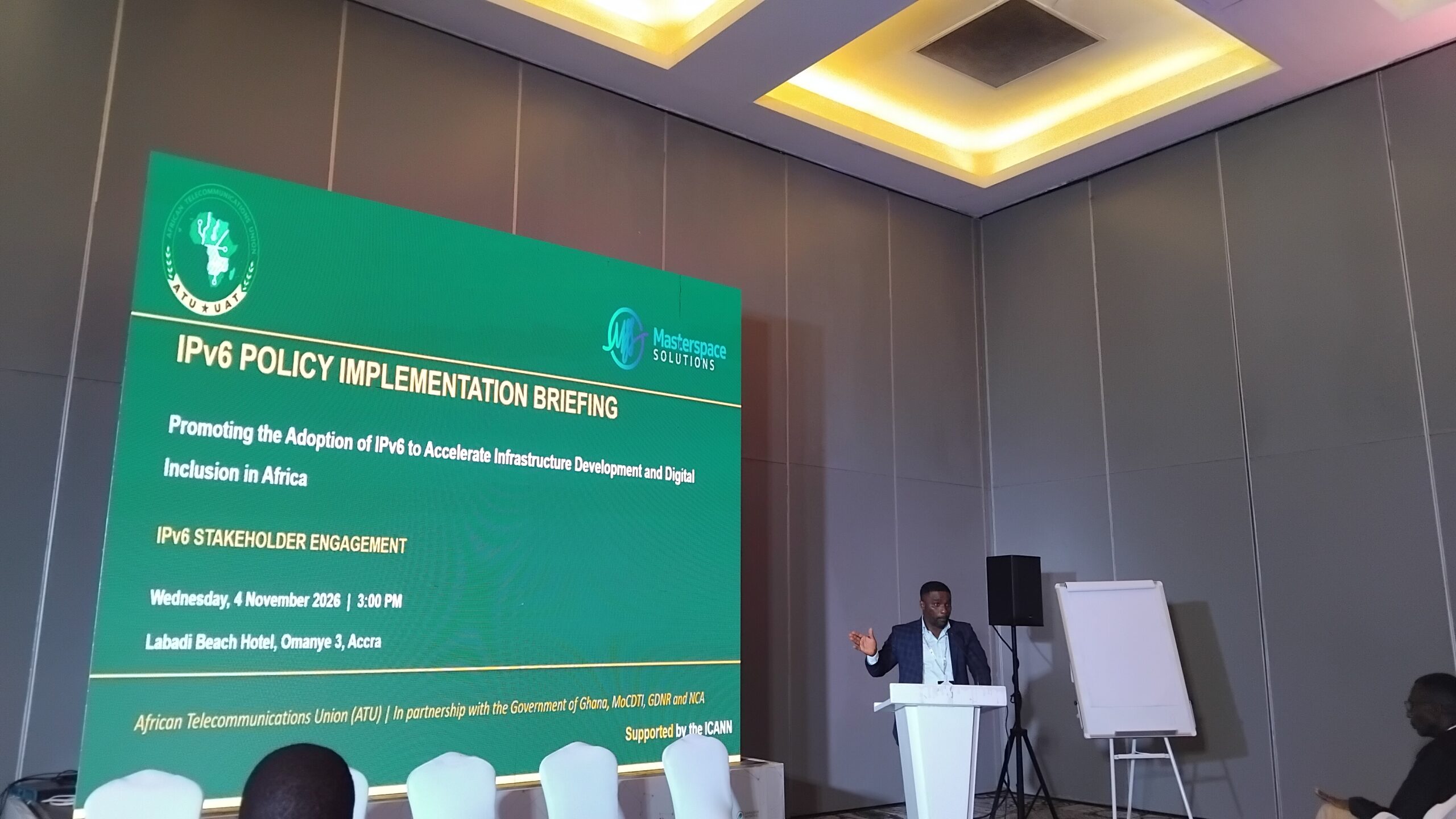
Accra, Ghana: Ghana’s preparations to host one of six planned regional Internet Protocol version 6 testbeds moved forward this week when stakeholders met in Accra to connect the facility to the policies and skills required for its use.
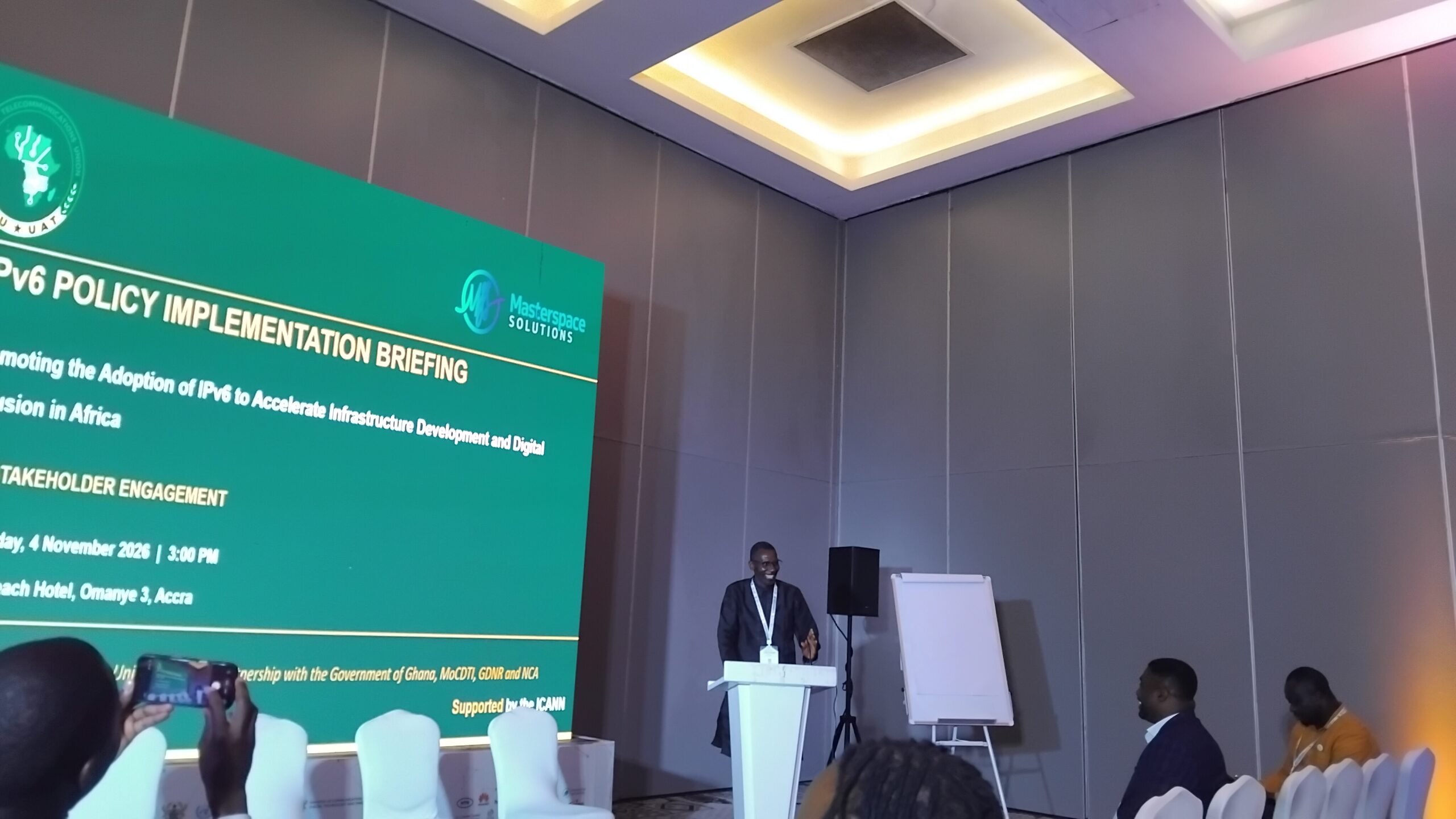
Held on 4 November 2026, the IPv6 Stakeholder Engagement Forum formed the policy briefing stage of Masterspace and African Telecommunications Union (ATU) project supported by the Internet Corporation for Assigned Names and Numbers(ICANN Grant Programme).
The forum brought the Union together with the Ministry of Communication, Digital Technology and Innovations , the Ghana Domain Name Registry (GDNR) and the National Communications Authority before installation and training. Participants examined how Ghana can use the testbed to prepare national networks through clear institutional responsibility, regulatory direction, procurement rules and people able to apply the training.
The policy and training work forms part of an ongoing continental effort to move African networks from IPv4 to IPv6, which provides the address capacity needed for expanding digital services and reduces dependence on costly, complex IPv4 workarounds.
The African Telecommunications Union cited data from Asia Pacific Network Information Centre (APNIC) Labs showing that 6.1% of tested users in Africa used IPv6 when both protocols were available, compared with 41.7% globally. Cloud services, connected devices, 5G and digital public infrastructure are increasing demand for internet addresses. Continued reliance on IPv4 has therefore led many operators to use workarounds that add cost and make networks more complex to manage.
By the time stakeholders met in Accra, the project had already completed the regional assessment and policy work needed to begin pilot deployment. It had examined IPv6 adoption and readiness, prepared recommendations for Member States and trained 52 participants from 26 Member States in Nairobi in November 2025.
Within that phase, Ghana is one of six planned hosts covering Africa’s five subregions. Botswana, Cameroon, Tanzania and Tunisia make up four sites, with Ghana and Togo serving West Africa so that the project can support countries working in English and French. The arrangement gives Ghana a regional training role within the larger programme.
In Ghana, ISAAC BOATENG, Director of Standardization at the African Telecommunications Union, said installation and stakeholder training were scheduled for 9–13 November at the National Data Centre. Discussion concentrated on the work required to commission it and the arrangements needed to keep it useful after the project’s initial support ends.
Once operational, the testbed is expected to give engineers a controlled setting to configure IPv6, identify problems and test solutions before changing live networks. It should also support refresher training and give participants from neighbouring countries experience their national networks may not yet offer.
The value of that training will depend on decisions outside the test environment. Participants identified the need for a national lead institution, an assessment of existing equipment, a time-bound transition roadmap and IPv6 requirements in licensing, type approval and public procurement. The forum established the areas in which the Government, the regulator, operators and public purchasing authorities would need to act. A proposed continental dashboard would then track adoption and show where support is needed.
Pierre Dandjinou, the Internet Corporation for Assigned Names and Numbers Vice President for Stakeholder Engagement in Africa, said the next stage would need to give greater attention to the business case for operators and to arrangements for sustaining the testbeds beyond the initial funding period.
A representative of the AFRINIC-The Regional Internet Registry for Africa said earlier capacity building had concentrated on engineers, although managers decide whether operators invest. Winnie Kamau, President of the Association of Freelance Journalists Kenya, called for a simpler public explanation of IPv6 that would enable journalists and communication professionals to relate the transition to services, investment and future applications.
That implementation focus continued when an ATU delegation led by Boateng subsequently met Ghana’s Minister for Communication, Digital Technology and Innovations, Hon. Samuel Nartey George, MP. The delegation briefed him on the forum and the planned installation and training, and explored further cooperation.
ATU also congratulated him after Ghana assumed the two-year chairmanship of the African Union Specialised Technical Committee on Communication and ICT, succeeding Lesotho following the Committee’s Sixth Ordinary Session in Libreville.
The Minister thanked ATU for the visit and assured the delegation of his support. Installation and training will provide the first test of that assurance.