
|
Getting your Trinity Audio player ready...
|
By Mercy Kachenge
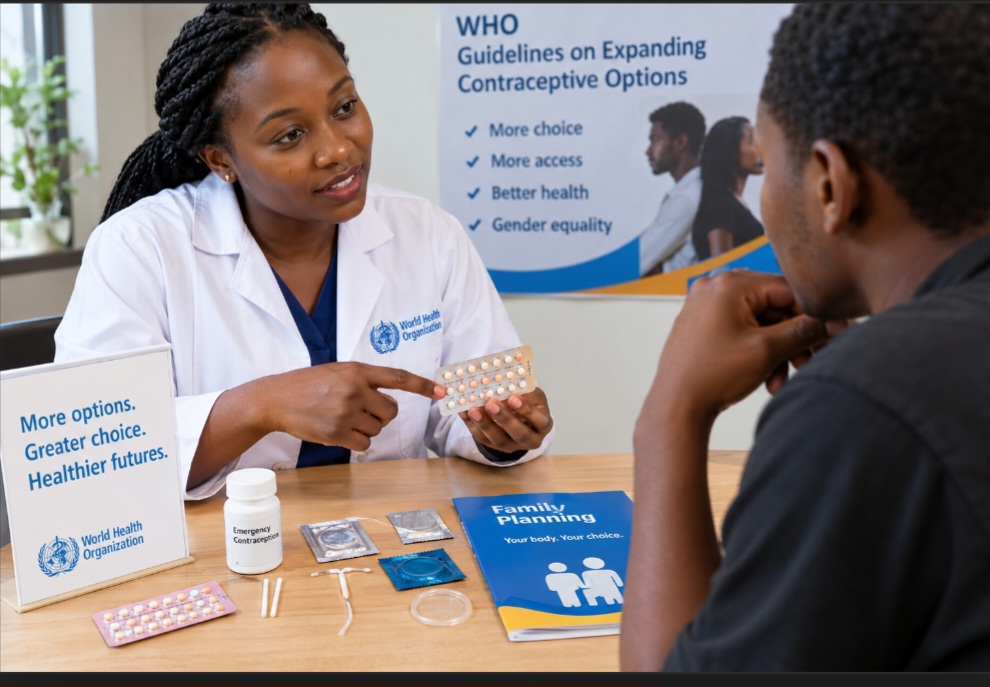
Nairobi, Kenya: To address a global shortfall leaving roughly 164 million women without access to wanted family planning, the World Health Organization has released updated guidance to broaden reproductive choices.
Titled “WHO Guidelines on Expanding Contraceptive Options,” the publication revises usage recommendations for established methods while driving forward the development of novel choices, including the agency’s inaugural blueprint for male contraception.
More Flexibility with Existing Methods
Rather than only introducing new products, much of the guidance loosens restrictions on methods already in wide use. Combined oral contraceptive pills, WHO now says, can be taken continuously or in extended cycles up to six months at a stretch, or even a full year instead of the traditional monthly pattern.
Contraceptive implants got a similar update: WHO now backs leaving them in place for up to five years, which could cut down on the number of replacement procedures, doctor visits, and costs patients face.
The guidelines also add mifepristone to the emergency contraception toolkit. Taken in the days following unprotected sex up to five days, ideally as soon as possible the drug appears comparably safe and effective to existing emergency options at low doses.
Not every method got a green light. WHO said the evidence on ormeloxifene remains too thin to recommend rolling it into national family planning programs, and called for further research. Quinestrol-containing pills fared worse: WHO explicitly advised against adding them to programs, citing sparse evidence and reports of serious side effects.
“Choice is a gender equality issue”
Pascale Allotey, who directs WHO’s sexual and reproductive health department, framed the guidance as fundamentally about autonomy rather than any single method.
She said contraception isn’t one-size-fits-all, and that both men and women need options weighing convenience, invasiveness and reliability with real choice meaning the power to start, switch, or stop a method on one’s own terms.
Looking Toward Male Contraceptives
The release devotes significant attention to an underserved area: contraceptive options for men. Currently, men have just three real tools that are condoms, withdrawal and vasectomy yet WHO notes that roughly 30% of couples already rely on one of these male-controlled methods despite the limited menu.
New WHO-backed research pushes back on the assumption that men wouldn’t use additional options if they existed.
In surveys, more than three-quarters of couples said they’d be open to trying a new male contraceptive, and over 85% of women said they’d trust a male partner to manage contraception himself.
To convert that appetite into actual products, WHO has published its first Target Product Profile for male contraceptives, a document spelling out the safety, effectiveness, acceptability and cost benchmarks new methods should meet.
The goal is to give drug developers and funders a clearer target, since several hormonal and non-hormonal candidates are already in advanced clinical trials. WHO estimates new reversible male contraceptives could reach the market within five to ten years.
WHO says it will now work with individual countries to help them update national family planning policies in line with the guidance.