|
Getting your Trinity Audio player ready...
|
By Juliet Akoth
Nairobi, Kenya: A new international declaration is calling for coordinated action to protect the flyways that sustain migratory birds, as a global assessment warns that 45% of migratory species are in decline while one in nine is threatened with extinction.
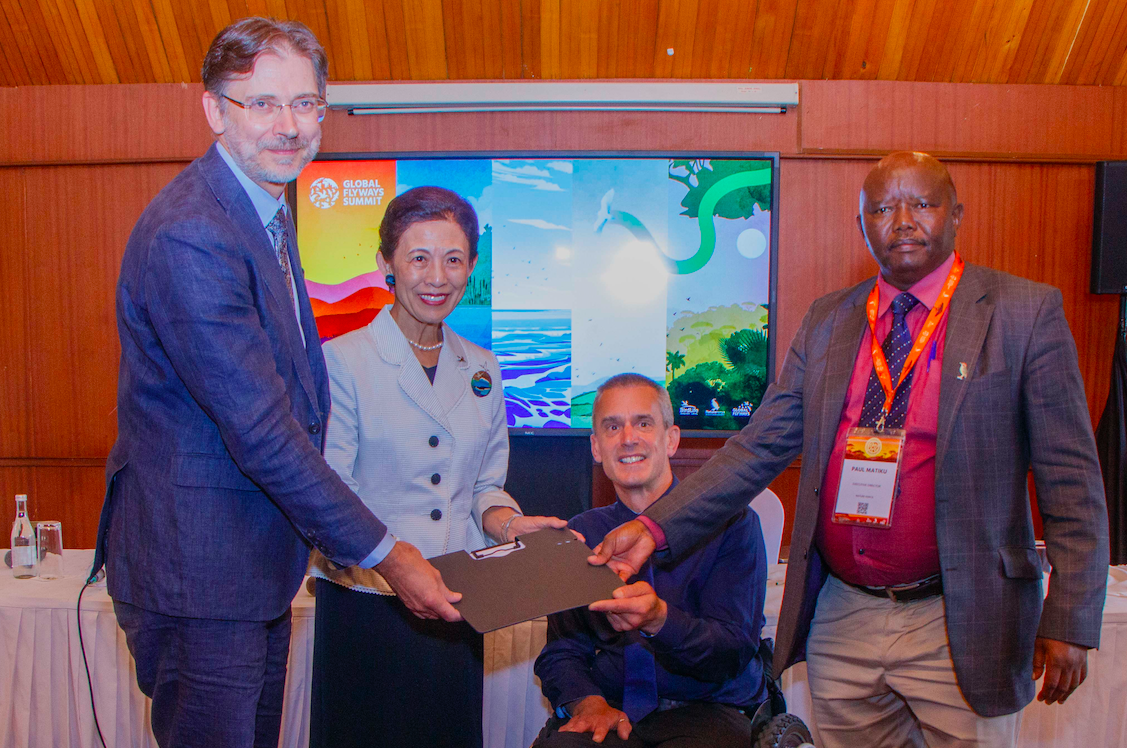
The Nairobi Flyways Declaration, an unprecedented commitment to coordinated protection of migratory routes across borders was unveiled at the Global Flyways Summit in Nairobi on September 11 by Birdlife International with Nature Kenya as the co-host.
The event which brought together scientists, NGOs, conservationists, governments and financial institutions also saw the unveiling of the State of The World’s Birds report. Published every four years, this is the first edition devoted to migratory birds and the flyways they depend on.
Speaking during a media briefing, Her Imperial Highness Princess Takamado of Japan, Honorary President of BirdLife International, called for international cooperation to safeguard birds throughout their journeys.
“Migratory birds do not recognize borders. They connect Asia to Africa, the Arctic to the tropics. The Nairobi Flyways Declaration acknowledges this reality. I am proud to see the scientific community, conservation organizations and finance institutions united behind the science,” she said.
The declaration is being presented as a major international conservation commitment, with flyway action brought together around a recurring global process. Its focus is on creating an ecologically coherent network of sites that are protected or restored across the great flyways, recognizing that damage to one link can threaten the entire chain.
Martin Harper, BirdLife International’s CEO, noted that the evidence makes the need for action clear, but the scale remains the challenge. “There is no argument about the need to act. Instead, the argument is the scale of action required,” he said.

Harper explained that the summit was also about changing how conservation is financed and ensuring resources reach organizations working on the ground. Since 2021, more than $6 billion in development finance has been mobilized through regional flyway initiatives involving the Asian Development Bank, Development Bank of Latin America and the Caribbean (CAF) and the World Bank.
The Asian Development Bank is mobilizing $3 billion over the next decade for at least 50 priority wetlands in the East Asian-Australasian Flyway, supporting areas used by more than 50 million migratory waterbirds and nearly 200 million people. CAF is mobilizing $3–5 billion through 2050 across more than 30 landscapes and seascapes in 35 countries.
Momentum is also growing for community-led action. In June 2026, the Global Environment Facility approved the Global Flyways Grant Mechanism, providing $8.97 million in direct grants and $107 million in co-financing for conservation and restoration across nine million hectares of wetlands, benefiting an estimated 330,000 people.
The urgency of those commitments is underscored by BirdLife’s new findings. Stuart Butchart, BirdLife International’s chief scientist, reiterated that almost half of migratory species are declining and that 32 species are critically endangered.
The report also finds that 58% of the most important sites for migratory birds are in poor or very poor condition. Seven migratory species have also been confirmed or suspected to have been lost in the last 150 years.
Seabirds and shorebirds are among the groups of greatest concern, while marine habitats, forests and coastal wetlands face severe pressure. Major drivers include invasive species, agricultural expansion and intensification, climate change, and unsustainable hunting and trapping.
However, Butchart said that the findings should not only lead to alarm. He pointed to conservation measures that can restore habitats, prevent extinctions and help populations recover, including protecting important sites and tackling illegal killing and fisheries bycatch.
“Migratory birds are sentinels, and their declines reveal growing pressure on the natural systems that sustain us. But the science is equally clear: conservation works, with co-ordinated action preventing extinctions and helping populations recover. The solutions exist: what is needed now is their implementation at flyway scale,” noted Butchart.
For Kenya, the global issue has a direct local dimension. Dr. Paul Matiku, executive director of Nature Kenya, spotlighted that the country sits at the center of a major migration system.
“Kenya sits at the heart of the African-Eurasian flyway. Two million birds travel this system every year between the Arctic and Southern Africa across more than 500 species. Many of them pass through this country.”
Moreover, Dr. Matiku emphasized the importance of Africa’s participation in this transboundary collaboration. “As a proud co-host of the Global Flyways Summit, Nature Kenya is honoured to bring African perspectives. The birds that breed in Europe, Asia and the Arctic depend on our wetlands, grasslands and forests. The Nairobi Declaration and finance commitments recognize that African nations are not just stakeholders: we are stewards of solutions.”
The Nairobi commitments therefore place the protection of flyways above the conservation of individual sites or species in isolation. Their success will ultimately depend on whether international promises translate into protected wetlands, healthier forests, safer coastlines and restored stopover sites.