|
Getting your Trinity Audio player ready...
|
By Gideon Mutembei
Nairobi, Kenya: To support mental health when covering climate-related stories, the Association of Freelance Journalists (AFJ) partnered with the ZenCafe initiative. Through a webinar series, the initiative provided freelancers with practical tools to manage eco-anxiety and navigate the emotional toll of disaster reporting.
The virtual workshop began with a question, what is eco-anxiety? The spectrum of emotions triggered by climate change, loss of biodiversity, and environmental degradation was explained.
While reporting on climate disasters such as floods, droughts, and landslides is now second nature for many reporters, dealing with the resulting psychological impact remains a challenge. To bridge this gap, an online training session held yesterday evening provided journalists, primarily freelancers, with effective strategies for handling emotional stress caused by climate reporting.
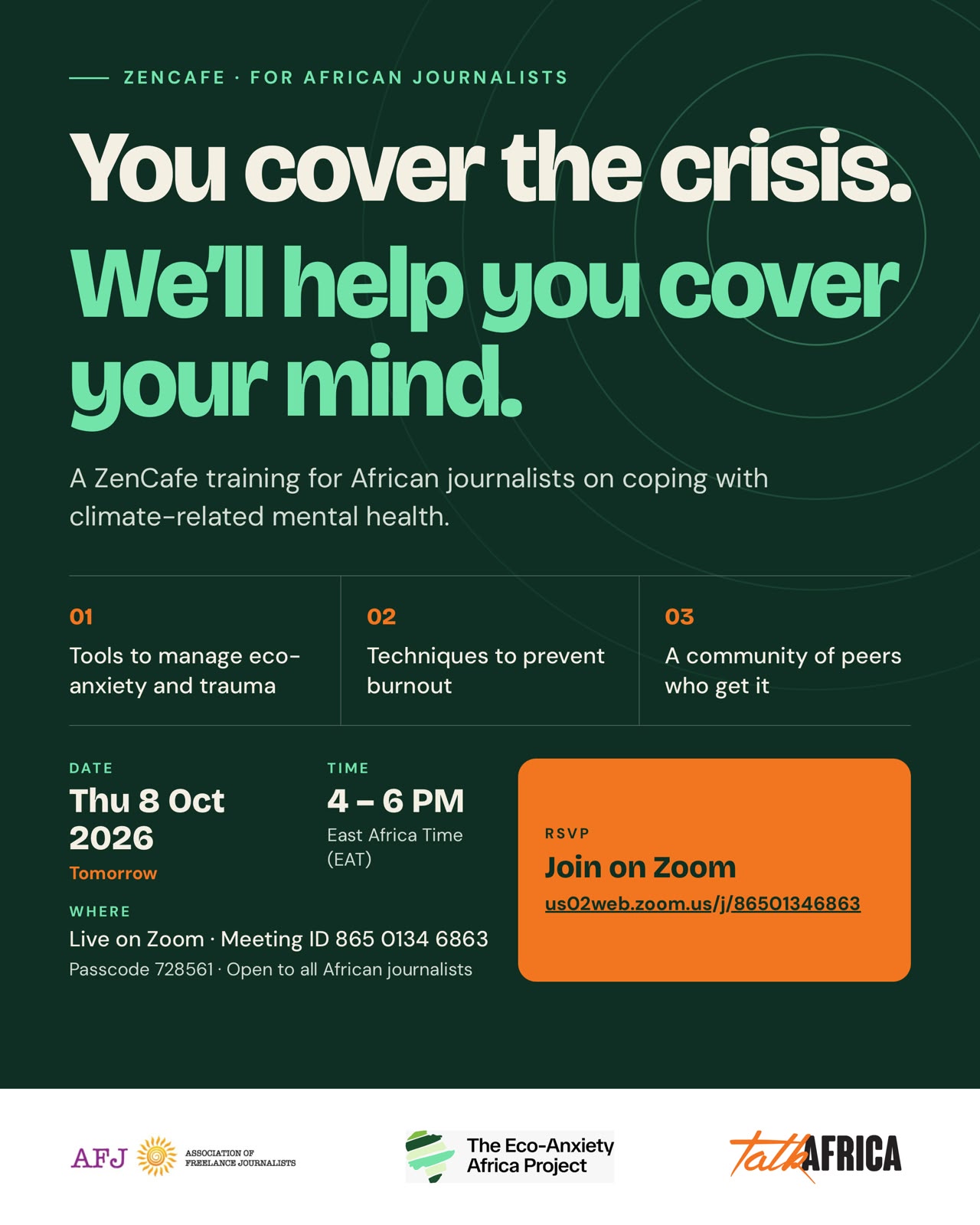
The virtual workshop, titled “ZenCafe for African Journalists,” was held via Zoom under the theme “The Eco-Anxiety Africa Project.” Jointly organized by Nigeria-based Sustyvibes, Talk Africa, and AFJ, it brought together journalists from Zambia, Ethiopia, Kenya, Uganda, Nigeria and DRC Congo among others.
In contrast to traditional media workshops focused on data collection and story crafting, this session prioritized the storytellers themselves, creating a safe environment where they could open up about their personal experiences.
 A message in the Zoom chat, “If it bleeds it leads,” highlighted the core dilemma facing reporters today: climate journalists are regularly exposed to tragedy, loss, and destruction, yet mainstream newsroom culture seldom provides the time or space needed to process emotional stress after an assignment.
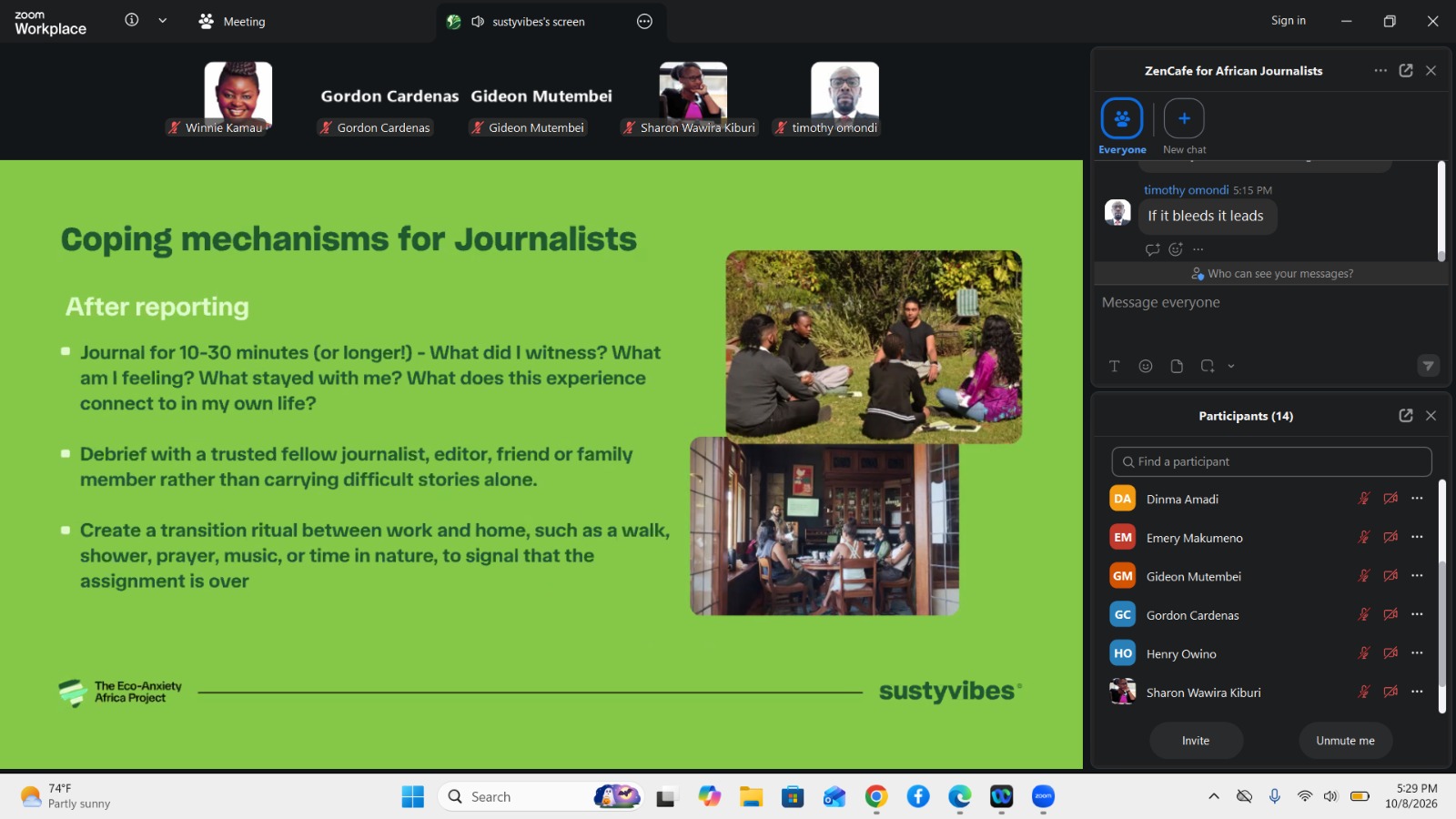
Three Immediate Tools according to slides shared by Sustyvibes, journalists were taught three practical steps to take after a difficult assignment.
First, journal for 10-30 minutes. Ask: What did I witness? What am I feeling? What stayed with me? What does this experience connect to in my own life? Second, debrief with a trusted fellow journalist, editor, friend or family member rather than carrying difficult stories alone. Third, create a transition ritual between work and home, such as a walk, shower, prayer, music, or time in nature, to signal that the assignment is over. Building Resilience and Knowing When to Seek help beyond the immediate coping, the session emphasized long-term resilience.
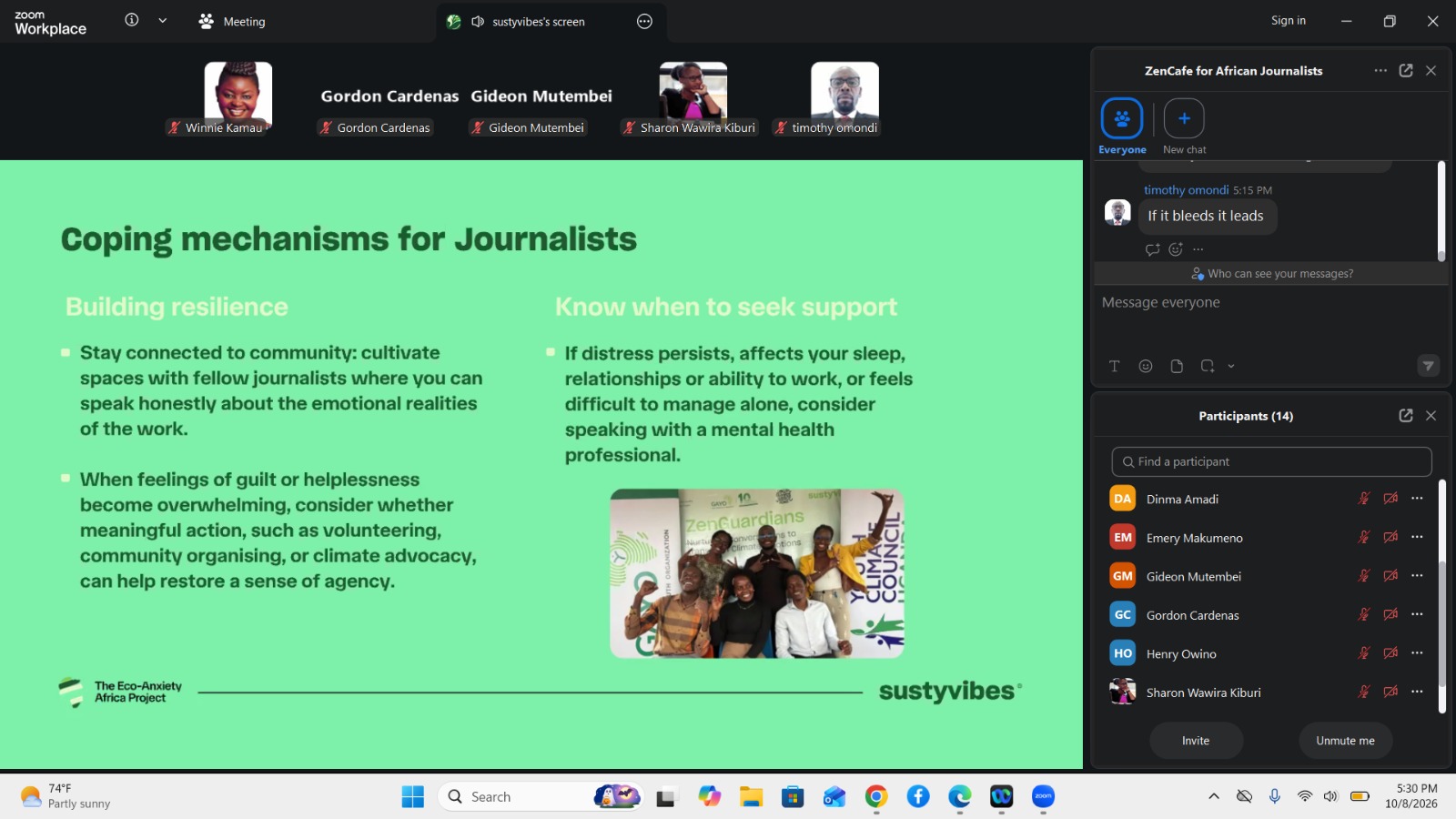
Journalists were urged to stay connected to community and cultivate spaces with fellow journalists where they can speak honestly about the emotional realities of the work
When feelings of guilt or helplessness become overwhelming which is a common experience after interviewing families members who have experienced loss occasioned by Climate change .
Participants were also advised to consider meaningful action such as volunteering, community organizing, or climate advocacy to help restore a sense of agency. Crucially, the training also addressed when to seek professional support.
“If distress persists, affects your sleep, relationships or ability to work, or feels difficult to manage alone, consider speaking with a mental health professional,” says Dinna Amandi, a professional therapist with ZENACAFE.
 This message holds profound importance across Africa, where findings indicate that environmental reporters experience significant job-related threats and elevated levels of post-traumatic stress symptoms. Despite these challenges, they remain among the least likely to receive psychological care—a gap especially pronounced for freelancers who lack access to organizational counseling resources.
Across the continent, where journalists continuously report on severe flooding and persistent droughts in semi-arid regions, institutional mental health support is virtually non-existent.
Programs such as The Eco-Anxiety Africa Project are stepping in to address this shortage, championing the view that journalist well-being is vital to the long-term sustainability of climate reporting.
As one attendee emphasized, resilience is not about suppressing emotion; it is about equipping reporters with the strategies needed to cover critical climate issues without compromising their mental well-being.
The workshop concluded by reminding participants that eco-anxiety extends beyond the individual level it can also be experienced collectively. As journalists witness the grief, anxiety, and uncertainty of communities firsthand, these shared struggles can become absorbed into their own emotional lives.
It became evident that journalists cannot shoulder the burden of saving the world on their own. Consequently, eco-anxiety evolves into both an individual struggle and a shared collective experience.