|
Getting your Trinity Audio player ready...
|
By Winnie Kamau
Nairobi, Kenya: In a recent edition of her TechPoint Africa newsletter, Victoria Fakiya posed a compelling thought “Imagine if your Wi-Fi came with a fuel gauge, and every YouTube video, Zoom call, or Netflix episode moved the needle closer to an extra charge. That is essentially the direction Kenya’s proposed Internet billing rules could take the country. The Kenya Information and Communications (Amendment) Bill, 2025, would require ISPs to measure how much data customers consume and bill them based on that usage, instead of the fixed monthly packages many households currently use”.
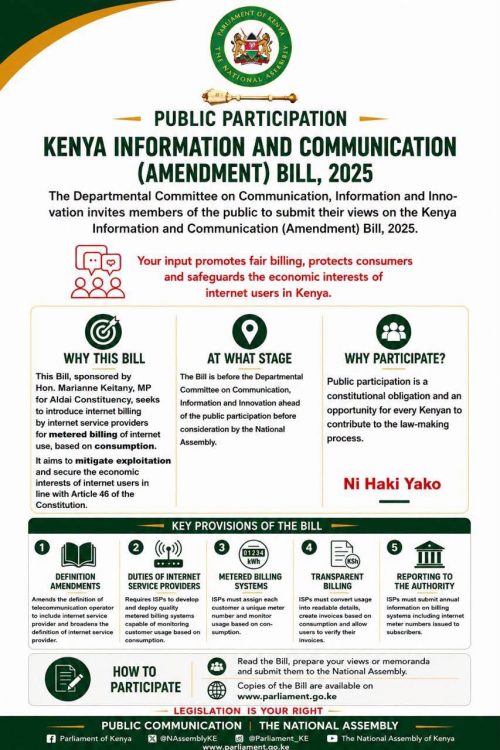
This got me thinking and wondering about the Kenya Information and Communications (Amendment) Bill, 2025. This proposed Bill sponsored by Aldai MP Marianne Keitany proposes requiring Internet Service Providers (ISPs) to measure subscribers’ data consumption and bill them according to actual usage, potentially changing the way Kenyans currently pay for fixed broadband services.
Instead of paying a predictable monthly fee for an unlimited or fixed package, customers could increasingly see their bills tied to how much data they consume.
ISPs Push Back
Fakiya notes “The proposal has already drawn concern from major industry players, including Safaricom, Jamii Telkom, Zuku, Poa Internet and Liquid. Service providers argue that mandatory metering would require significant investment in new technical infrastructure, including advanced billing systems and Deep Packet Inspection (DPI) technology”.
The industry fears that these additional operational costs could ultimately be passed on to consumers through higher internet bills.
The proposed changes also raise questions about the future of the unlimited fibre packages that have become increasingly important to households, businesses, students and remote workers.
Proposed billing rules raise questions over the future of unlimited internet, consumer costs and online privacy
The core advantage of unlimited broadband lies in its cost certainty, enabling subscribers to stream and browse without monitoring consumption. Introducing mandatory data tracking fundamentally disrupts this predictable pricing structure.
Then Comes the Privacy Question
Beyond the potential impact on prices and packages, the proposal has triggered concerns about what internet metering could mean for privacy.
The proposed legislation could mandate that ISPs assign unique meter numbers to subscribers and systematically track their real-time internet usage. This requirement also sparks concern over whether state authorities might gain access to such consumption data.
Additionally, the Bill would require cyber cafe operators to mandate user registration prior to granting access to computers or the internet. Such a requirement seems unreasonable, raising serious questions about why individuals relying on cyber cafes to bridge the digital divide should face these burdensome obstacles.
Digital rights advocates and legal experts have warned that combining detailed consumption records with network inspection technologies could create significant privacy concerns, particularly in relation to Article 31 of the Constitution of Kenya, which guarantees the right to privacy.
The concern is not simply how much data a person uses, but what detailed records of internet consumption could reveal about their digital lives.
Consumer Protection or Surveillance Risk?
Supporters of the proposed framework could argue that usage-based billing would make internet charging more transparent by allowing consumers to pay according to what they actually consume.
But critics are asking whether the cost of achieving that transparency could be too high.
The use of technologies such as DPI is particularly sensitive because network inspection can involve analysing traffic passing through an internet network.
This presents a complex regulatory dilemma: how can Kenya enhance billing transparency for internet services without establishing mechanisms that compromise subscriber privacy? Lawmakers will need to address this critical tradeoff as the bill moves through Parliament.
A connected country at a crossroads
The debate comes as Kenya’s demand for internet connectivity continues to grow.
Fixed broadband subscriptions reached approximately 2.66 million in the third quarter of the 2025/26 financial year, while mobile-first internet use continues to expand.
Internet connectivity is no longer simply about entertainment. For millions of Kenyans, it is infrastructure for work, education, business, communication, banking and access to government services.
A shift towards metered internet could alter how households budget for connectivity, how businesses manage digital operations and how students and remote workers use online services.
Consequently, these contemplated billing reforms carry significant implications that could reshape the financial landscape of Kenya’s fast-growing broadband sector.
Parliament Holds the Key
For now, the proposed changes remain just that a proposal as Parliament retains the power to amend, reject or approve the Bill. The debate therefore extends beyond how Kenyans pay for Wi-Fi. It raises a much bigger question about the country’s digital future:
Should internet access be treated like a utility with predictable monthly costs, or increasingly like a metered resource where every gigabyte counts?
And perhaps an even more important question: As Kenya builds a more connected society, how much should citizens have to reveal about their digital lives simply to stay connected?