|
Getting your Trinity Audio player ready...
|
By Winnie Kamau
Nairobi, Kenya: Kenya’s Rift Valley lakes, Baringo and Bogoria, are facing a severe survival crisis, with the distance separating the freshwater and alkaline bodies shrinking from 15 km to under 9 km in recent years.
With predictions of El Niño on the horizon, the Kenyan government has released an urgent alert about the looming crisis. As active evacuation mapping is verified by the Permanent Secretary for Environment, a viral TikTok science breakdown outlines the key drivers causing water levels across these Rift Valley lakes to persistently rise.
Ahead of the upcoming October–November-December (OND) expected to be amplified by a growing El Niño the Kenyan government cautions that its primary climate threat is not merely incoming rainfall; it is the massive accumulation of water from past seasons that remains trapped with no outlet.
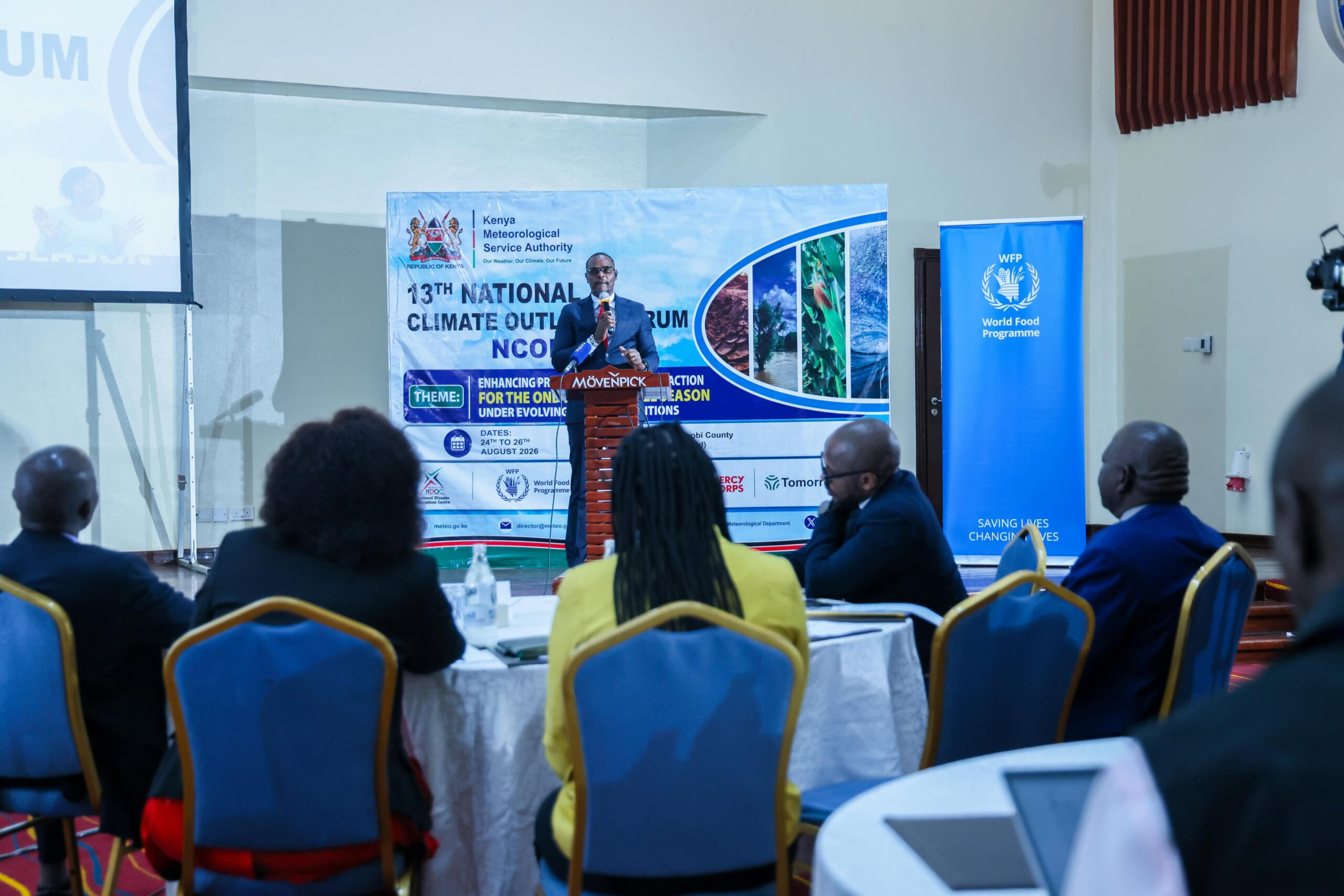
Eng. Festus Ng’eno, Permanent Secretary in the Ministry of Environment, addressed attendees at the 13th National Climate Outlook Forum. He warned that Rift Valley lakes, which have experienced rising water levels for years, are now nearing a highly critical threshold.
Highlighting several swollen Rift Valley bodies of water, PS Ng’eno noted that Lake Naivasha is “almost getting full,” Lake Nakuru continues to expand, islands in Lake Turkana have been submerged, and Lake Victoria faces ongoing encroachment. However, he emphasized that the most critical threat remains the rapidly closing divide between Lake Baringo and Lake Bogoria.
“It’s an ecological disaster. In 2020/2021, the distance separating the two lakes was around 15 kilometres. As we speak, that distance has narrowed to less than nine kilometres” said Eng. Ng’eno
‘Planning Early, Not Planning to Fail’
Ng’eno framed the government’s approach as a deliberate break from past practice, in which, he suggested, action typically waited for flooding to occur before losses were even quantified. He said ground teams are now mapping affected households around Baringo and Bogoria before the rains intensify — working out who may need to be evacuated to higher ground, and estimating the resources that will be required, ahead of time rather than after the fact.
“So, as the mapping is happening and the ministry of interior we have the NDOC disaster center for preparedness here. They are the ones who are coordinating and Kenya Red Cross are working closely to work out on those estimated figures that were early on in case they would be required they would be anything required to evacuate people. But we are working and planning early” said the PS.
He credited the Kenya Meteorological Service Authority (KMSA) with giving the government roughly two to three months’ notice of the El Niño outlook, and said the Ministry of Interior’s NDOC is coordinating directly with the Kenya Red Cross on evacuation planning and household-level impact estimates.
“When you don’t plan for an event, you are planning to fail. That is why the government is planning early.”
Citing the most recent KMSA update Ng’eno said the El Niño indicators were “very active,” citing a Niño 3.4 index reading of +2.7°C and what he described as roughly a 96% probability of a very strong El Niño event.
The Science: Why Do Rift Valley Lakes Keep Rising?
A widely shared TikTok explainer by Dr. Kimutai Katwa lays out the underlying mechanics behind the phenomenon the PS described and why it is proving so hard to reverse.
Rift Valley lakes, he explains, are “basin lakes” that collect at the lowest points of the valley floor. Because they sit at the lowest point of the surrounding landscape, they have no natural surface outlet for water to drain away with only two exceptions in the region, Lake Naivasha and Lake Baringo, which historically drained underground.
Dr katwa explained very well https://t.co/dQ8CZngeld pic.twitter.com/mbjJ3rhK3S
— Nyaf fx (@kichwa_) August 28, 2026
Every other Rift Valley lake relies on evaporation as its only way of losing water, which he notes is a slow and limited process compared to the volume of water flowing in.
“Think of an actual basin. When the bottom becomes heavily silted, the basin’s capacity is reduced. The same amount of incoming water then fills it much faster, causing it to spill over the sides” explains Dr. Katwa.
He attributes the rising water levels to a combination of factors compounding one another: siltation from poor agricultural practices and over-tilling upstream, which reduces the lakes’ storage capacity and can clog the underground drainage that lakes like Naivasha and Baringo once relied on; deforestation around the lakes, which increases surface run-off instead of letting rainfall soak into the ground.
Adding climate change, which he says is producing drier dry seasons and wetter wet seasons which are pushing more water into the lakes during increasingly intense rainy periods. He describes it as “a circular problem that is caused by overpopulation around the lakes, and also whose impact is worsened by overpopulation around the lake.”
What’s Actually at Stake if Baringo and Bogoria Meet
The reason the Baringo-Bogoria case draws particular alarm, according to Katwa’s explainer, is chemistry as much as geography: Lake Baringo is freshwater and Lake Bogoria is alkaline. A merger of the two, he says, risks collapsing both of their distinct ecosystems.
“If the two lakes merge, the mixing of alkaline and freshwater could disrupt and potentially collapse their unique ecosystems” warns Dr. Katwa.
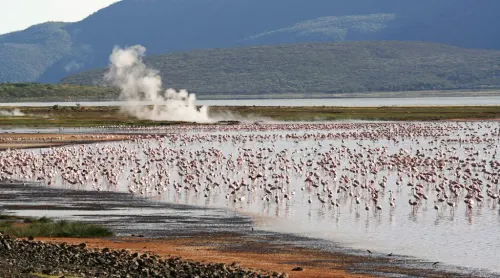
Concretely, he points to two things that would be put directly at risk: the Perkerra Irrigation Scheme, which depends on Lake Baringo’s fresh water, and the flamingo populations at Lake Bogoria, which depend on its alkaline conditions and are among the lake’s best-known tourist attractions.
Key Facts
Lake Baringo is a freshwater lake that provides critical support for local fisheries and farming, including the Perkerra Irrigation Scheme, alongside wildlife like hippos and crocodiles. A freshwater inflow disruption or alkaline contamination from Lake Bogoria would degrade water quality, damaging aquatic life and agricultural output.
Lake Bogoria is famous for its hot springs, geysers, and expansive flocks of lesser flamingos, Lake Bogoria relies on a highly alkaline and saline environment. Dilution from Lake Baringo’s fresh water would endanger the specialized algae flamingos feed on, threatening local ecotourism and driving the birds elsewhere.
As a key mitigation strategy to prevent an ecological crisis, Kenyan authorities are planning engineering interventions, including protective dykes and drainage channels. These measures aim to stop the imminent merging of Lake Baringo and Lake Bogoria.