
|
Getting your Trinity Audio player ready...
|
By Mercy Kachenge
Nairobi, Kenya: A stem of flower grown in East Africa might log thousands of kilometers traveling to Europe prior to being re-exported back to an African customer. A costly trade route that horticultural leaders say exposes the price of Africa’s fragmented markets.
Clement Tulezi, Secretary General of the newly launched Horticulture Council of Eastern Africa (HoCEA), cited the example of flowers needed by an importer in Ghana being shipped to the Netherlands before being imported into Ghana, despite the flowers originating in Kenya or Ethiopia.
For East Africa’s horticulture industry, the problem is therefore no longer simply producing enough flowers, fruits and vegetables for export. It is whether the region can move those products directly, cheaply and efficiently across African borders.
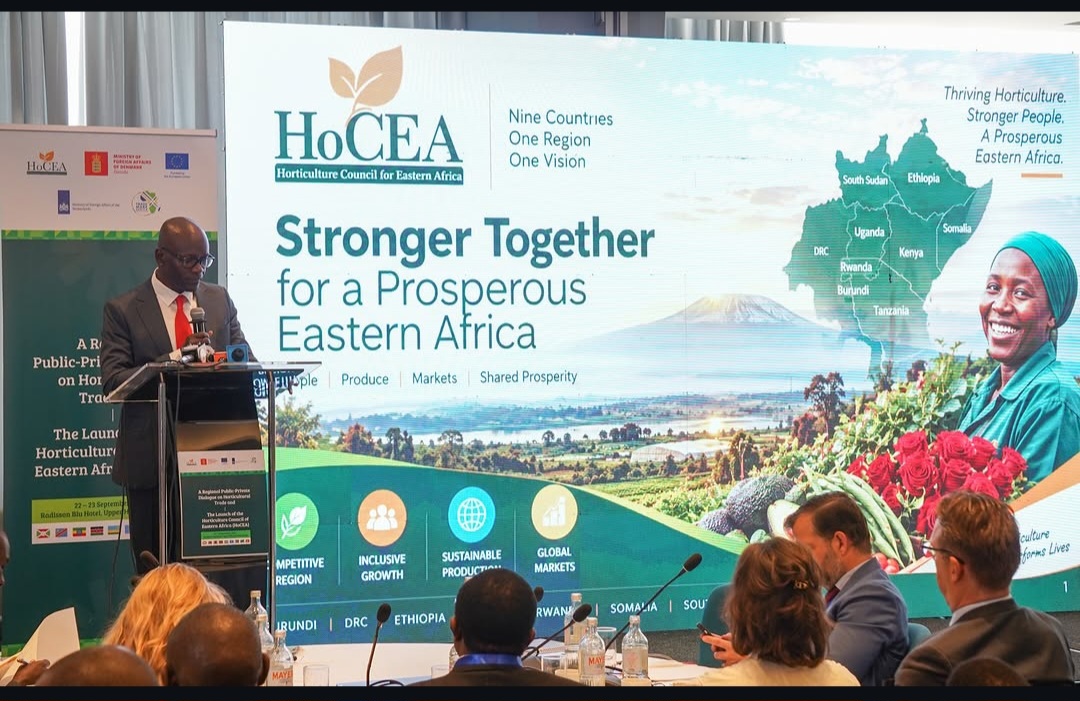
The launch of HoCEA brings together the horticulture industry across nine East African countries in an attempt to address that challenge through a unified private-sector voice. The council intends to push for the removal of trade barriers, harmonisation of standards, improved logistics, stronger regional markets and greater participation of East African producers in international trade negotiations.
The ambition is to change how the region competes: from nine countries negotiating separately to one horticultural bloc using its combined production and consumer market as bargaining power.
“If we put our collective voice together, then we have leverage over this,” Tulezi said.
The urgency comes as horticultural businesses face a combination of rising freight costs, geopolitical disruptions, technical barriers to trade and increasingly demanding international market standards.
Antaria Uwamariya, Director of Business and Competitiveness at Trademark Africa and leader of its pilot project in North Africa, said the sector had experienced repeated shocks in recent years, including COVID-19, geopolitical conflicts and rising logistics costs. She said the industry could no longer operate from an individual-country perspective.
“We are not competing at the individual countries alone. We are competing at a global level,” Uwamariya said.
Her argument reflects a central challenge facing East African horticulture: improving efficiency in one country is not enough when producers are competing against suppliers from other regions that may have lower logistics costs, better infrastructure or more integrated markets.
Uwamariya urged the sector to use regional cooperation to consolidate markets, share technology and strengthen resilience while reducing the costs associated with accessing international markets. She said the region needed to build stronger partnerships from the national level to the regional and continental levels.
For HoCEA, that regional approach is particularly important because horticulture is different from many other commodities. Produce is perishable, meaning that delays at collection centres, borders, airports or other points along the supply chain can quickly become financial losses.
Dr. Jacqueline Mkindi, chairperson of HoCEA, said the council was established as a unified voice for horticulture in Eastern Africa. She said HoCEA would focus on cross-cutting problems including logistics, technical barriers to trade and inefficiencies within systems and institutions.
The council’s agenda is captured in its ambition to “produce nationally, conduct regionally and compete globally.”
Mkindi said the region needed to work together to develop practical and innovative market solutions that would allow farmers to remain in business and benefit from regional integration.
One of the biggest problems is occurring before produce even reaches the market. HoCEA estimates post-harvest losses in the horticulture sector at between 30 %and 50%.
Mkindi said the council would respond through capacity building for farmers and other value-chain actors, as well as mobilisation of resources for infrastructure. The proposed interventions include collection facilities at farm level and chilling facilities at airports.
The approach is intended to address losses across the entire chain, rather than treating post-harvest losses as a problem that begins only after harvesting. The council also plans to advise governments on improving the handling and movement of perishables while helping farmers understand traceability requirements and market protocols.
But infrastructure alone will not solve the region’s market-access problem. A second battle is taking place around the rules governing who gets access to international markets and on what terms.
Mkindi said East African producers had traditionally been recipients of standards developed elsewhere, while having limited influence over how those standards were formulated.
“We want to participate in the standard formulation,” she said.
The council intends to take the concerns of East African farmers and exporters to international negotiations with standard-setting bodies. Rather than waiting for new standards to reach African producers, HoCEA wants the region to have a seat at the table where those standards are developed.
Esther Nekambi, HoCEA treasurer, said the council also plans to work towards harmonising standards across East Africa. She said common standards would make it easier for producers to trade within the region while also strengthening their ability to access markets across Africa and beyond.
Nekambi said HoCEA wants to see weaker horticultural economies in the region build their capacity alongside stronger ones. The council has set an ambition of achieving tenfold growth over the next five years, supported by unified standards, removal of non-tariff barriers and stronger private-sector participation in trade negotiations.
The regional market itself could provide an important part of that growth. Nekambi said the region needed to recognise the opportunities created by its combined population and purchasing power.
The argument is that East Africa should not view international export markets as the only destination for horticultural growth when millions of potential consumers already live within the region.
That would require making regional trade protocols easier for small businesses and farmers to understand. HoCEA plans to identify relevant protocols across regional economic blocs and translate them into simpler, user-friendly manuals and tools that can help horticultural value-chain actors understand and benefit from regional integration.
The private sector is also looking to governments to turn existing regional agreements into practical trade opportunities.
Matthew Kipchumba, representing Kenya’s State Department for Trade, said the government welcomed the emergence of a regional private-sector platform. He said the horticulture industry had reached a point where private-sector players were increasingly thinking beyond national markets.
The government, he said, would work with the private sector on policy changes and negotiations aimed at improving market access. Kenya is seeking opportunities in markets including the European Union, the United Arab Emirates and the United States, while also pursuing greater participation in African markets.
But for exporters already struggling with the cost of doing business, access to a market is meaningless if the cost of reaching that market wipes out competitiveness.
The flower industry is already feeling that pressure. A representative of the flower sector said growers and exporters across the region were struggling with rising freight costs and geopolitical disruptions. The sector, he said, was currently focused more on survival than expansion.
He said regional freight costs had risen to levels that were making some horticultural products uncompetitive.
The industry is also seeking changes to Kenya’s tax environment. Tulezi said the Kenyan flower industry alone is owed approximately KSh12 billion in VAT refunds, with some claims dating back two or three years. He said some companies were owed more than KSh2 billion each.
The delayed refunds, according to Tulezi, are putting pressure on businesses that require cash flow to continue operating. He said the voucher system offered as an alternative to cash refunds had not resolved the problem for many businesses because of restrictions on how the vouchers could be used.
The industry is therefore calling for a mechanism that would allow the outstanding refunds to be resolved before the accumulated debt becomes even larger.
The VAT dispute illustrates the kind of national-level problem that HoCEA hopes to carry into a broader regional conversation: issues that begin in individual countries but ultimately affect the competitiveness of the entire regional horticulture value chain.
Uwamariya similarly called for stronger links between national institutions, regional organisations and continental initiatives. She said the sector needed to move from country-by-country approaches towards a regional bloc capable of negotiating from a stronger position.
For East Africa’s horticulture industry, the significance of HoCEA will ultimately depend less on the launch itself and more on whether the new council can turn regional cooperation into lower trade costs, fewer barriers and more direct routes to markets.
The council now faces the task of translating existing regional and continental trade instruments into practical benefits for farmers, exporters and consumers. East Africa already has regional integration frameworks. The challenge is making those frameworks work consistently at borders, in markets and throughout supply chains.
If HoCEA succeeds, the test will not simply be whether East Africa exports more horticultural products. It will be whether a flower grown in Kenya, Uganda, Ethiopia or another East African country can reach a customer in another African market without first having to take the long way around.
That is the economic question behind the council’s launch whether East Africa can turn the scale of its combined horticulture industry from a collection of national strengths into one regional bargaining force.