|
Getting your Trinity Audio player ready...
|
By Omboki Monayo
Nairobi-The global conversation on nature has shifted from an ecological concern to an economic imperative.
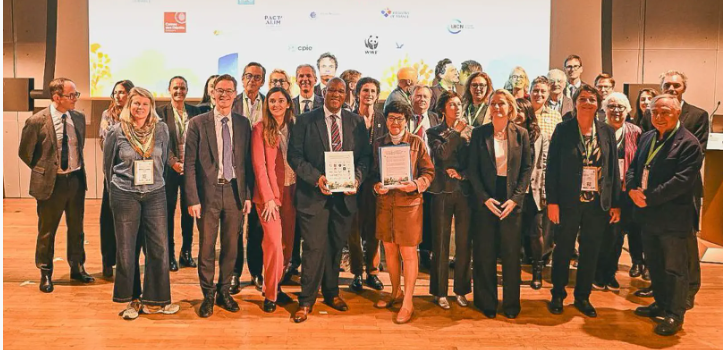
At the Biodiversity and Economy Forum at the Cité des Sciences et de l’Industrie in Paris, more than 30 networks representing business, finance, civil society and public authorities signed a joint declaration responding to findings by the Intergovernmental Science-Policy Platform on Biodiversity and Ecosystem Services (IPBES), often called the “IPCC for biodiversity”. Its core message is that no business can survive for long in a degraded natural environment.
The declaration comes after the UN Biodiversity Conference (COP17) in Yerevan, Armenia, where negotiators from 182 parties adopted the “Yerevan Pathway”, acknowledging that current efforts fall short. The talks put the spotlight on the Kunming-Montreal Global Biodiversity Framework (KMGBF), which aims to halt and reverse nature loss by 2030. Its Target 3, the “30 by 30” goal, commits countries to effectively conserve 30% of terrestrial, inland water, and coastal and marine areas.
Monique Barbut, France’s Minister for Ecological Transition, Biodiversity and International Climate and Nature Negotiations, stressed the urgency at the forum. “No business can lastingly thrive in a degraded natural environment. Preserving biodiversity must therefore be fully integrated into economic choices, business strategies and investment decision-making,” she said. “Science provides us today with the tools for action. We must seize them and unite the efforts of businesses, governments and financial actors.”

For Kenya, this is not distant policy. Olivier Thibault, Director General of the French Biodiversity Agency (OFB), put it plainly: “Businesses are not only affected by biodiversity loss: they depend on biodiversity, and they can help to halt its decline.”
That dependence is clearest along Kenya’s roughly 600-kilometre coastline, an economic and ecological engine of coral reefs, mangroves, sea turtles, dolphins and whales. Yet [global shipping lanes overlap with 92% of critical marine habitats], and fishing gear regularly entangles marine life. For coastal tourism and the wider blue economy, the collapse of these habitats is a direct financial risk. Globally, [more than half of GDP depends on nature], and the loss of coastal resources threatens millions of local livelihoods.
Kenya is responding. Principal Secretary for Environment and Climate Change, Dr. Eng. Festus K. Ng’eno, has confirmed that the country is aligning its National Biodiversity Strategy and Action Plan (NBSAP) with the global targets. Kenya has also signed the Nairobi Convention Protocol on Marine and Coastal Biological Diversity and Protected Areas, a legally binding regional instrument that obliges parties to establish, manage and protect marine sanctuaries. It prohibits activities that damage the marine environment, including unregulated coastal development, destructive fishing and land-based pollution, while respecting the traditional rights of local fishers. At home, Article 69 of the Constitution and the Environmental Management and Co-ordination Act (EMCA) keep business within ecological limits.
IPBES Executive Secretary Dr. Luthando Dziba told the Paris forum that the biodiversity crisis should be seen as an opportunity for transformative change. “Every business depends on nature, and every business has a role to play in protecting it,” he said. “The IPBES Business and Biodiversity Report has brought clarity, based on the best-available scientific evidence, about options for meaningful and effective business action on nature.”
Kenyan firms are showing that profit and conservation can coexist. SunCulture, a Kenyan climate-tech company, supplies solar-powered irrigation that reduces farmers’ reliance on fossil-fuel pumps and helps smallholders cope with erratic weather without clearing more wild land.
Equity matters too. Lucy Mulenkei, a Maasai leader and co-chair of the International Indigenous Forum on Biodiversity, told the Yerevan negotiations that real progress means moving from symbolic recognition to structural authority. Of the Sevan Guidelines, which set the rules for a permanent body to safeguard Indigenous peoples’ rights, she said: “It gives us a proper seat at the table, but it’s taken too long.” Conservation cannot rest on top-down mandates alone, she argued; the communities who have stewarded nature for generations must govern their ancestral ecosystems.
Turning global frameworks into domestic practice will take cooperation among government, pioneering green businesses like SunCulture, and local communities. By enforcing its policies, honouring Indigenous leadership, and using the best science, Kenya can turn the lessons of the IPBES assessment into lasting, nature-positive growth.