|
Getting your Trinity Audio player ready...
|
By Henry Owino
Nairobi, Kenya: Kenyans are hereby warned to prepare for heavy downpour starting in June this year as the El Niño weather pattern returns. New forecasts show that chances are rising that it could become historically stronger compared to previous years.
Weather experts said that if El Niño continues developing as predicted, it is likely to rank among the top five strongest El Niño events in the past 44 years. However, it may not be as strong as the 1997 and 2015 events.
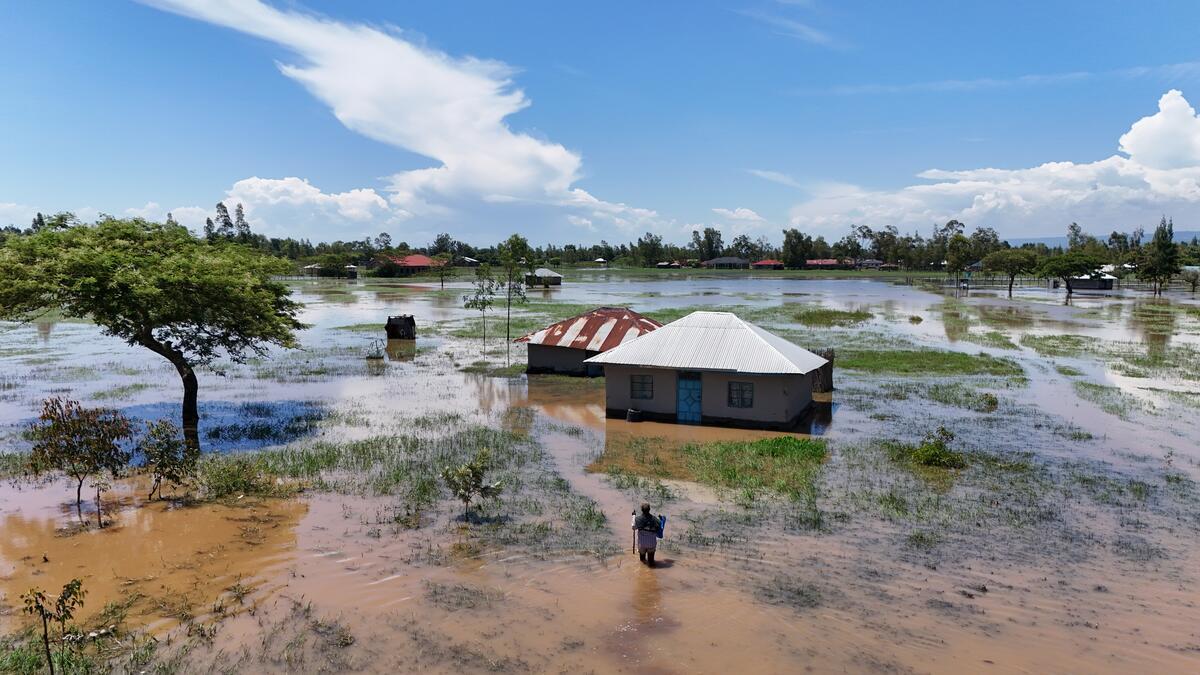
This caution should be worrying for Kenyans and the government to prepare in advance to contain its impact. This is especially where past El Niño events have triggered deadly flooding that displaced thousands of families.
In Kenya’s capital, Nairobi, flood-prone locations include Madaraka, Nairobi West, Lang’ata, Kawangware, Kangemi, Lavington, Westlands, Parklands, Kitisuru, Spring Valley, Kileleshwa, and Chiromo, areas situated along upstream and midstream sections of the river network. Western Kenya’s most flood-affected counties are Kisumu, Homabay, Busia, and Migori, among other regions of Kenya.
According to the US Climate Prediction Centre, there is a likelihood the phenomenon will begin between May and July and extend into next year.
“El Niño is likely to emerge soon, thus 82% chance in May to July 2026 and continue through the Northern Hemisphere winter 2026-27. Again, at 96% chance in December 2026 to February 2027,” the Centre said in a statement.
It added that while confidence in the occurrence of El Nino, it has increased since April. There is still substantial uncertainty about the peak strength of El Niño, with no strength categorization exceeding a 37% chance.”
Origin and Impacts
El Niño is a naturally occurring climate phenomenon characterized by the warming of sea surface temperatures in the central and eastern tropical Pacific Ocean. The event typically recurs every two to seven years, disrupting global atmospheric circulation, altering weather patterns, agricultural yields, and temperatures worldwide.
The impacts of El Niño vary by region, and stronger events typically trigger more pronounced weather anomalies. In Kenya, it often brings heavy rains and high temperatures, causing floods killing dozens, wash away crops, and destroy property worth millions of shillings, forcing people to flee with nothing.
In most other parts of the world, it brings drought, leading to deaths of livestock, outbreaks of diseases, just to mention a few impacts.
The World Meteorological Organization (WMO) recently warned that El Niño affects global rainfall patterns and can increase rainfall across the Horn of Africa, of which Kenya is a part.
“After a period of neutral conditions at the start of the year, climate models are now strongly aligned. There is high confidence in the onset of El Niño, followed by further intensification in the months that follow,” said Wilfran Moufouma Okia, Chief of Climate Prediction at the WMO, in a statement.
Several recent scientific and media analyses suggest ocean temperatures are warming fast enough to potentially produce a “super El Niño”, a term commonly used for exceptionally strong events,
However, a recent analysis published by the University of Colorado said El Niño is only likely to be the fifth strongest since 1982.
“Since 1982, when satellite measurements of ocean temperature began, there have been at least four very strong El Niño events: 1982-83, 1997-98, 2015-16, and 2023-24. Based on current forecasts, if an El Niño develops this year, it will be the fifth since 1982,” the analysis said.
Kenya has suffered severe damage during previous El Niño events. The 1997-98 El Niño remains one of the country’s worst weather disasters.
For instance, floods swept through Nyanza, Coast, North Eastern, and Rift Valley, washing away roads and bridges and cutting off entire communities.
Thousands of families were displaced, while outbreaks of malaria, cholera, and Rift Valley fever were reported in several areas.
Research published on the impacts of the 1997-98 El Niño rains in the Mount Kenya region described the rainfall as “extraordinarily heavy rainfall” that lasted nearly 10 months and caused extensive destruction to farms and infrastructure.