
|
Getting your Trinity Audio player ready...
|
By Lenah Bosibori
People in Northern Kenya who are drought hit are the biggest beneficiaries of solar dried vegetables and fruits.
Kamae, Nyandarua- On the misty slopes of Mount Kenya, where the cold morning air often keeps people indoors, Robert Chege a store keeper at Food Banking Kenya (FBK) is already awake. At 65, he rises before dawn, and by 7 a.m. he is unlocking the doors of FBK store in Kamae, Nyandarua County.
One by one, small-scale farmers arrive; balancing sacks and crates of surplus vegetables harvested from their farms. Chege records each delivery carefully by indicating the names, quantities and dates determined that nothing edible should go to waste. For him, managing the food bank is more than routine work but a commitment to making sure food grown with effort does not rot unseen.
Located about 20 kilometres roughly a two-hour drive from Nairobi, the Kamae food bank serves as a collection point for farmers donating excess fruits and vegetables daily from their farms. At least twice a week, trucks from FBK arrive to ferry the produce to Nairobi for further processing and redistribution.
By the time I arrived at around 11 a.m, Chege had received only five crates of kale and five sacks of spinach far less than usual. He blamed the low volumes on the ongoing dry season.
“When harvests are good, farmers bring as much as they can,” Chege said. “But this January’s scorching heat and prolonged dry spells have changed that. It’s the ideal weather for drying food and the worst time to find surplus.”
Turning sunlight into sustenance
Food Banking Kenya is a non-profit organization working to tackle hunger while reducing post-harvest food losses. It collects surplus, safe, and nutritious food from small-scale farmers, markets, and food processors, food that would go to waste and redistributes it to vulnerable communities, including informal schools, shelters, and organizations supporting people with disabilities.
To preserve perishable produce, FBK relies on solar drying, a low-cost, climate-friendly solution that extends shelf life and allows food to reach remote, food-insecure regions such as Turkana, Marsabit, Isiolo, and Wajir in northern Kenya.
At the heart of the Kamae food bank is a solar dryer mounted on the rust-red corrugated iron roof of a storage container. A rectangular solar panel about 300 to 350 watts sits angled toward the sky, positioned to capture maximum sunlight throughout the day. Its dark photovoltaic cells contrast sharply with the weathered roof, quietly converting sunlight into electricity that powers food preservation below.
Behind it, two white-paneled solar dryer units rise like small sheds of simple structures that signal something powerful: renewable energy woven directly into food security.
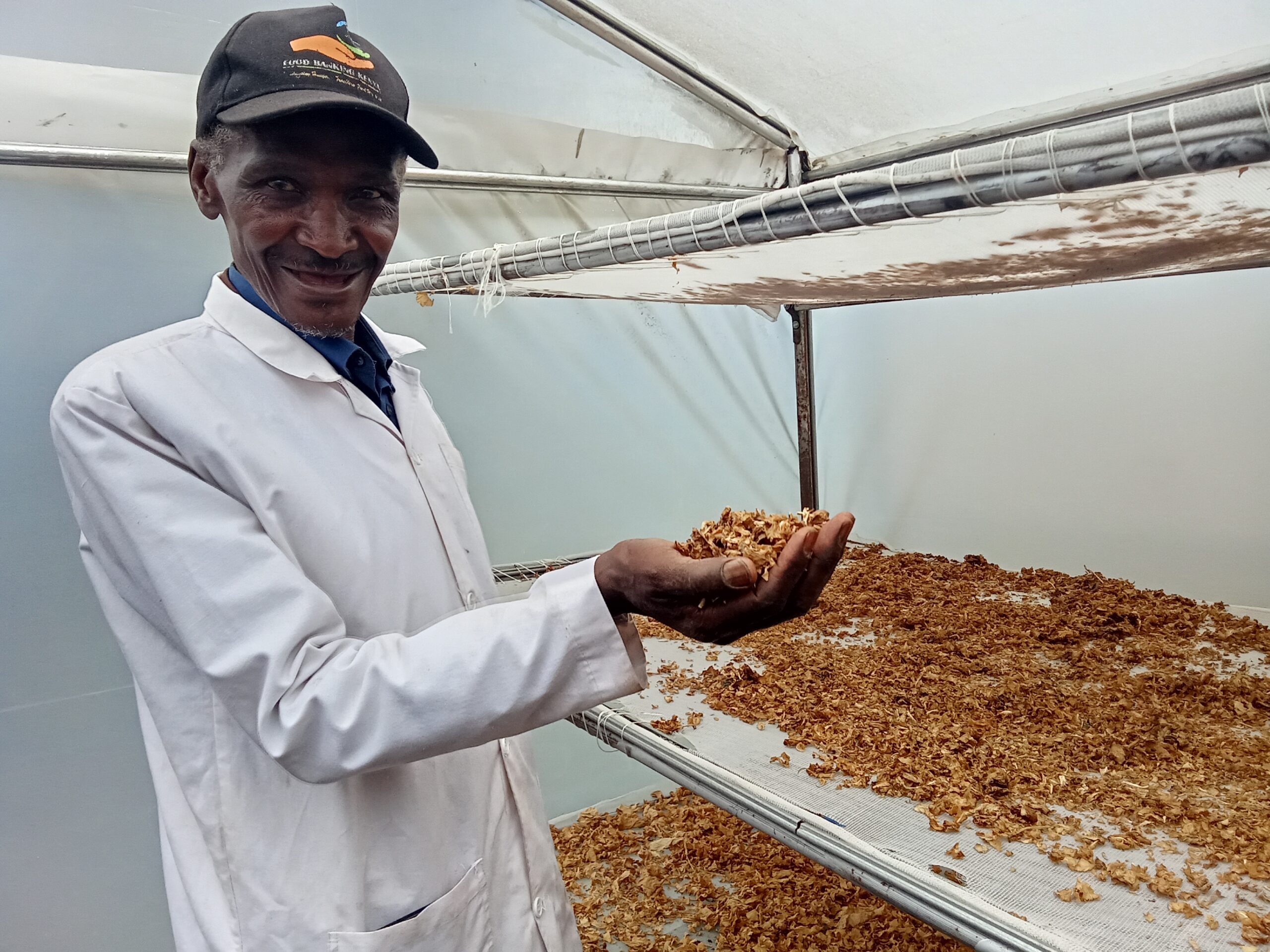
Inside the drying chambers, fresh vegetables are transformed into long-lasting nourishment. Chopped spinach, cabbage, kale, carrots, and Irish potatoes are first blanched briefly in hot, lightly salted water to preserve nutrients and colour. They are then laid out on trays, where gentle solar heat rather than harsh direct sunlight slowly removes moisture, preserving the vegetables for weeks or even months.
“When the sun is strong, food dries in about three days,” Chege said. “In a month, we dry around 30 to 40 sacks. Once dried, the vegetables shrink, but one sack represents a large amount of fresh produce.”
From farm to far north
Wycliffe Aswani, a logistics officer at FBK, oversees food collection from farms, depots, and supermarkets. From Kamae, he says, collections happen once a week because much of the food is already dried.
“Here, we receive, register, and measure the donations before drying or transporting them,” Aswani explained.
FBK trucks fitted with coolers transport both fresh and dried food safely. “According to our estimates, one kilogram of dried vegetables is equivalent to about six kilograms of fresh produce,” he noted. “That’s why dried food makes sense for long-distance transport.”
Most of the dried vegetables from Kamae are sent to northern and northeastern Kenya, where access to fresh produce is limited and diets are often restricted to cereals and milk. “This helps supplement nutrition and reduce malnutrition, especially among children,” Aswani said.
Before FBK introduced solar dryers and refrigerated trucks, much of the food collected from farmers spoiled before reaching Nairobi. “Solar dehydration has significantly reduced waste,” Aswani said.
The urgency of this work became clear during a phone call with John Gathungu, FBK’s executive director, during the Christmas season, a time when demand for food assistance spikes sharply.
“We are trying to ensure as many families as possible have something to eat this Christmas,” Gathungu said, his phone buzzing with incoming calls.
When asked about linking up with beneficiaries in northern Kenya, he paused. “The moment you call a Member of Parliament from Isiolo or Marsabit, they assume food is ready for collection,” he explained.
That hesitation revealed a painful truth: Kenya has food, but too few systems to preserve it and move it efficiently to those who need it most. That gap is exactly what FBK is trying to close.
A nation of surplus and hunger
According to a 2025 World Resources Institute (WRI) Africa report, about 15 million Kenyans—28 percent of the population face food insecurity. At the same time, 30 to 40 percent of all food produced in the country is lost or wasted between farm and table.
Each year, Kenya loses an estimated 9 million tonnes of food worth KSh 72 billion (US$578 million) Food loss and waste in maize, potato, fresh fruits, and fish value chains in Kenya | WRI Africa
The report further adds that fresh fruits suffer the highest losses, with up to 56 percent wasted. Mango losses range between 17 and 56 percent, followed by avocados (15–35 percent) and bananas (7–11 percent). Staples are not spared: 36 percent of maize, 34 percent of fish, and 23 percent of potatoes are lost along value chains.
These losses deepen food insecurity, erode farmer incomes, raise household food prices, and increase greenhouse gas emissions. WRI Africa estimates that halving food loss and waste by 2030 could feed more than seven million people annually, recover KSh 36 billion, and cut over seven million tonnes of carbon emissions.
From dried vegetables to healthier children
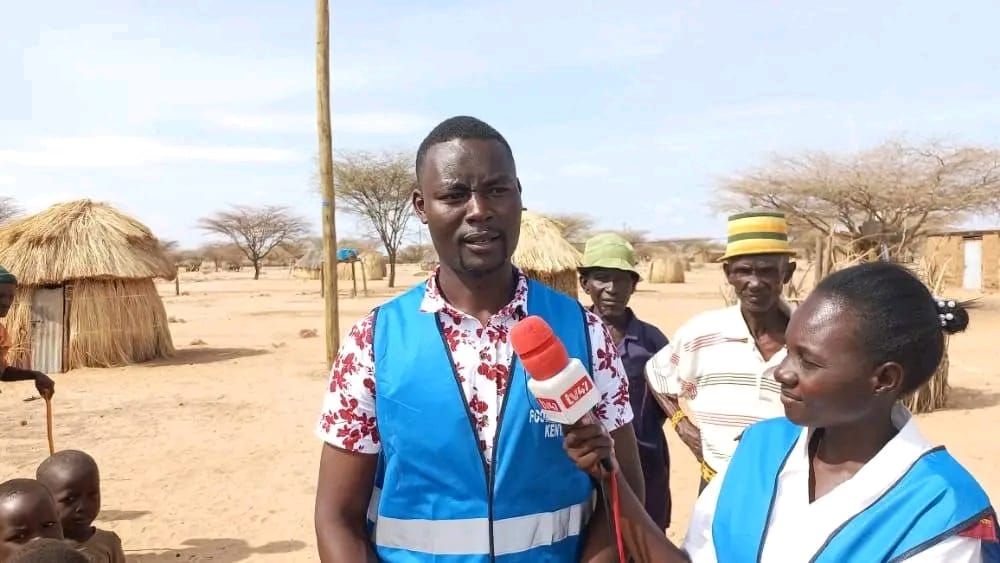
Hundreds of kilometers north of Kamae, in Turkana County, Emmanuel Letungo is seeing the impact of those dried vegetables firsthand.
A father of five, Letungo remembers how his family reacted when the dried food was first introduced.
“At first we did not know what to expect,” he said in a phone interview. “We were hesitant.” But over time, curiosity turned into routine and routine into appreciation. “My children now love the dried spinach, especially when we eat it with fermented milk,” he said.
He has also noticed a change in their health. “Since I started feeding them the dried vegetables, I have seen many improvements. They rarely get sick now. Before, we used to visit health centres quite often.”
During festive seasons, warehouses are often cleared within days as community groups seek assistance. FBK now focuses on informal and makeshift schools after suspending operations in public schools within Nairobi following the rollout of County’s Dishi na County programme.
“About 13 percent of food globally is lost post-harvest,” Gathungu said. “With better training, technology, and data, we can stop food from going to waste and get it to people who need it most.”
Why food is lost and how drying helps
According to Dr. Eng. Erick K. Ronoh, a lecturer in Agricultural and Biosystems Engineering at Jomo Kenyatta University of Agriculture and Technology (JKUAT), post-harvest food loss in Kenya is largely structural.
“Poor rural road networks, limited storage and processing facilities, and fragmented value chains make it costly and inefficient to move surplus food from production areas to deficit regions,” he said.
High transport costs, weak market coordination, and limited access to value-addition technologies mean food often spoils before it can be sold, stored, or redistributed.
“Food dehydration, especially of fruits and vegetables, offers a practical response, particularly in remote and arid regions Dr Ronoh said. “By removing moisture, drying slows microbial growth and extends shelf life from a few days to several weeks or months.”
Solar-powered dehydration, he added, is especially effective in off-grid areas, eliminating the need for cold chains while allowing nutritious food to be transported over long distances and consumed year-round.
From a nutrition standpoint, dehydrated foods have notable advantages according to Dr Ronoh. “When water, which makes up 80 to 95 percent of fresh produce is removed, nutrients such as fiber, iron, potassium, and magnesium become more concentrated per gram,” Dr Ronoh explained.
When done properly, dehydration causes minimal nutrient loss compared to canning or freezing. Dietary fiber remains largely intact.
However, he cautioned that heat-sensitive vitamins such as vitamin C and some B vitamins can be reduced, and sugars and calories become more concentrated making portion control important.
Food safety is also critical. Low moisture levels inhibit bacterial and mould growth, allowing dried foods to be stored for long periods without refrigeration. Still, dehydration is not a complete “kill step.”
“Proper blanching, hygienic handling, airtight packaging, and storage are essential,” Dr Ronoh said. Beyond reducing waste, food banking and preservation models help communities adapt to climate shocks such as drought.
“Instead of relying on repeated emergency food aid, these models allow communities to store surplus during good seasons, diversify diets, and maintain access to nutritious food during lean periods,” he said.
To scale such initiatives sustainably across Kenya, Ronoh emphasized the need for clear food donation and liability protection laws, fiscal incentives for donors, integration with county and national food strategies, and investment in public-private partnerships for storage, transport, and processing infrastructure.
“Equally important are strong research and data systems, farmer capacity-building and digital tools that improve logistics and coordination,” he added.
On the slopes of Mount Kenya, as the sun climbs higher and the solar panels quietly do their work, food that once risked being wasted begins a new journey of drying, storing, travelling north, and finally reaching homes where it nourishes not just bodies, but resilience itself.
This story was produced with the support of the African Centre for Media Excellence (ACME) in partnership with the Charles Stewart Mott Foundation.