|
Getting your Trinity Audio player ready...
|
By Winnie Kamau
Nairobi, Kenya: Millers warn of the steepest production decline in years and want a nine-month duty waiver on white maize. The government is fast-tracking yellow maize for animal feed and scouting Zambia and Tanzania even as its own food authority warns global supplies may not be there to tap.
Agriculture and Livestock Development Cabinet Secretary Sen. Mutahi Kagwe is weighing a request from cereal millers for the duty-free importation of 3 million metric tonnes of white maize, as Kenya confronts a seven-year production low and moves to shield consumers from sharp increases in the price of maize flour.
At the same time, the Government is moving ahead with gazetting the importation of 360,000MT of yellow maize specifically for animal-feed manufacturing, a move designed to take pressure off the country’s white maize supplies.
The Steepest Decline in Production
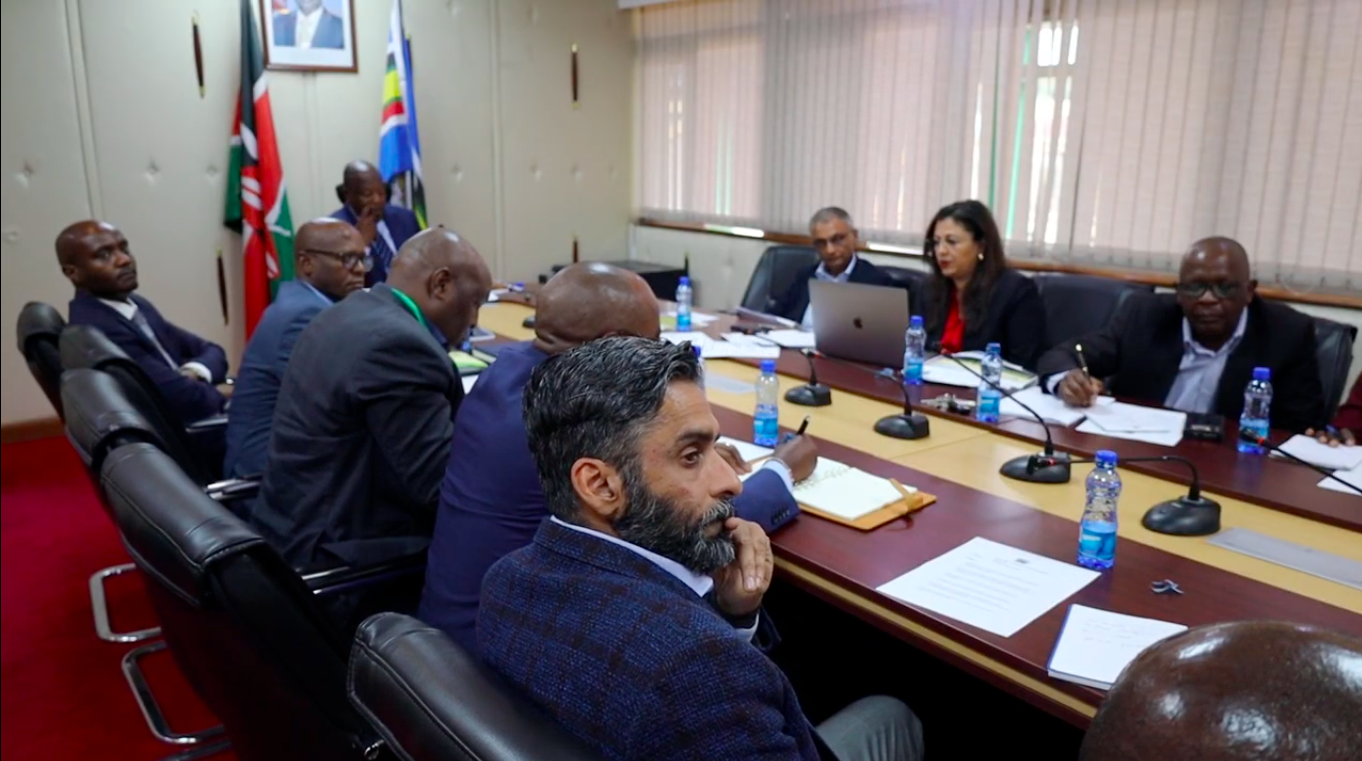
Speaking at a grain-sector meeting convened by CS Kagwe, Cereal Millers Association (CMA) CEO Paloma Fernandes said Kenya is facing a seven-year low in maize production, with only six major producing counties expected to deliver more than one million bags this season.
 “This is the steepest decline in production and it is huge for us,” said Paloma Fernandes.
Adding “ We’ve got two staple grains, two short crops. We are looking at long-grain production of about 22 million 90 kilo bags of maize, compared with about 42 million or even higher. Last year against annual demand of approximately 46 million bags. At the same time, the local wheat crop is only 800,000 bags in a market where we’re already 98% dependent on imports” she explained.
The CMA is asking the Government to gazette the 3 million MT white maize window for nine months, arguing that importers need sufficient time to secure contracts, arrange financing and shipping, and land adequate quantities of grain.
The association says removing duty is critical because import taxes raise the landed cost of maize, which eventually feeds into milling costs and the retail price of maize flour aka unga and that a wider sourcing window would let millers shop for competitively priced non-GMO white maize beyond a handful of regional suppliers.
A Two-Track Plan: Yellow Maize for Feed, White Maize for Food
Cabinet Secretary of Agriculture and Livestock Development Mutahi Kagwe backed consideration of the nine-month duty-free window, framing early action as essential to keeping the country supplied.
“We cannot afford not to have maize,” said CS Kagwe with urgency in his voice.
The yellow maize intervention of 360,000MT gazetted specifically for animal-feed manufacturing is designed to shift feed manufacturers away from white maize, freeing up more food-grade supply for human consumption and reducing direct competition between millers and feed producers for the same grain.
Looking to Zambia and a Reality Check from AFA
With Zambia and Tanzania emerging as the most immediate regional options, Kenya’s High Commissioner to Zambia, Lillian Tomitom, told the meeting that supply is not the constraint.
“There is enough maize in Zambia” said Kenya’s High Commissioner to Zambia, Lillian Tomitom
Tomitom said she had faced considerable pressure from Kenyan investors and traders already based in Zambia who wanted to get into the maize business but were unsure how to proceed under the mistaken impression that the Kenyan government itself would be the buyer.
“This is not about the exchequer from the government, you have to land the commodity to the millers” she explained.

She pledged to connect the industry with Kenyan traders operating in both Zambia and Malawi. CS Kagwe, for his part, pushed for direct engagement with the Zambian government to bring down the source price of the grain and offset Kenya’s relatively high transport costs, telling the High Commissioner directly to raise the matter with Lusaka.
“Engage the Government in Zambia, Balozi to bring down the cost of maize” urged CS Kagwe.
The CMA separately cautioned that Tanzania can impose export restrictions whenever its own stocks tighten the risk that could affect not only direct Tanzanian supply but also Zambian maize transiting through Tanzanian routes.
Fernandes urged the Government to give importers flexibility to source from alternative international markets to reduce Kenya’s exposure to regional supply and logistics shocks.
That flexibility, however, ran into skepticism from Kenya’s own food authority. Agriculture and Food Authority (AFA) Acting Director-General Calistus Kundu told the meeting that his officers had already scoured South Africa, Durban and other markets including Mexico, which he said does not have surplus maize available this time and found the global picture tighter than the import proposals assumed.
“Even within six months, you might not be able to raise even a quarter of the tonnage. I don’t know how you are going to do this unless you have a strategy. Historically, yellow maize imports have struggled to bring in even 20,000 metric tonnes a year, because it simply isn’t available at the volumes we need, and global prices are high. Are we really going to get maize from Brazil to Mombasa at a lower price than getting it from Tanzania? Those are risks we need to look at” explained Calistus Kundu Ag. Director General, Agriculture and Food Authority.
Kundu’s intervention pointed to a tension in the Government’s plan: opening a duty-free window solves the cost problem, but only if the physical tonnage of maize actually exists on the international market at a competitive landed price — which is not guaranteed once shipping distance and fuel costs are factored in.
Food Safety Is Non-Negotiable
CS Kagwe stressed that efforts to boost supply and cut costs cannot come at the expense of food safety, saying all maize entering Kenya must meet sanitary and phytosanitary standards — particularly on moisture content and aflatoxin contamination.
“Do not bring maize that is not going to pass the tests. There should be no maize in our stores that has been condemned” urged CS Kagwe.

To back that up without slowing trade, he pushed for rapid laboratory testing capable of establishing maize quality within about 10 minutes, replacing procedures that currently take up to four hours or, in some cases, days.
Cutting Red Tape at the Border
CS Kagwe also called for one-stop border processes to cut clearance delays of between three and five days, arguing that such inefficiencies raise transport, storage and financing costs that are ultimately passed on to consumers.
“The government must operate at the same pace as the private sector for efficiency” he said.
In parallel, the Government is working to strengthen national grain reserves. The National Cereals and Produce Board (NCPB) indicated it currently has storage capacity equivalent to approximately two million 90kg bags.
Adding “We want to stock up our grain reserve” he said.
CS Kagwe said the Government is also considering a support structure involving millers to strengthen their role in national food-security interventions. For their part, millers asked the Government to settle approximately KSh4 billion they say remains outstanding from a subsidy programme implemented roughly five years ago, arguing the funds would help rebuild their capacity to restock.
A Second Staple Under Pressure
The maize challenge is unfolding alongside pressure in the wheat sector, exposing Kenya to simultaneous risk across two major staples.
CS Kagwe called for a two-track approach on wheat: raising domestic production while developing a longer-term regional strategy to identify countries with the climate and land capable of commercially producing wheat for the Kenyan market.
The Agriculture and Food Authority is to organise a retreat to examine measures for boosting domestic wheat production, including mechanisation, irrigation and productivity improvements.