|
Getting your Trinity Audio player ready...
|
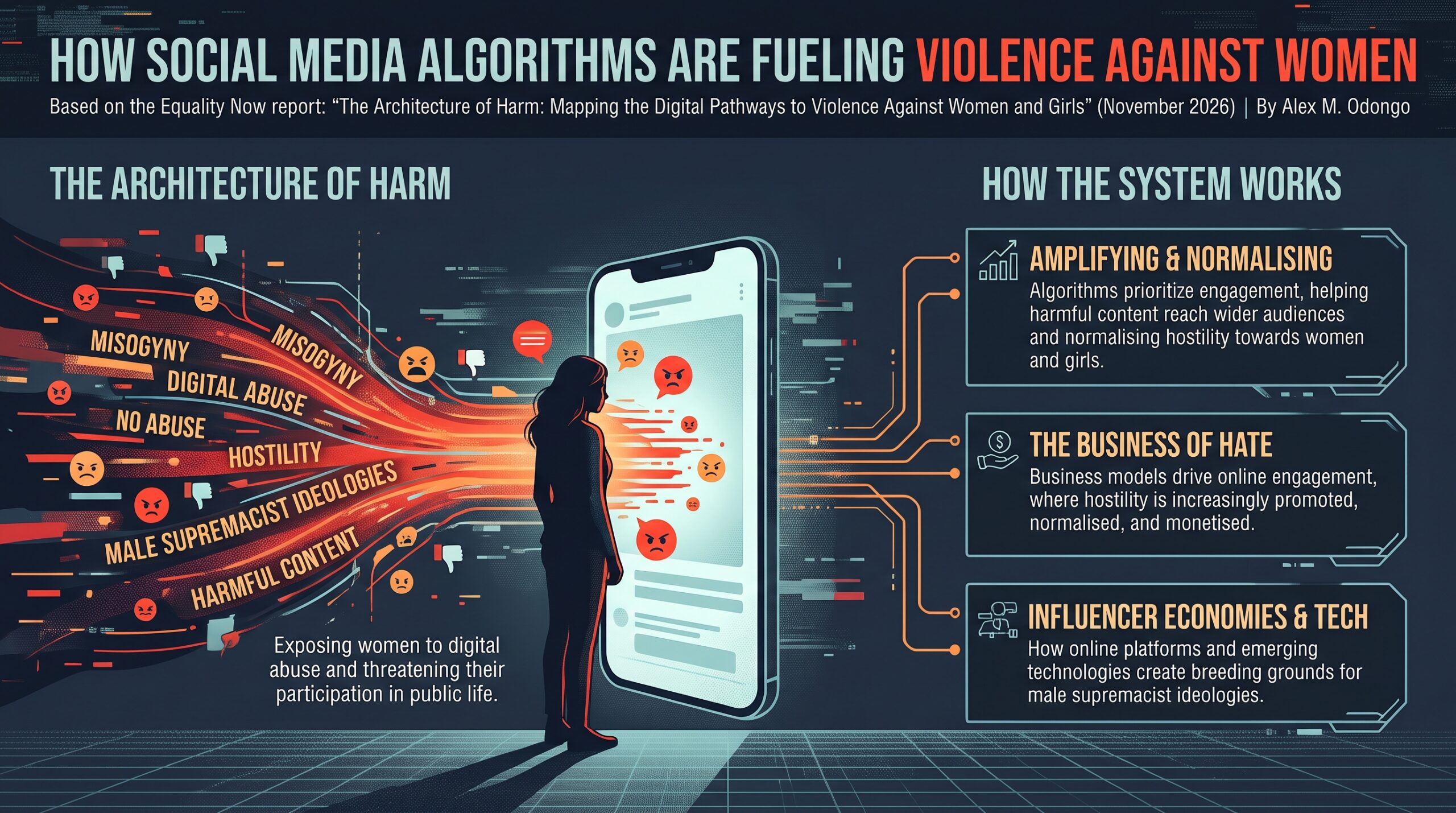
Nairobi, Kenya: Social media platforms are increasingly becoming breeding grounds for misogyny, with algorithms helping harmful content reach wider audiences and normalise hostility towards women and girls. A new Equality Now report warns that the business models driving online engagement are also amplifying male supremacist ideologies, exposing women to digital abuse and threatening their participation in public life.
The report, titled The Architecture of Harm: Mapping the Digital Pathways to Violence Against Women and Girls, published in November 2026, examines how online platforms, influencer economies and emerging technologies are creating an environment in which hostility towards women is increasingly promoted, normalised and monetised.
Drawing on academic research, investigations and expert interviews, the report argues that online misogyny should not be viewed simply as a problem of offensive comments or individual social media users. Rather, it is part of a wider ecosystem in which platform designs, algorithms and financial incentives can amplify harmful narratives and expose users, particularly young men and boys, to increasingly extreme content.
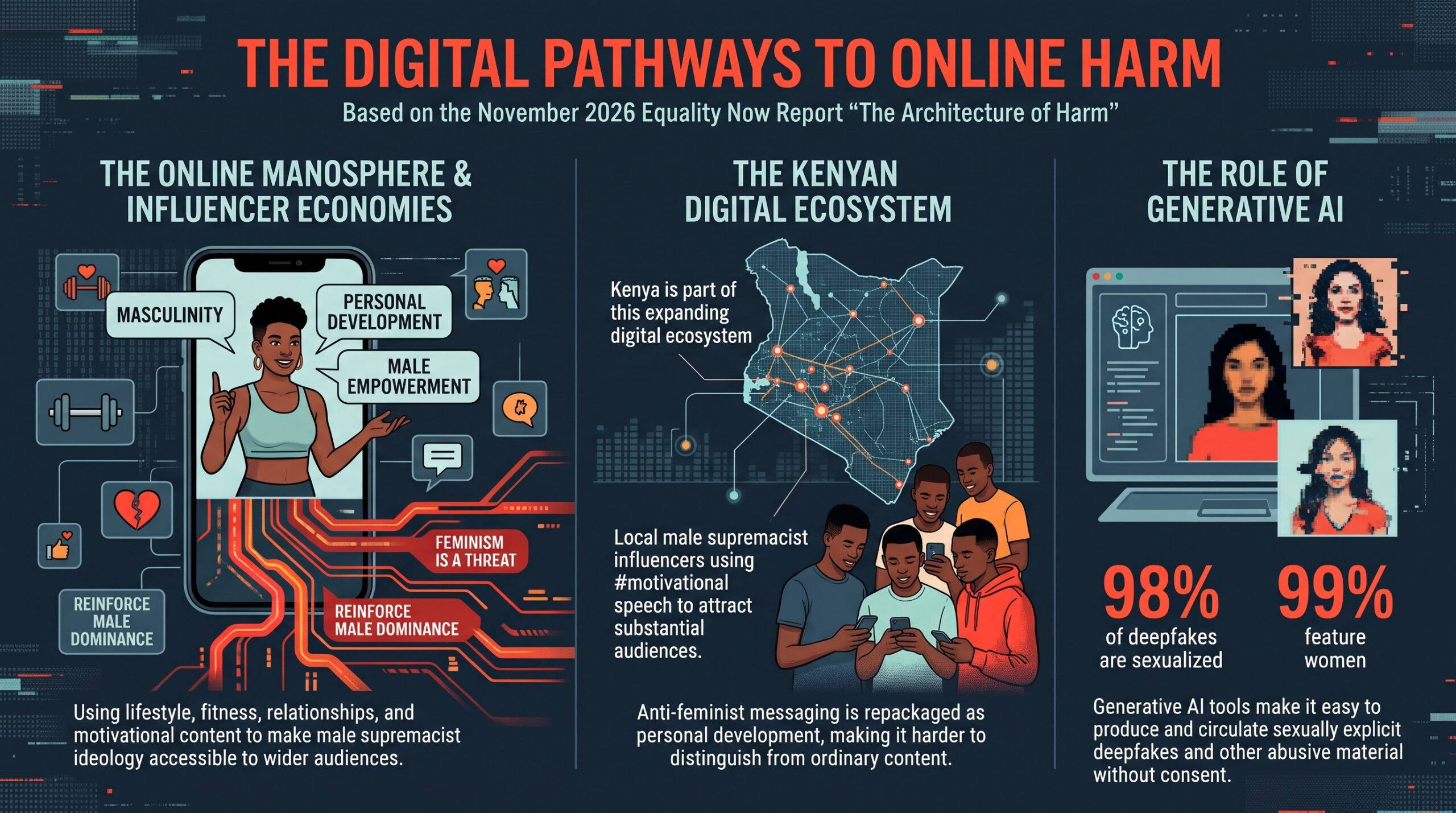
A key concern is the growing influence of male supremacist networks, commonly associated with the online manosphere. These communities promote beliefs that reinforce male dominance, portray feminism as a threat and encourage hostility towards women. The report identifies the growing use of influencers who package such messages within lifestyle, fitness, relationships and motivational content, making the ideology accessible to wider audiences.
The findings also point to the role of artificial intelligence in intensifying the problem. Generative AI tools have made it easier to produce and circulate sexually explicit deep fakes and other abusive material without the consent of those depicted. The report cites research indicating that 98% of deep fakes are sexualized and that women feature in 99% of them.
The report identifies Kenya as part of this expanding digital ecosystem. It notes that local male supremacist influencers have attracted substantial online audiences by presenting ideological messages through motivational content and hashtags. This illustrates how anti-feminist messaging can be repackaged as discussions about masculinity, personal development and male empowerment, making it harder to distinguish from ordinary lifestyle content.
Beyond individual harassment, the report warns that online misogyny poses a threat to women’s participation in public life. Women journalists, politicians, activists and human rights defenders are increasingly exposed to coordinated harassment, threats and gendered disinformation intended to undermine their credibility and discourage their participation in public debate. Research covering Kenya, Colombia and Indonesia has documented declining participation in political discourse following online abuse.
Equality Now argues that existing responses have largely concentrated on removing harmful content and banning individual influencers, approaches it considers inadequate because they fail to address the systems that allow such material to circulate and generate revenue.
The organization is calling on governments to strengthen regulation of technology companies, require greater transparency in recommendation algorithms and introduce measures to prevent platforms from financially benefiting from misogynistic content. It also recommends incorporating digital safety and gender equality education into school curricula and investing in programmes that challenge harmful attitudes among young people.
The report raises a wider question about the responsibility of technology companies in shaping online behaviour. While social media has expanded access to information and public participation, its commercial model increasingly places engagement and profitability at the centre of content distribution.
For Kenya, the findings point to the need for a broader response involving regulators, technology companies, educators, civil society and policymakers. Addressing online misogyny will require more than taking down offensive posts; it will demand scrutiny of the digital systems that allow gender-based hostility to thrive and influence behaviour beyond the internet.
Alex M. Odongo is a freelance Journalist, Budget champion and Media Trainer