
By Joyce Kimani
Nairobi, Kenya: When Kenya launched its National AI Strategy 2025-2030, it set its sights on becoming a regional leader in AI research and development, innovation and commercialisation.
The strategy identifies infrastructure, data, research, talent, investment and responsible AI governance as priorities, while also calling for inclusive AI innovation, local AI talent development and the participation of women, youth and marginalised communities.
For women, these policy commitments come against a backdrop of underrepresentation.
Stanford University’s 2025 AI Index found that women accounted for 30.5% of AI professionals on LinkedIn in 2024, compared with 69.5% men.
Across Africa, women are underrepresented in AI leadership, product development and policy teams, according to a policy brief by Research ICT Africa. In Kenya, women occupy less than 30% of ICT roles, according to UNESCO.
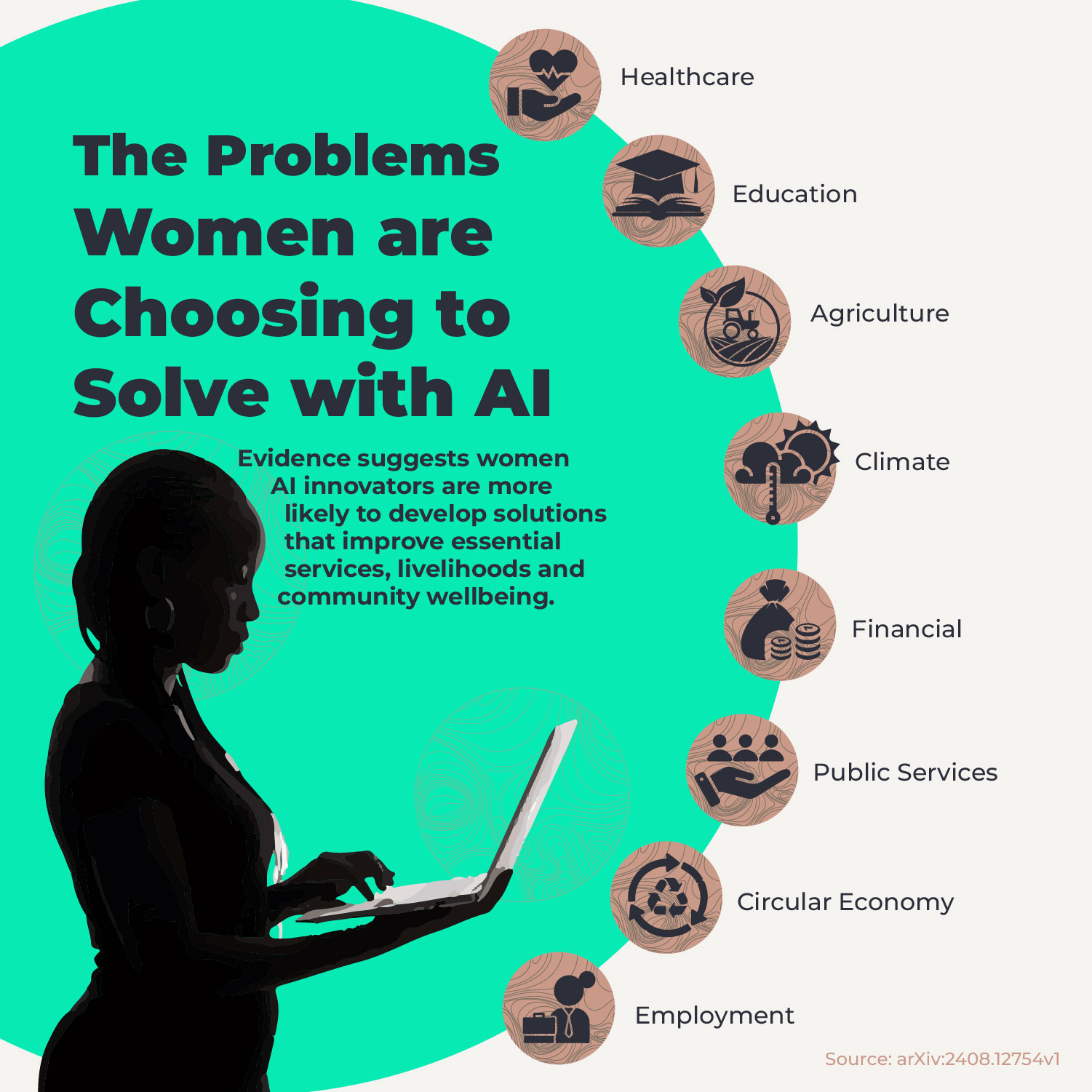
While there is limited publicly available data on women’s participation in Kenya’s AI sector, research on women-led technology innovation found that in Africa women entrepreneurs are more likely to develop technologies addressing healthcare, education, financial inclusion, community services, social protection, climate resilience, agriculture and public service delivery, rather than consumer entertainment or purely commercial applications.
Building for Local Problems
Esther Kimani, a computer programmer, developed the Early Crop Pest and Disease Detection Device inspired by her parents’ experience as smallholder farmers. The solar-powered device uses computer vision and machine learning to capture and analyse images of crops within a 600-metre range. It identifies pests and diseases, before they cause significant crop losses, and sends SMS alerts to farmers. The system can recommend interventions based on the identified threat.
Data from the devices is collected on a live-tracking dashboard, which can be used to monitor patterns, identify trends and inform policymaking.
The technology ecosystem promises to create opportunities for women to become builders, not just users, of technologies like AI. Across Kenya, various initiatives are training women in technology, including AI and data science, and connecting them with mentors. One such initiative is the Enabling Girls in AI and Growing Expertise in Data Science for Public Health (ENGAGE) project by the University of Nairobi and partners, which reports 329 beneficiaries.
Another project – African Girls Can Code Initiative (AGCCI) implemented by UN Women, the African Union, and the International Telecommunication Union – aims to train at least 2,000 girls and young women aged 17–25 years across Africa in coding and digital skills while encouraging careers in ICT.
While such programmes build a pipeline of women with technical skills, turning ideas and prototypes into sustainable products and businesses requires support from the wider ecosystem.
A 2026 study of 520 women entrepreneurs engaged in technology-oriented or digitally enabled businesses across Kenya, found that digital skills, access to finance, mentorship and supportive entrepreneurial ecosystems significantly enabled women’s participation. The study also identified skills mismatch, the digital divide, corruption and weak institutional support as barriers.
The findings published in the Journal of the International Council for Small Businesses suggest that improving women’s participation in technology requires more than teaching them technical skills. Funding, networks and institutional support can determine whether those skills translate into viable businesses.
Power of Networks
The researchers also found that women often rely on informal networks, mobile platforms and peer mentorship to navigate barriers and build their businesses.
For Linet Wangui, Esther Kungu, Joy Mugao and Gwendolyn Amanda access to opportunity came through a network. In November 2025, they responded to a call shared in the Tech Sisters Kenya WhatsApp group inviting participants to take part in the Connecting Humans to Artificial Intelligence (CHAI) hackathon.
Their team developed a platform that uses image recognition to grade waste products and connect sellers with potential buyers.
“We have been linking companies to buyers of their waste. For example, we look for a market for plastics from Java’s cooking oil containers that meet a certain quality and grade. This ensures that the product is well recycled,” Kungu told Talk Africa.
Amanda said mentorship and support from other women in the community have been instrumental to their success.
“The one-on-one conversations, shared experiences and guidance have been invaluable,” she said. “Being part of a community means you are constantly learning from others, growing through shared experiences and finding people who genuinely want to see you succeed.”
Persistent Funding Gap
While training and networks are important, women still face a persistent funding gap that hinders their ability to turn promising ideas into sustainable businesses. Kenya’s Innovation Outlook 2024 by the Kenya National Innovation Agency (KENIA) cites Briter Bridges data, which found that women-only startup founders got 12% of startup funding between 2019 and 2023.
Research examining venture-capital investment in Kenya between 2019 and 2022, published in Finance and Space, also found that startups by women founders received less than 3% of investment in each year. The researchers found evidence of structural bias against Black Kenyan entrepreneurs, particularly women without the social networks considered desirable by investors.
While the data is not specific to AI-related companies, it paints a picture of the environment in which women trying to build technology businesses are operating. Lack of capital can limit the ability to hire technical talent, develop products, reach customers or expand.
Despite the constraints, Kenyan women are building technologies for agriculture, waste management and other everyday challenges, and various initiatives are in place to get more women into technology and AI.
But inclusion is more than getting women into the room; the real test of inclusion is what happens after entry. Training programmes, hackathons, early-stage innovation and individual success stories do not necessarily translate into equal participation.
Women need sustainable access to capital, data, technical infrastructure, networks and decision-making power to turn ideas and skills into scalable enterprises, and to be part of shaping the development of Kenya’s AI economy.
This article was produced as part of the Gender+AI Reporting Fellowship, with support from the Africa Women’s Journalism Project (AWJP) in partnership with DW Akademie. The journalist used AI-assisted research tools to review and summarise relevant policy and research documents, identify patterns, surface data points for independent verification, and extract key statistics. All reporting, analysis, editorial decisions, fact-checking and final wording were done by the reporter, in line with Talk Africa’s editorial standards.