
|
Getting your Trinity Audio player ready...
|
By Juliet Akoth
Nairobi, Kenya:While Kenya has recorded hundreds of climate initiatives, significant gaps in publicly accessible data hinder attempts to form a comprehensive understanding of climate funding allocations.
To bridge these information gaps, Transparency International Kenya (TI-Kenya) created the Climate Finance Watch Tool a platform designed to assist journalists, policymakers, and the public in monitoring climate resources across the country.
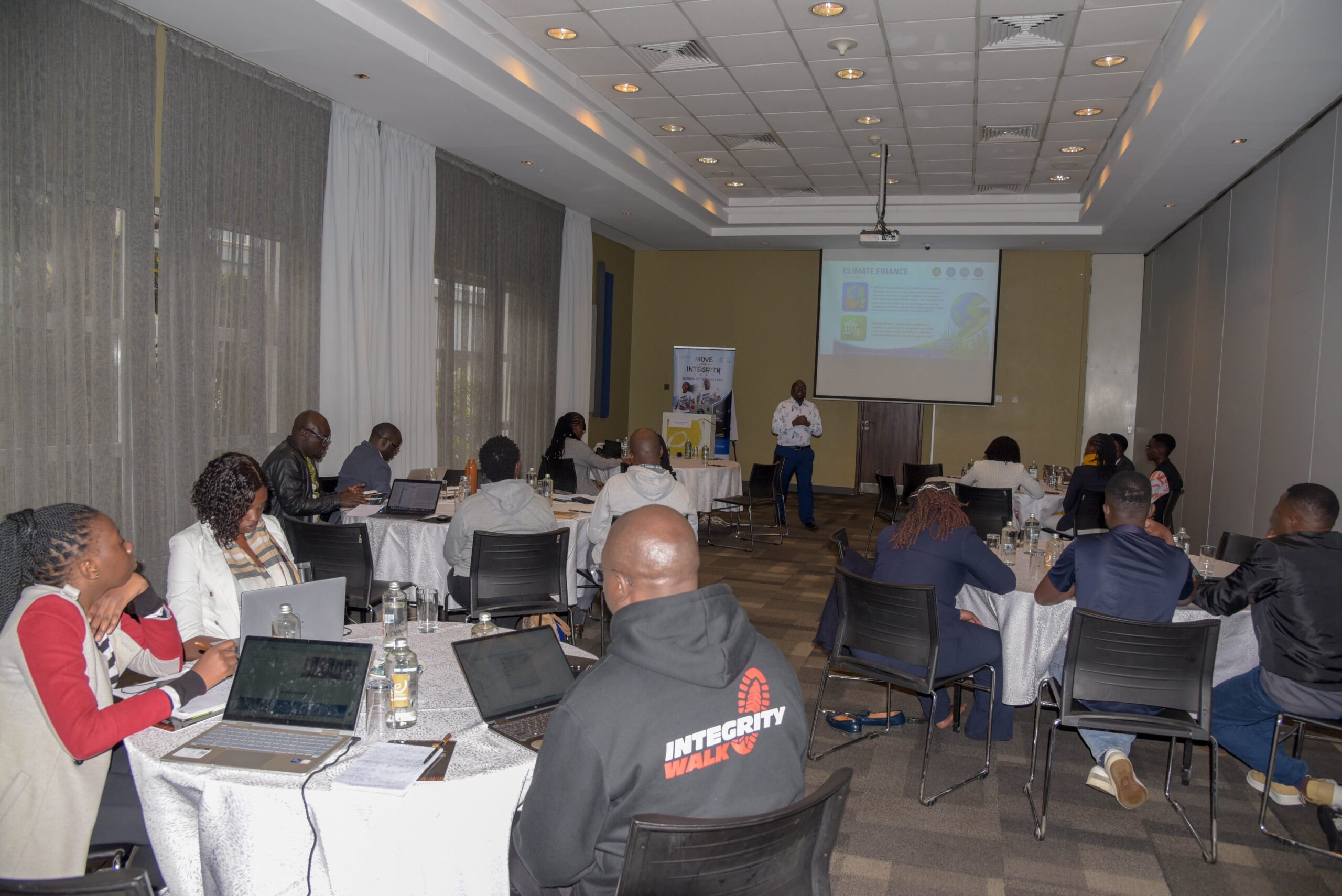
The tool was recently highlighted during a media roundtable in Nairobi, where journalists and climate governance stakeholders gathered to address issues surrounding transparency, accountability, access to information, and resource tracking.
During the event, Andrew Letting, Project Officer for Natural Resources and Climate Governance at TI-Kenya, shared that the organization gathered climate finance project data spanning from 2020 to 2024, successfully tracking over 100 projects on the platform.
“One of the key characteristics of climate finance that is coming out is that the World Bank is the biggest financier of climate intervention in Kenya, followed by the African Development Bank,” Letting said.
Letting noted the projects captured by the tool also indicate that more funding is going towards mitigation than adaptation.
The finding raises a broader question about how climate finance reaching Kenya is distributed between reducing emissions and helping communities prepare for the effects of climate change.
Under Article 9 of the Paris Agreement, scaled-up climate finance should aim to achieve a balance between adaptation and mitigation while taking into account the priorities and needs of developing countries.
The wider picture shows why adaptation finance remains an important issue. The UNEP 2025 Adaptation Gap Report says international public adaptation finance to developing countries fell from $28 billion in 2022 to $26 billion in 2023. It estimates that developing countries could need between $310 billion and $365 billion annually for adaptation by 2035.
But for Kenya, Letting explained that the challenge is not only how much climate finance is available. It is also whether information about that money is accessible and complete.
“The biggest gap is in terms of accessibility of data and the completeness,” he said.
TI-Kenya identified about 500 projects during its data-collection exercise, but incomplete information meant many could not be captured on the Watch Tool.
That means the tool should not yet be treated as a complete record of all climate finance in Kenya. Instead, it provides a growing dataset that can help identify trends and give journalists and the public leads for further scrutiny.
Letting said the organization was continuing to update the platform and wanted government agencies and other stakeholders to work with it to improve the information available.
“It’s not meant to point fingers, but just to show and be able to pick up trends that can inform policy discussions and how best can we inform allocation of climate finance in Kenya,” he noted.
For TI-Kenya, the value of the platform will ultimately depend on whether the information behind it becomes more complete and regularly updated.
“It is a work in progress. It is not yet finalized. We will continue to work on it,” Letting concluded.
As Kenya seeks climate finance to meet both its mitigation and adaptation needs, the Watch Tool offers one way of asking a basic but important question: not just how much climate money is coming into the country, but where it is going, who is financing it and what can be established about its use.