|
Getting your Trinity Audio player ready...
|
By Juliet Akoth
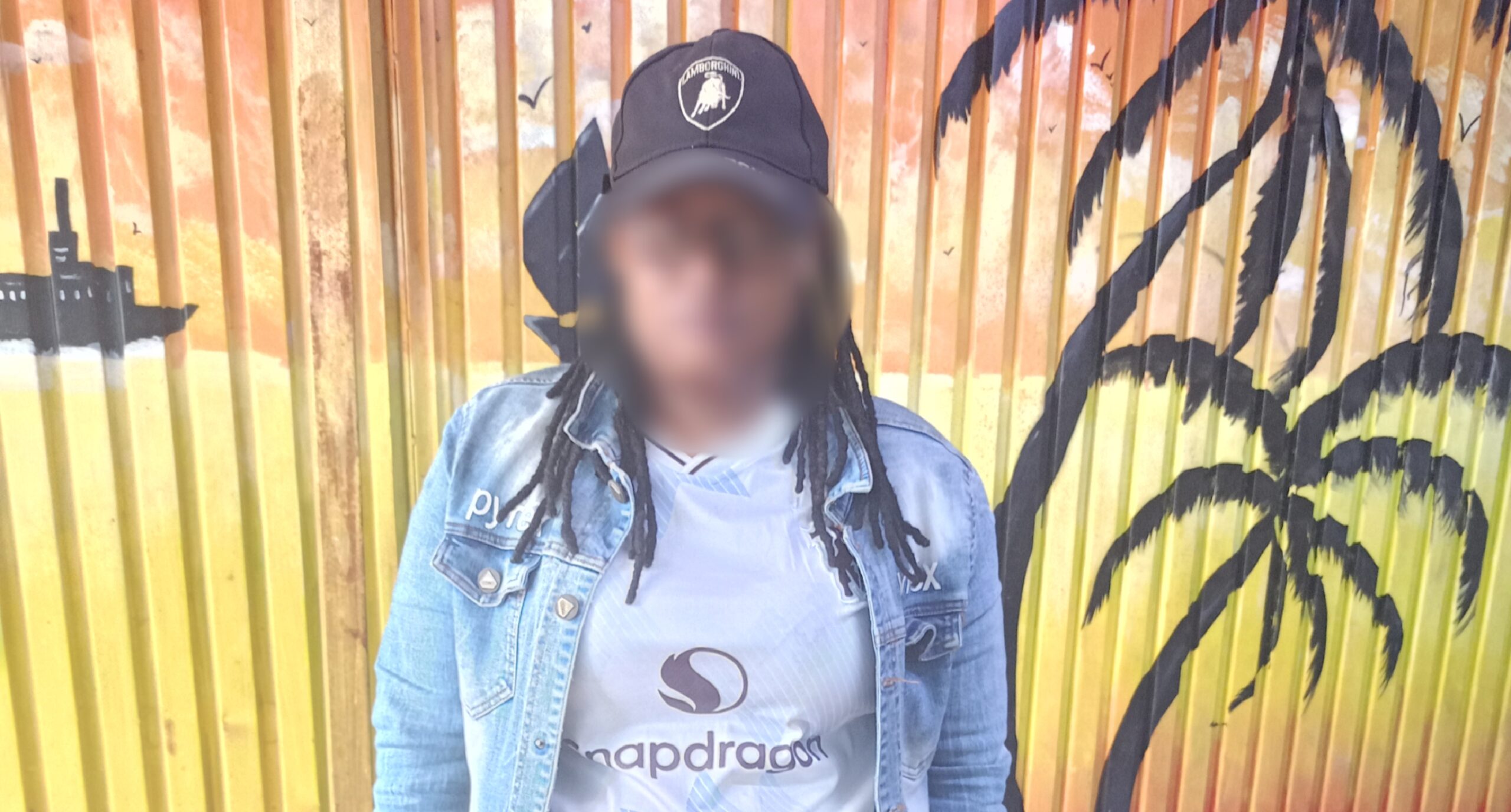
Nairobi, Kenya: This is Miriam. Behind the pain in her eyes lies a history of unimaginable resilience—a journey from a cruel childhood in Machakos, to the desperate survival on the streets of Kibera, and into the clutches of a man who promised protection but delivered a lifetime of trauma. He was her karate instructor, her partner, her jailer.
His violence broke her body, but not her spirit. Now, living in constant fear, she fights for the one thing she has never known: safety. This is her story. And it is a mirror reflecting the silent suffering of countless women across Kenya.
When I first met 40-year-old Miriam (not her real name) at the Polycom offices in the Olympic area in Kibera, she was trembling. Her hands shook as she wiped away tears, her voice barely above a whisper.
Yet beneath the pain, there was a quiet strength. A determination to be heard, to be seen, to be believed. This is her story, one that echoes the silent suffering and resilience of countless women across Kenya, where gender-based violence and femicide have reached record highs, and justice remains elusive for too many.
A Childhood Stolen
Miriam, the second of three children, was born in Machakos County. Her family faced hardship; her mother had a physical disability that impaired her ability to walk, and her father, a casual laborer, struggled to earn enough to support them.
Life was already difficult, and it became even harder when the father abandoned his family. They eventually located him in Kibera. When the daughter was eight, the family followed the father to his new home, only to discover he had remarried.
Miriam’s biological mother was compelled to return to their rural village, leaving Miriam and her brothers behind. Their situation quickly deteriorated with the arrival of a cruel new stepmother. Miriam was forced into premature adulthood, shouldering all the household chores and enduring constant physical and verbal abuse.
“She called me her fellow woman, like I was a rival, not a child,” Miriam recalled.
The decision was made for ten-year-old Miriam, overriding her father’s hesitation. Her stepmother proposed the procedure, claiming Miriam’s “maturity” necessitated female genital mutilation, and so Miriam was forced to undergo it.
Her older brother, who was thirty at the time, began to harass her in the years following the trauma of that day. He made degrading remarks about her circumcision, threatening to harm her if she spoke out. He repeatedly stated his desire to “test” whether the rumors he had heard about circumcised women were true.
“I felt trapped and questioned why I was brought to this life to suffer like this,” she says.
Forced to flee for her life, Miriam ended up homeless on the streets of Kibera. She sought shelter in market stalls and survived by scavenging for discarded food. Though just a child, she was rapidly forced to mature. Tragically, she endured two sexual assaults, resulting in the birth of two children before she turned 16. The fathers remained unknown.She just wanted to survive. “I used to sleep in the market stalls in the Kwa Reli area. I ate whatever I could find but I was always looking over my shoulder” she recounts harrowingly.
Surviving the Streets
After the birth of her two children, the difficulty of providing for them led her to return to her mother in Machakos. However, she was rejected and told she could not stay because her biological father did not want to see her. She left her children with her mother and went back to the streets, where she spent a total of seven years, fighting a daily battle for survival.
“I spent seven years on the streets. Every day, I wondered if I would make it to the next.”
In 2005, when she was 20, desperate to protect herself, Miriam made up her mind to enroll for Karate classes.
“I used to feel bad given how people used to attack me, so I decided to go take classes to learn about self- defense,” she notes.
Despite her lack of funds, the instructor offered free lessons, leading her to believe she had finally found a compassionate person. Tragically, this turned into yet another abusive cycle, one that would profoundly shape her life for years to come.
Trapped in a Cycle of Abuse
Wafula (not his real name), a karate instructor nineteen years Miriam’s senior, first appeared to be the only person who truly understood her difficulties. Soft-spoken and generous, he offered her free training when he learned she couldn’t afford the classes. This led to him soon inviting her to his single room home in Laini Saba village in Kibera to share meals.
“I would eat with him but never spend the night,” Miriam recalls. “I hadn’t told him that I didn’t have a place to stay.”
The dinners became a regular occurrence until she eventually moved in, believing she had finally found security. However, the respite was brief. Wafula’s initial kindness swiftly morphed into a need for control.
“He started locking me inside whenever he left,” she says. “I’d stay there the whole day, waiting for him to return so I could use the toilet, bathe, and eat.” The isolation was unbearable, but with nowhere else to go, Miriam endured it in silence.
As their bond grew stronger, Miriam shared that her children were living with her mother, and Wafula readily agreed for them to join the household. The new family of five children was made up of his two from a prior marriage and her three had not yet met to form their new, blended family.
However, upon traveling to his rural home in Western Kenya, Wafula’s relatives rejected her outright. They viewed her as too young and only acknowledged his first wife. Despite this, she remained, steadfast in her resolve to provide a stable life for her children.
By 2012, the cracks in the relationship had deepened into routine violence. The occasional beatings evolved into a pattern of abuse. Even while two months pregnant, Miriam endured the violence; it didn’t cease, not even when she traveled from upcountry back to Nairobi for her grandmother’s funeral, who had died following a brutal assault.
“One time he beat me until I passed out,” she recalls. “He took me to the hospital only to confirm if I was still alive, then left me there.” Doctors warned her not to return to him, but her children were still in his care. She had no choice.
Hoping motherhood would soften her husband, Miriam gave birth later that year. Her hope was unfounded. The other children had joined them in their small living space and were enrolled in a local primary school to continue their education.
Tragically, in 2016, a subsequent brutal attack resulted in a severely damaged spinal cord, To avoid suspicion, Wafula falsely informed hospital staff that she had sustained the injuries from a fall.
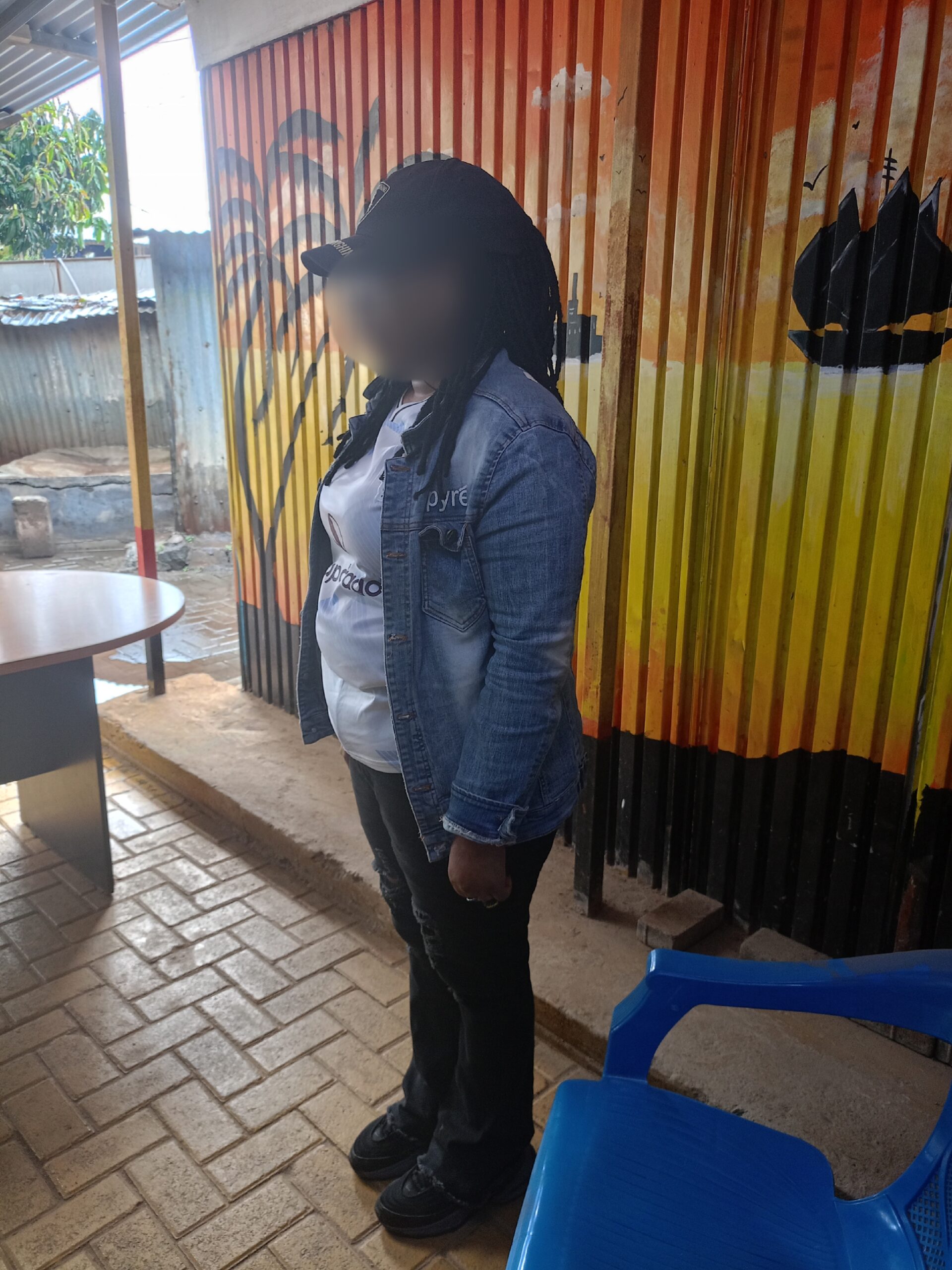
A year after her accident, she was discharged from Kenyatta National Hospital, now permanently using a wheelchair. Her husband, citing their home’s unsuitability for her new condition, moved her to a house in Karen, a wealthy Nairobi suburb, owned by another man. It was in this new location that the man of the house began to sexually abuse her.
“I told Wafula, but he didn’t believe me. He said his friend couldn’t do such a thing” she says.
Two months after the accident, Miriam finally regained enough strength to manage on crutches and made her escape. She used the money saved from her various odd jobs to rent a small room in Karen C, a local slum village.
The price of her freedom was steep. Wafula pursued her, accusing her of betrayal and subjecting her to another assault. Following a call from neighbors, the police briefly arrested him, but he was released with only a warning. Soon after, he abducted their young daughter as she was walking home from school.
“She was in class one at the Karen C Primary and I had to go back to Kibera to get her,” Miriam says.
Her two stepchildren had dropped out of school and started families, while her own daughter was now attending a secondary boarding school, thanks to a sponsorship from Plan International. However, her only son, after completing primary school, had been forced to leave home to find work and support himself due to their financial struggles.
Wafula eventually came back, expressing remorse and vowing to change. Miriam, yearning for peace, forgave him, but the abuse quickly resurfaced, escalating to a darker level. He started bringing men to their house, initially claiming they were there for his wife’s massage services, only for her to shockingly realize their true intent was sexual.
“He told me I had no choice since at the time he was helping me pay rent,” she narrates.
In the tumultuous year of 2020, Miriam gained a much-needed flicker of personal stability through an informal inheritance: the right to occupy one of fifteen iron-sheet rental units in Soweto, a sub-area of Nairobi’s Kibera slum. Stemming from the passing of her estranged father, this bittersweet possession offered Miriam, after years of precarious living, a rare, fragile sense of permanence.
For years, she had felt she was finally reclaiming her life. However, this illusion was violently broken in 2023 with the return of Wafula. He demanded she transfer the houses into his name, claiming he needed them to receive government compensation and buy a car. The houses were located in a prime area designated by the Nairobi County Government for the affordable housing scheme. When she refused his demand, his fury erupted.
“He hit me on the head with a metal pole three times,” Miriam says quietly. “I felt the first blow, then everything went dark.”
Mirriam regained consciousness in Kenyatta National Hospital, the rhythmic beeping of vital signs monitors her only welcome. Her head was bandaged, and her vision was blurred. Doctors later confirmed a broken nose and a head injury. Post-surgery, her sight deteriorated, and she developed a vesicovaginal fistula, resulting in involuntary leakage.
“I use adult diapers now,” she says. “The left side of my body also still doesn’t move well.”
Miriam was temporarily discharged while still recovering so she could record a statement about the assault at the Kibera Police Station, accompanied by one of her attending medics. Receiving an Occurrence Book (OB) number there offered her a slight glimmer of hope that her case would finally be followed up.
She returned to the hospital briefly but was soon discharged to recover at home, though she was still required to attend regular checkups. During this time, a police officer following up on her case introduced her to Sarah Dafala, a paralegal who also helped Miriam settle her hospital bills.
Wafula returned to Miriam’s house, but this time, he was apprehended. He was subsequently charged with attempted murder at Kibera Law Courts, with her children and neighbours serving as key witnesses. Their unwavering support proved vital in a legal process that frequently lets down survivors. Despite the case proceeding, however, Miriam began receiving anonymous calls threatening her and demanding that she retract the complaint she had filed with the police.
“One caller who’s a known politician and was my partner’s student back then told me to go to court and say that I fell,” she says. “He told me Wafula had powerful friends who could finish me if he didn’t.”
The perpetrator was released on cash bail after only a few days in police custody and later, in early 2025, he received a two-year non-custodial sentence. While Miriam was still unwell, a probation officer visited her to persuade her to sign papers for the release of the perpetrator, Wafula, with the promise of child support in exchange.
“I was weak and confused,” she says. “They told me he’d help our child. I signed, but I’ve never seen a cent.”
Haunted by the memory of the man who almost took her life, she now lives with lasting injuries, including permanent bladder control issues. “He walks free while I live in pain,” she narrates “Sometimes I wish he could feel what I feel.”
Miriam lives in constant fear, haunted by the perpetrator and his influential associates. The threat of eviction from her Soweto home adds to her distress, as she was defrauded and never received government compensation for her loss.
She has been given a deadline of March 2026 to vacate the property. Her only source of stability is her children, who support her financially through menial labor. Miriam’s plea is straightforward: she urgently needs a plot of land to build a safe home for her family, ensuring her children’s security.
“I just want a piece of land where I can build a house for my family. I want my children to be safe.”
Link between GBV and Kenya’s Femicide Crisis in Numbers
Miriam’s experience mirrors that of many others. Statistics from the Kenya National Bureau of Statistics reveal that over 40% of Kenyan women between the ages of 15 and 49 have suffered physical violence, with intimate partners or husbands being the primary aggressors.
Furthermore, a 2024 UN Women blog post highlights the disturbing escalation of gender-based violence (GBV) cases into numerous femicides across Kenya. Ann Mutavati, UN Women’s Kenya Representative, emphasizes in the report that this dangerous progression underscores the vital importance of supporting and believing survivors when they speak out, as a crucial step to prevent further violence before it tragically culminates in murder.
Additionally, a 2024 study by the Africa Data Hub, notes that Kenya recorded 170 femicides in just 10 counties last year, the deadliest year on record for Kenyan women. Nationally, more than one woman a day is murdered, most often by someone she knows. In 77% of cases, the perpetrator is an intimate partner or family member.
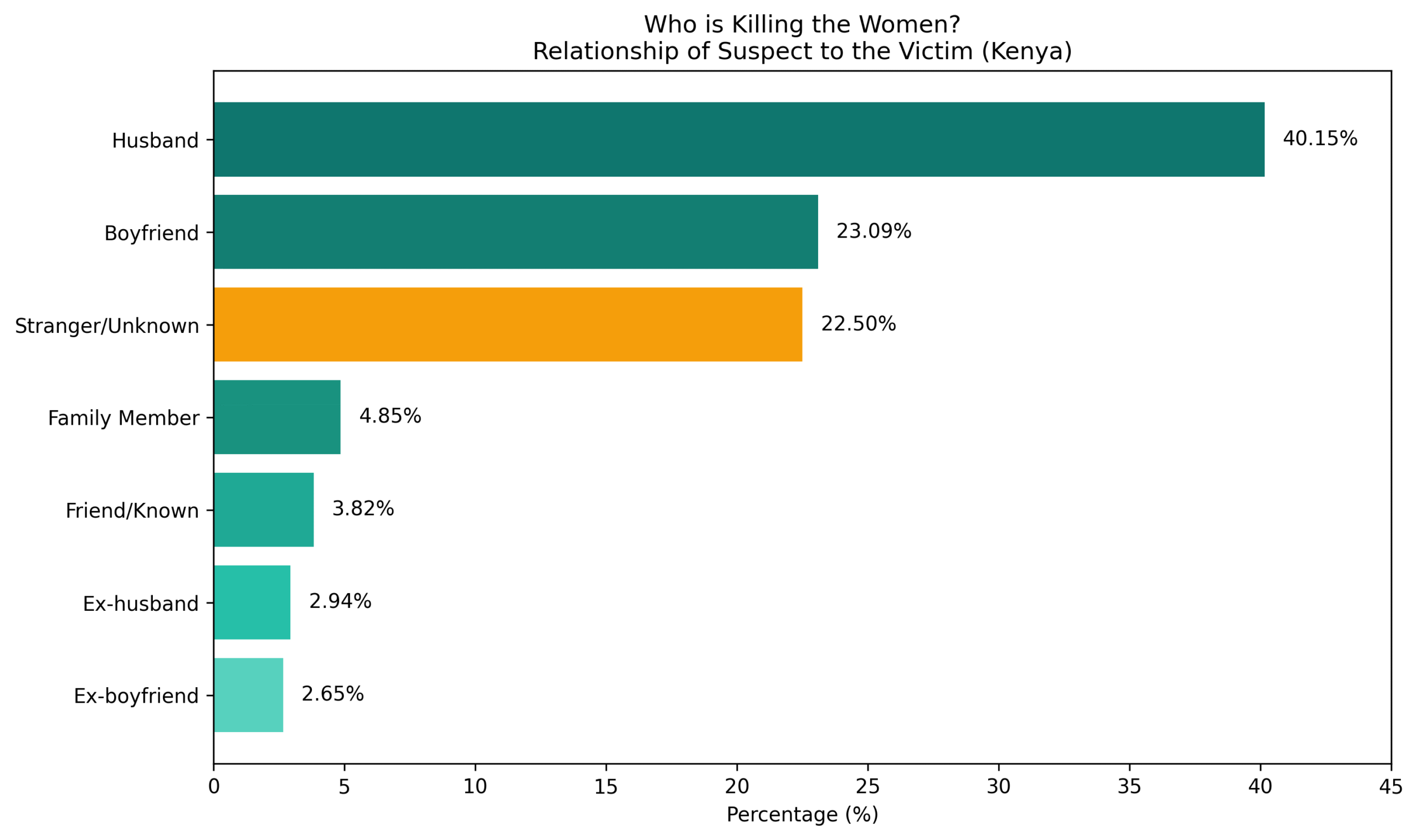
The majority of killings, that is 72%, happen at home, a place that should be safe but too often is not. The study also highlights that women below 40 years are the most at risk, and the justice system is failing them as it takes an average of four years for a femicide case to reach a verdict, and many perpetrators are released on bail or never prosecuted at all.
The Voice of an Expert
For people like Sarah Dafala, a paralegal and project officer at the Feminist for Peace Rights & Justice Center in Kibera, says these numbers reflect the reality she sees every day. Her organization handles dozens of GBV cases each month and at least 3 per day, with the highest spikes during school holidays.
“Most cases we deal with are domestic violence and rape,” she says. “During holidays, we can get over ten new reports in a month because children and women are more exposed at home.”
Dafala is part of the Court Users Committee in Kibera, where she works closely with police, medics, and other justice actors to follow up on survivors’ cases. Her position gives her a front-row view of both progress and persistent challenges.
“Kibera is big, and many survivors walk long distances to reach the police or hospital,” she explains. “Some give up because they can’t afford transport.”
She adds that stigma within families and communities remains one of the biggest barriers to justice.
“Most perpetrators are people known to the survivor, such as husbands, fathers, uncles and neighbours. When a woman reports, she’s often told to stay quiet because it’s a family matter,” Dafala says. “Even religion can be misused. Many are told to pray and forgive instead of seeking justice.”
According to her, even when survivors manage to report, the system often works against them. She notes that some prosecutors still ask for witnesses in rape or defilement cases, yet most of these attacks happen in the dark or behind closed doors.
“Lack of a witness shouldn’t mean the case is dismissed” she explains.
She acknowledges some progress, especially with the establishment of gender desks in police stations.
“At least now survivors can find officers trained to handle such cases,” she says. “What we need is for these desks to be more visible and for survivors to know they have the right to request another officer if they feel uncomfortable even with a male officer.”
At her organization and the partners she works with, support goes beyond the courtroom. Survivors receive free counseling and group therapy designed to help them rebuild confidence and community.
“When a woman walks in, I treat her like a sister or mother,” Dafala says. “I drop my titles because what she needs first is empathy.”
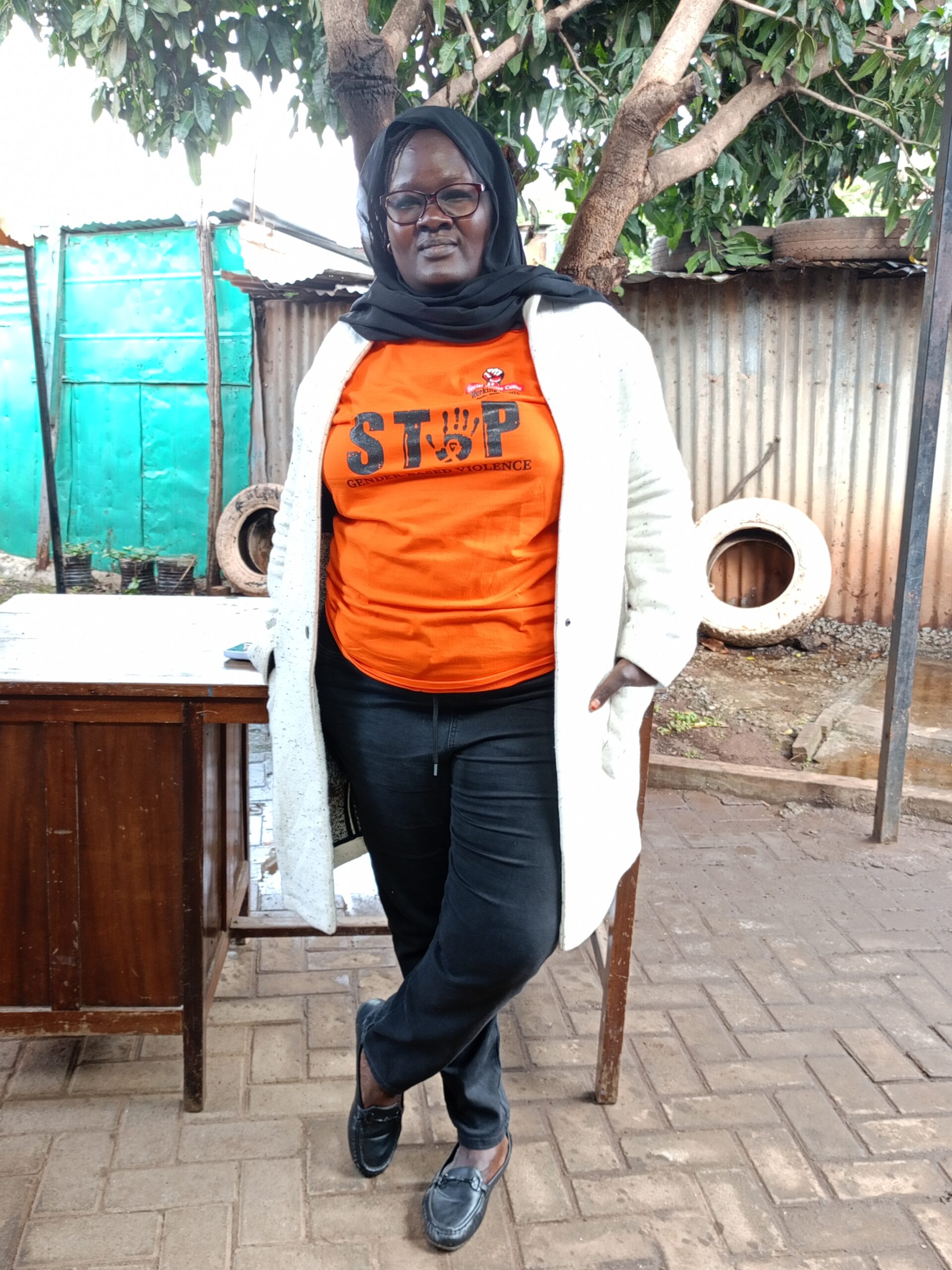
New survivors are then introduced to group sessions where they meet others who are healing. Through this interaction, they share stories, laugh, and find strength in each other. However, if this doesn’t work the survivors are linked with therapists who offer pro bono services where they can have one on one sessions with the survivors. This is the case with Miriam who’s still undergoing therapy sessions through this program.
Beyond emotional healing, the center also focuses on economic empowerment. Survivors are linked to organizations that offer small business grants or training.
“Poverty traps many women in abusive relationships,” Dafala notes. “If she can earn her own income, she can make her own choices.”
Though Dafala has secured justice in 22 cases, she acknowledges the significant distance yet to be traveled. Her principal source of frustration is the ease with which offenders are released from custody.
“It breaks survivors to see their abusers released on bail just days after arrest,” she says. “If we want real justice, bail and bond for GBV cases must be reviewed or removed entirely. Otherwise, we are sending victims back into danger.”
Dafala is convinced that change is achievable, but stresses that it will necessitate enhanced collaboration between government bodies and community-based organizations.
“Justice is not only about convicting perpetrators,” she says. “It’s about restoring survivors’ dignity and ensuring they never have to live in fear again.”
Endurance and Hope
Miriam’s story is a powerful testament to her remarkable endurance, offering a raw look at the human toll of the ever growing Kenya’s Gender-Based Violence (GBV) crisis.
“I am still here,” she says. ‘I want my children to be safe. I want justice, not just for me, but for all women.”
To effectively confront this crisis in Kenya, the perspectives of survivors such as Miriam and advocates like Sarah Dafala must be prioritized. Their personal accounts transcend mere statistics, serving instead as a powerful call to action, a demand for accountability and justice, and a strong affirmation of the enduring resilience of women who refuse to remain silent.
This story was made possible with the grant from WANIFRA-WIN SIRI Accelerator Programme. #16DaysOfActivism2025