|
Getting your Trinity Audio player ready...
|
By Henry Owino
Nairobi, Kenya: “The rollout of Kenya’s third-generation ID card aims to streamline services and digitize personal data, but critics warn of privacy risks, potential exclusion, and constitutional challenges.”
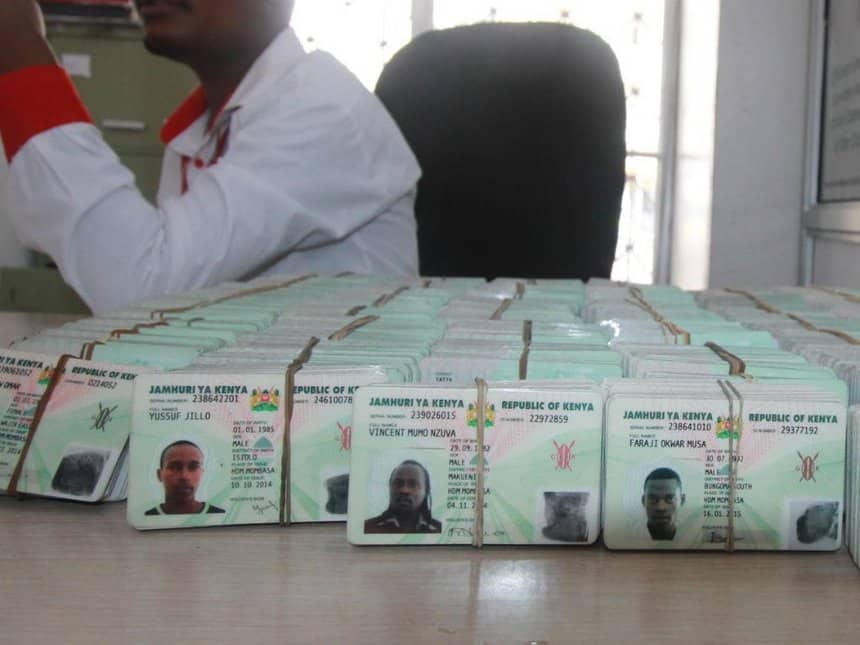
The Kenyan government’s enforcement of third-generation ID cards, known as Maisha Namba, has sparked fears over citizenship verification, access to public services, and personal identity, triggering nationwide debate.
Citizens across the country are concerned about privacy, data security, and potential exclusion, even as the government emphasizes efficiency and digitization.
The Maisha Namba initiative aims to consolidate personal information into a single, centralized digital ID, allowing Kenyans to access government services quickly and conveniently. The system is designed to reduce human interaction, limit bureaucratic delays, and minimize corruption associated with manual paperwork and identity fraud.
Once fully implemented, citizens will be able to access vital records including; birth certificates, baptism certificates, bank cards, NSSF records, KRA PINs, driving licenses, health records, and academic certificates through a single ID card.

According to government officials, this digitization ensures transparency, accountability, and lifelong documentation of key life events, including death certificates. The system also facilitates revenue collection and aims to streamline service delivery both within and outside the country. New applicants, as well as those replacing lost IDs, are now issued Maisha Namba cards.
Replacement costs KES 1,000, while new issuance is KES 300. The rollout began in June 2022, with official issuance starting in late August 2022. The ID contains multiple components, including a microchip, and is designed to be renewed every ten years to update personal data and incorporate new technology.
Risks and Privacy Concerns
Despite these advantages, centralizing all personal data raises serious privacy concerns. Mustafa Mahmoud, Co-Director, Citizenship Program at Namati warns that unauthorized access could compromise citizens’ confidential information.
“Banking staff, for example, could access health records to influence loan approvals, while medical personnel could check financial information to determine eligibility for treatment,” Mahmoud anticipated.
“Organizations may access data including irrelevant which they don’t need and misuse it or share with authorized people hence breach of privacy,” he added.
Critics also highlight the potential misuse of personal data by government or private entities, exposing citizens to surveillance and identity theft.
Moses Gowi, Senior Officer, Citizenship Media and Campaigns at Namati said civil society organizations have raised legal and constitutional concerns over the rollout.
Gowi revealed two organizations; Haki na Sheria and Katiba Institute, joined by Nubian Rights Forum as interest party filed a petition in November 2023, challenging the Maisha Namba system as unconstitutional and illegal.
“The case, Petition No. 6 of 2024, is set for hearings from 17th–19th March 2026 at the High Court, Milimani, Nairobi,” Gowi disclosed. “The organizations argue that citizens were not adequately consulted, and that the system lacks adequate safeguards to protect personal data.” He explained.
Critics also warn that the new system may deepen inequality. Marginalized communities, including certain religious or ethnic groups, may face greater exclusion. They will also struggle to access the necessary technology or infrastructure to register for the digital ID card.
“Furthermore, the system lacks clear guidance on data ownership, processing, and storage under the Data Protection Act, 2019,” Gowi emphasized. Adding that risk assessments on internet access, electricity connection, device availability, and literacy were not taken into account.
Reportedly, there are insufficient information concerning Maisha Namba raising concerns that many Kenyans could be left behind. For example, applicant holders of the new ID card complain it is not recognized by banks among many vital institutions.
Implications for Citizens
The highly centralized system also raises concerns about mass surveillance. Biometric data; including fingerprints and facial recognition if stored digitally, creating potential vulnerabilities if the system is compromised.
Citizens worry that sensitive personal data could be accessed or misused by unauthorized parties, putting privacy and security at risk.
Despite these challenges, the government defends Maisha Namba as a crucial step toward modernization, efficiency, and transparency in public service delivery. Proponents argue that, if implemented carefully with proper safeguards, the digital ID system can simplify access to essential services and reduce fraud.
However, the debate continues over whether the system adequately balances efficiency with citizens’ right to privacy and security. As Kenya awaits the High Court’s ruling, the Maisha Namba rollout remains a flashpoint in the broader discussion on digital identity, citizenship, and data protection in the country.