
|
Getting your Trinity Audio player ready...
|
By Juliet Akoth
Nairobi, Kenya: For Freelance Science Journalist Lenah Bosibori, the arduous task of manually transcribing hours of recorded interviews is a thing of the past. Her current workflow involves utilizing an Artificial Intelligence (AI) transcription tool followed by an AI editing application to refine the text.
She then applies her unique journalistic voice to the narrative before submitting the final draft to her editor. This technological integration has fundamentally altered her professional pace with efficiency.
“Before AI, one feature story could take me six hours to complete. Now I can turn it around in one to two hours,” Bosibori says.
As artificial intelligence reshapes workflows, freelance journalists are adopting AI tools to work faster. A recent Thomson Reuters Foundation survey of journalists in the Global South found about 80% use AI, mainly for transcription, drafting, editing and research.
However, not all journalists are benefiting equally. Access to these tools and the skills to use them effectively is uneven. Cost, limited training opportunities and weak institutional support risk deepening existing inequalities, particularly for women and community-based reporters such as Bosibori.
Bosibori describes her workflow as a back-and-forth between AI and editorial judgement. She uses AI to transcribe and to fix errors, then writes the story in her own voice.
“I use TurboScribe to transcribe all the audio recordings,” she says. “After that, I put that work in ChatGPT to refine it and clean it if it has many errors.”
“Then I go back to the Word document and read through the entire text,” she says. “Then I rewrite the story, because I’m the one who went out to the field, and I’m the one who knows where the story is.”
She treats AI suggestions cautiously, using prompts to highlight key points or suggest structure, and discarding anything that does not align with the facts in her notebook and recorder.
“AI always gives you so many things, but I don’t use all of them,” she says.
For freelancers balancing multiple drafts and uncertain income, time is currency; working faster can mean the difference between meeting a deadline and missing an opportunity. Yet the ability to do so depends on access to tools and training that are not equally available.
AI is helping freelance journalists work faster, but unequal access to tools, training, and income is creating new forms of inequality, especially for women and those outside major news hubs.
Some newsrooms, like the Nation Media Group and Radio Africa Group, have introduced AI guidelines, signalling formal adoption, but media practitioners say that policies alone are not enough. Without training, capacity building and clearer ethical grounding, these frameworks may remain stronger on paper than in practice.
Staff journalists may benefit from structured programmes, but freelancers often have to figure it out on their own. Few initiatives are designed around the realities of independent reporters working across multiple outlets, increasing their risk of falling behind as the industry evolves.
Learning through informal networks
Without newsroom support, many freelancers and community-based reporters turn to peer networks and self-learning. A study on newsroom adoption of AI found that 58% of journalists using AI tools learnt independently or through colleagues rather than formal training programmes.
“I learnt to use these tools through colleagues,” says Victoria Masaya, a freelancer who writes about health, environment, and gender.
Masaya uses Otter AI to transcribe interviews and ChatGPT to organise information and tighten drafts. She recalls working on a fellowship story that had to be completed within a week, a task that would have been difficult without AI support.
“The deadlines were really tight, but AI tools made the process a lot easier,” she says.
Even so, some aspects of reporting remain unchanged: Finding reliable experts, data and interview time can still slow a story down.
“Sometimes the experts you need are not available,” she says. “Other times, the data you need is difficult to find.”
Cost of keeping up
While AI has reduced production time for freelance journalists like Masaya, cost remains a major barrier. Most advanced features are behind paywalls, leaving freelancers to rely on free versions that limit the length of audio files, the number of documents they can process, or the frequency of use. Once limits are reached, journalists must either pay subscription fees or return to slower manual methods.
In an industry already marked by irregular pay and missed payments, the cost of keeping up risks reinforcing existing inequalities.
Masaya describes the financial instability that makes it difficult to pay for premium tools. She has experienced periods when commissions were scarce or payments fell through after work was delivered.
“Freelancing can be tricky because many outlets, and even some non-governmental organisations, still prefer journalists from mainstream media,” she says. “Sometimes freelancers are paid less for the same work, and in some cases, you agree on payment, but the money never comes.”
Winnie Kamau, an editor at Talk Africa and president of the Association of Freelance Journalists, says the cost of AI can quickly become burdensome for freelancers who already operate on unpredictable income.
“AI is supposed to make your work efficient,” she says. “You do not have money, but you end up paying for that tool. For freelance journalists, that is a lot of money.”
Beyond cost, access to training is another barrier
“We have discussed how to engage our members in AI training,” she says.
Adding “But without enough support, particularly funding or partnerships, we have not been able to organise those sessions yet” says Winnie.
The benefits of AI depend not only on access to the right tools but also on how well journalists understand and use them. Even when tools are accessible, using them effectively is a challenge. Kamau notes that many of the problems she sees stem from overreliance on AI output, without proper editorial oversight.
“When they use AI, they don’t proofread,” she says. “You still need to go back and give it the human touch.”
She also warns that AI systems can reproduce inaccuracies or biases from the data they are trained on, something that journalists without AI literacy might not be aware of.
“If the information is not correct, that’s what the AI will feed you back with,” she says. “You need to do a lot of fact-checking.”
She adds that clear editorial guidelines on acceptable use and disclosure would remove uncertainty.
At Nation Media Group, lifestyle editor Diana Mwango has observed similar challenges. While both freelance and staff journalists use AI, the difference is seen in less experienced writers who rely on it as the main tool rather than as an assistant. She says some stories where the writers rely heavily on generative AI have been rejected on the basis that they do not connect with readers.
“AI has no soul; the articles are very soulless,” she says. “The words are words that a Kenyan audience would not use.”
Mwango also believes journalists should disclose AI use.
“Whether they disclose or not, editors know when someone has used AI or not,” she says. Newsrooms, she adds, are developing policies that require journalists to state when AI assisted with research, data work or production.
Gender Disparities
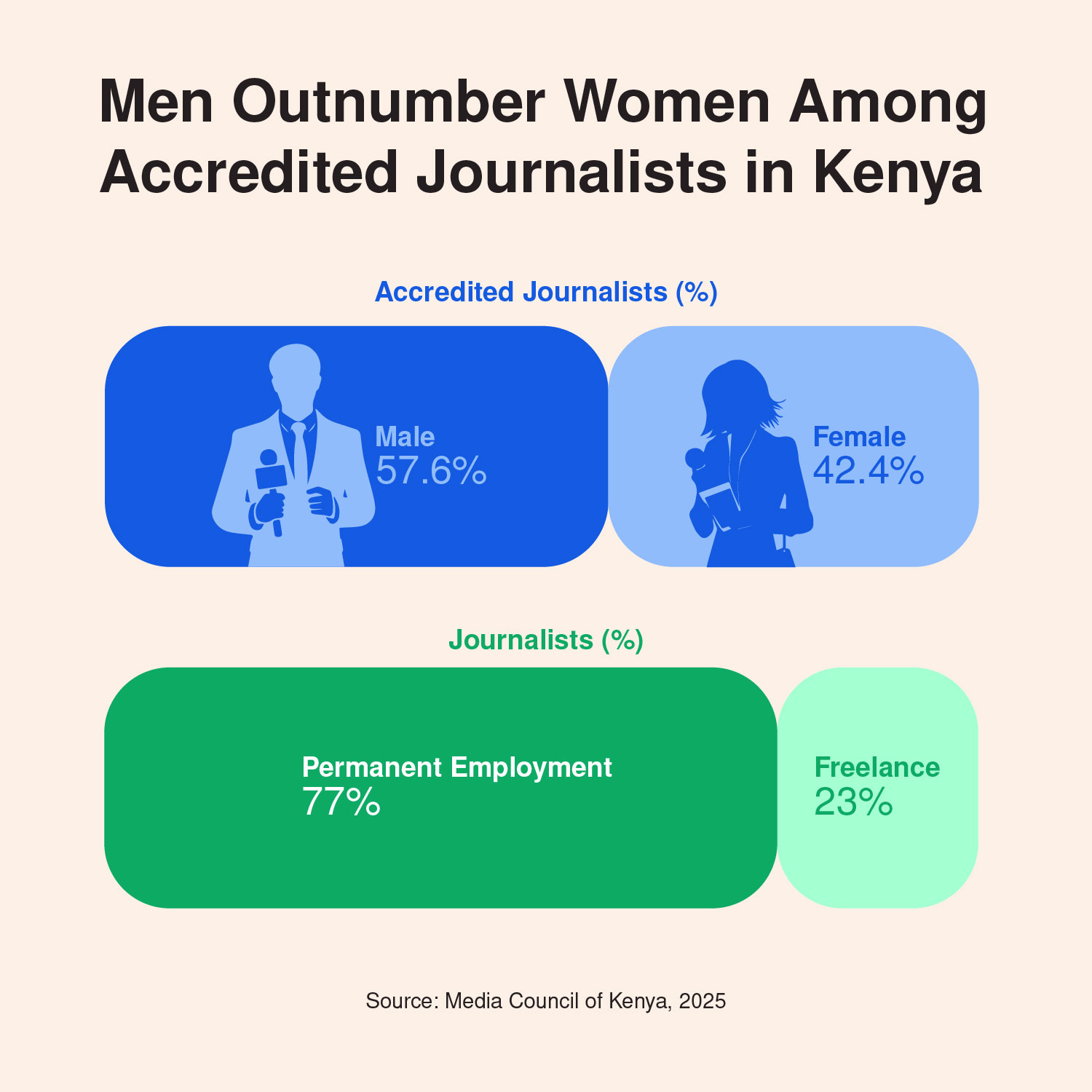
For many freelance journalists, gender disparities further complicate access to AI training. In her research, Rebecca Mutiso, the Media Council of Kenya’s manager of accreditation and an independent researcher on AI, has found that women journalists are often disadvantaged both by limited access to technology and by newsroom structures that still place men at the forefront of new roles.
“Women journalists are disproportionately disadvantaged, especially when it comes to the uptake of technology, so they usually lag in adoption of technology,” she says.
For freelancers, especially those working outside major news hubs, she notes that the divide can widen quickly.
“The freelance journalists, especially those based at the community level, are disadvantaged,” she says.
Training opportunities tend to cluster around Nairobi, leaving community-based journalists to navigate AI adoption with fewer resources and less institutional backing.
Bosibori has tried to fill the gap through online tutorials and informal learning.
“As freelancers, we can’t find someone who can come and give us training,” she says.
She believes partnerships between journalism organisations and freelancer associations could make training more accessible.
Mutiso agrees and notes that training must go beyond basic tool demonstrations.
“AI literacy encompasses many components,” she says. She adds that journalists need to learn both how to use tools and how to use them responsibly, including how to question where a tool comes from, how it works, and whether bias may be built into its output.
Mutiso warns that if women freelance journalists are not supported now, they risk being left behind as AI, data analysis and digital skills become part of what newsrooms value.
“As AI spreads across the industry, the ability to adapt and verify may become just as important as reporting itself,” she says.
Quiet adaptation
While artificial intelligence is reshaping journalism workflows, the fundamentals of journalism, especially after the AI tools produce their output, remain unchanged. Reporters still verify quotes against recordings, confirm statistics with original sources, and call experts when information is incomplete. Accountability still rests with the journalist.
Bosibori describes her routine as a constant return to the page. She transcribes interviews, cleans the text, rewrites the story and reads it again until the voice sounds like her own. The machine may help her work faster, but the story only becomes hers once she shapes it.
As AI becomes embedded in newsroom workflows, freelancers who lack access to tools, training and support risk being edged out of an already precarious industry. For many, especially women and those outside major news hubs, this may determine whether they can continue to compete in a rapidly changing industry.
This article was produced as part of the Gender+AI Reporting Fellowship, with support from the Africa Women’s Journalism Project (AWJP) in partnership with DW Akademie. The journalist used AI tools as research aids to review and summarise relevant policy and research documents and extract key statistics. All interviews, analysis, editorial decisions and final wording were done by the reporter, in line with Talk Africa’s editorial standards.