|
Getting your Trinity Audio player ready...
|
By Halima Gongo
Kwale County, Kenya: The classroom at Jego Primary School in Kwale County fell quiet, and the pupils lowered their gaze when the teacher asked for a volunteer to read aloud. Each hoped that their name would not be called.
The teacher picked Neema Ngoa. In Grade Four, she still struggled to recognise the alphabet.
“I didn’t know the ABCD. When I saw the letters, I could not tell which one was which. I felt like I would never catch up,” she recalls.
Neema attends school every day, but like many children in her community, she struggles with reading.
“I would read but not understand anything; I could not pass exams because I didn’t know how to read,” she adds.
Neema’s story reflects a wider literacy crisis. Across Kenya, millions of children are enrolled in school but cannot read or understand a simple text by the age of 10. A national learning assessment by Uwezo found that six out of 10 Grade 4 learners could not read a Grade 3-level text.
The World Bank refers to this as “learning poverty”, which affects about 70% of 10-year-olds in low- and middle-income countries and nearly 9 out of 10 children in Sub-Saharan Africa. Pandemic-related school disruptions exacerbated the crisis.
Kwale County’s literacy rate is estimated at 57%, with women significantly disadvantaged. Only 47% of women can read and write, compared to about 66% of men.
Binti Hamadi, a businesswoman in Lunga Lunga, has seen the impact at home.
Along the Swahili coast, the khanga, a brightly coloured piece of fabric worn by women, has long carried messages of wisdom. Printed along its hem are short proverbs or sayings, often playful, sometimes sharp, and deeply rooted in coastal culture.
For generations, these messages created a learning ritual. Grandmothers who could not read would call their grandchildren over and ask them to read the saying on the khanga aloud.
One afternoon, Binti handed her daughter a khanga and asked her to read the message printed along the edge. The girl stared at the fabric silently.
“She could not read it,” Binti recalls.
Binti believes family instability may have contributed to her daughter’s difficulties.
“There were family conflicts, and we were moving from place to place. She didn’t like school at all. She would pretend to be sick and stay at home rather than sit her exams,” she explains.
Teachers at Jego Primary School say even Grade Seven pupils could not write their names without copying.
“When children can’t read, they begin to doubt themselves, lose interest, and the cycle of absence starts,” says Sarah Wainaina, a teacher at the school.
While the net enrolment in primary education in Kwale is about 76%, it drops to about 25% in secondary school, according to the National Council for Population and Development. Poverty, child marriage, teen pregnancy, and substance abuse are associated with school dropout in Kwale.
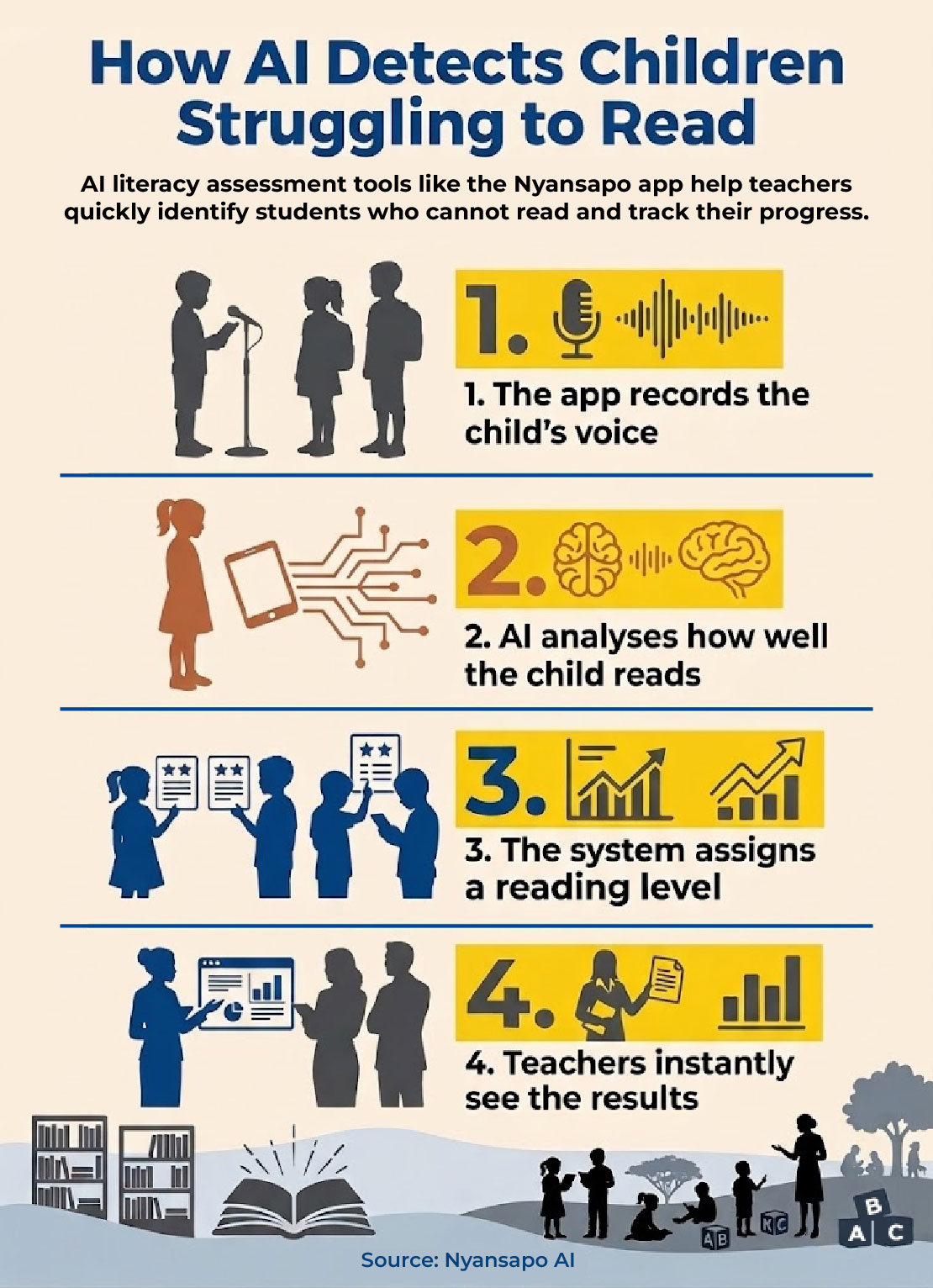
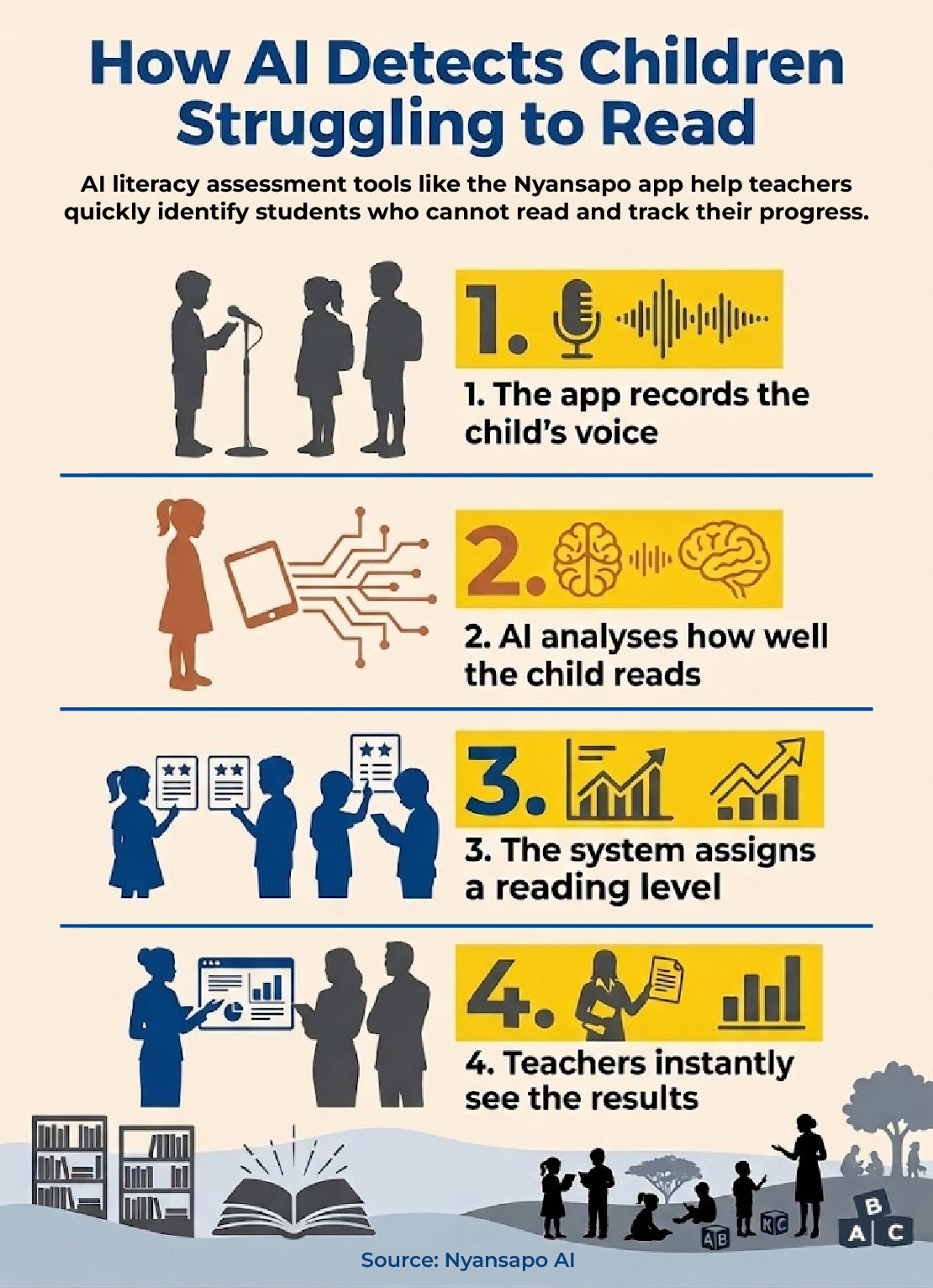
In the search for solutions, Jego Primary School has turned to an AI-powered literacy app – Nyansapo AI. The smartphone app uses a speech recognition system to assess and support reading skills in real time. It listens as a child reads aloud, identifies missed words, and produces feedback that teachers can act on.
The app also organises students into small groups based on ability, allowing instruction to be tailored to their learning needs.
“The app ensures that struggling students are noticed early and supported before they fall behind,” says Mumbe Mwangangi, founder of Nyansapo AI.
Speech-recognition systems like Nyansapo AI rely on large datasets of recorded voices to learn how people speak.
Mumbe says the app has been trained using voice recordings from Kenyan children. The data is collected during reading assessments and anonymised, allowing the system to learn how children pronounce words, mix languages, and express themselves.
In Kwale, children speak Kiswahili and other local languages such as Digo, Duruma, and Kamba, occasionally mixing them in the same sentence—a practice known as code-switching. Rather than treating this as a mistake, the app identifies when a child understands the concept but lacks English vocabulary, allowing teachers to offer more targeted support.
However, experts say these systems do not always work equally well for everyone.
While many global AI systems have historically performed better with Western accents, Nyansapo AI’s developers say their model is designed to reflect local realities. To improve accuracy, especially for children with strong local accents, teachers review and verify the AI’s assessments by listening to recordings and correcting any errors. This improves how the system understands local speech patterns.
The literacy lessons happen through learning camps run by the G for Girls Initiative. Under the programme, mentors with smartphones assess and support the learners in class and during the camps.
Teachers at Jego Primary School say confidence is growing, children are more engaged, and attendance is improving, especially when the learning camps are held.
“The children are coming back to school,” says Wainaina.
One of those children is Mohammed Baraza, a Grade 5 pupil. He says, “I used to be scared of reading. Every time the teacher asked me to read aloud, my friends would laugh at me; they would even make a joke by writing random words and asking me to read. I felt ashamed of myself.”
Now, Mohammed picks up a book every day after school, practising words he once couldn’t recognise. At home, he teaches his younger sibling in PP1 how to read letters and simple words.
“It feels good to help someone else after learning. I read anything I find because it’s fun: newspapers, my mother’s messages, and English books. I want to learn English,” says Mohammed.
Neema Ngoa now reads confidently, sounding out sentences and completing exercises.
“The camps are safe spaces where children who were once afraid to read or write can experience achievement. Some children were initially afraid to touch the phones; now they read aloud and help one another. Even students who used to skip school are coming consistently,” says Ilse Kithembe, co-founder of G for Girls Initiative.
While the results are promising, literacy experts caution that technology is not a complete solution. In many rural households, girls lack access to smartphones and spend more time on chores, leaving them with less time to practise.
Simon Muchiri, Senior Programme Officer, Literacy, at Mizizi Africa Foundation, says this could affect how much girls benefit from AI-driven learning.
“Technology can support learning, but it does not automatically remove existing inequalities; if girls have less time or access, they may not benefit at the same level as boys,” he says.
In Kwale County, where only a quarter (25.6%) of residents use the internet, according to the 2023/24 Kenya Housing Survey Basic Report, scaling such technology remains a challenge.
Under the Competency-Based Education (CBE) framework, parents are expected to support learning by reviewing homework, encouraging extra reading, and creating a conducive home environment. This is also a challenge in marginalised communities.
“Home environments play a significant role, especially before a child joins school. Children from economically disadvantaged families, particularly where parents cannot read and where children lack sufficient books and a supportive learning environment, miss out on basic learning support,” says Muchiri.
Without early intervention, he warns, the children risk falling behind.
The Nyansapo AI literacy project started in five schools in Lunga Lunga: Jego, Ngathini, Tsuini, Kiwegu, and Mwalewa. But with so many children and only a handful of mentors, they narrowed it down to three schools so mentors could spend more time with each child, notice little improvements, and give support when needed.
Nyansapo AI is currently being used by more than 30,000 learners across 100 schools in several counties, including Kwale, Kitui, Kisumu, and Nairobi, with plans to expand through partnerships with community-based organisations.
After months of practice at Jego Primary School, the pupils who were in Grade 4 are now in Grade 5. Fatuma Chembea, their teacher, scans the room and asks for a volunteer to read a passage.
For a moment, no one moves. Then a hand goes up—it is Neema Ngoa’s. This time, she does not shrink into her seat. She sits up, her fingers tracing each word as she begins to read.
Around her, classmates follow along, some whispering the words under their breath.
This article was produced as part of the Gender+AI Reporting Fellowship, with support from the Africa Women’s Journalism Project (AWJP) in partnership with DW Akademie. The journalist used AI tools as research aids to review and summarise relevant policy and research documents and extract key statistics. All analysis, editorial decisions, and final wording were done by the reporter, in line with Talk Africa’s editorial standards.