|
Getting your Trinity Audio player ready...
|
By Omboki Monayo
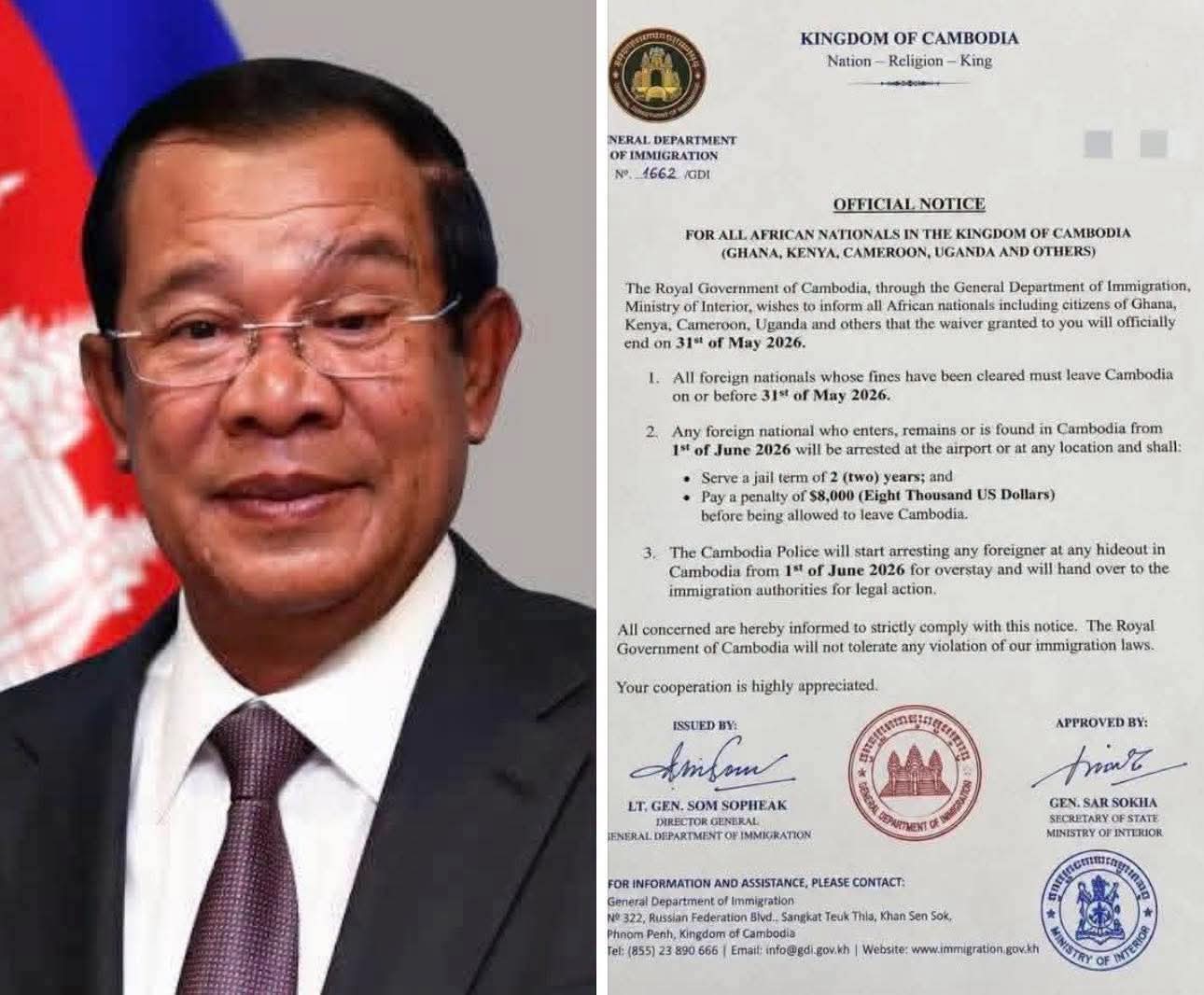
PHNOM PENH, Cambodia: The Royal Government of Cambodia has issued an urgent and uncompromising directive ordering all African nationals, specifically naming citizens of Ghana, Kenya, Cameroon, and Uganda, to leave the Kingdom by May 31, 2026, or face immediate arrest, a two-year prison sentence, and an $8,000 fine.
The official notice, released by the General Department of Immigration (GDI) under the Ministry of Interior, states that the current “waiver” granted to these foreign nationals will expire at the end of the month. Authorities are warning of a significant escalation in enforcement beginning June 1.
“In Cambodia, the law must be respected. The waiver granted to you will officially end on the 31st of May 2026,” stated Lt. Gen. Som Sopheap, Director General of the GDI, in the formal directive.
“Any foreign national who enters, remains, or is found in Cambodia from the 1st of June 2026 will be arrested at the airport or at any location,” the notice reads. It adds that violators “Shall serve a jail term of 2 (two) years and pay a penalty of $8,000 before being allowed to leave Cambodia.”
‘Zero Tolerance’ for Overstayers
The directive comes amid a broader crackdown on illegal immigration and transnational crime. While the notice specifically targets African nationals, it follows a massive wave of deportations spanning dozens of countries.
According to data obtained by this outlet, Cambodia has already expelled 7,282 foreigners in the month of May alone. Between May 1 and May 20, authorities deported 3,684 individuals of 35 nationalities, followed by another 3,598 from 37 nationalities between May 11 and May 20.
Gen. Sar Sokha, Secretary of State for the Ministry of Interior and the official who approved the notice, emphasized that the expulsions are a direct implementation of Prime Minister Hun Manet’s strict legal measures.
“These actions are to clean up and eliminate all cybercrime occurring in the Kingdom of Cambodia to ensure the safety of citizens,” Gen. Sar Sokha stated in a recent address regarding the deportation surge.
Nationwide Manhunt
Officials have made it clear that simply leaving the capital or hiding will not be a viable option for those who miss the deadline. The directive explicitly instructs law enforcement to take the search to “any hideout.”
“The Cambodia Police will start arresting any foreigner at any hideout in Cambodia from the 1st of June 2026 for overstay and will hand it over to the immigration authorities for legal action,” the notice warns.
The GDI notice specifies that this order applies to “all foreign nationals whose fines have been cleared,” meaning that even those who have previously settled their immigration debts are not exempt and must leave by Sunday.
Kenyans Caught in Cambodia’s Trafficking Crisis
While the total number of Kenyan nationals currently residing in Cambodia remains unconfirmed by official sources, recent data from Kenya’s Foreign Ministry reveals that at least 393 Kenyans were rescued from exploitation in Cambodia between January and April 2026 alone, with 304 successfully repatriated . The government has formally identified Cambodia alongside Myanmar, Laos, and Thailand as a high-risk destination for human trafficking .
Prime Cabinet Secretary and Kenya’s Foreign Minister Musalia Mudavadi provided testimony to the Senate Standing Committee on Labour Migration, describing a sophisticated trafficking network operating across Southeast Asia.
“These cases demonstrate a convergence of human trafficking, recruitment by rogue agencies, and deceptive job offers,” Mudavadi told the Senate. “All these pose a risk to national security” .
The Foreign Minister revealed that the trafficking scheme is driven by “well-coordinated transnational criminal networks operating across multiple jurisdictions,” with victims including Kenyan women trafficked primarily for sexual exploitation and forced involvement in cybercrime operations run from so-called “scam compounds” .
‘Like a Horror Film’: Victims Recount Ordeal
The brutal reality of these operations came into sharp focus in February 2026, when over 600 Kenyans filed an urgent petition before the High Court in Nairobi seeking government intervention . The group described being lured to Southeast Asia by fraudulent recruitment agents promising legitimate jobs with salaries reaching up to $2,000 per month .
Instead, upon arrival, they were transported against their will to Cambodia and handed over to human trafficking syndicates . Court documents describe being confined in a guarded compound surrounded by “high perimeter walls and barbed wire” to prevent escape, with their phones, passports, and other personal documents confiscated .
The petitioners alleged they were forced to work punishing 16-hour days under intense pressure to meet extreme performance targets. Those who failed to meet quotas were reportedly beaten or electrocuted. “Several petitioners are victims of stabbings and internal bleeding… their lives are at risk and need immediate medical treatment,” the court papers state .
Samuel Esakina, a petitioner who provided a supporting affidavit, detailed systematic abuse including physical assault, electrocution, sexual harassment, and threats of violence for attempting escape .
The situation shifted only after Cambodian security forces raided the compound, prompting the traffickers allegedly operated by Chinese nationals and armed security personnel—to flee . The Kenyans were left behind and are now sheltering in difficult conditions without adequate food, medical care, or the means to leave the country .
Nairobi Court Battle
Through their lawyer, Danstan Omari, the petitioners filed a certificate of urgency seeking conservatory orders to compel the Kenyan government to take immediate diplomatic and logistical steps to secure their rescue . The petition invokes constitutional protections against torture and slavery, arguing the state has a duty to protect citizens abroad .
“The violations complained of relate to non-derogable rights under Article 25 of the Constitution, including freedom from torture and cruel, inhuman or degrading treatment,” the petition states .
The court filings noted that Cambodian authorities had instructed the group to leave the country by February 28, 2026, or face legal action and imprisonment, a deadline that has since passed. The group says it cannot afford flights back to Kenya independently .
A spokesperson for Kenya’s Foreign Affairs Ministry reportedly said she was not aware of the case at the time, while Cambodia’s Interior Ministry did not immediately respond to requests for comment .
A Three-Day Ultimatum
With the deadline looming this Sunday, affected individuals are facing a frantic race to secure flights out of the country. Embassies in Phnom Penh have reportedly been inundated with calls from citizens seeking emergency travel documents, though many consular sections have yet to issue a formal public response to the blanket nationality-based order.
“The Royal Government of Cambodia will not tolerate any violation of our immigration laws,” the directive concludes, signed by both Lt. Gen. Som Sopheap and Gen. Sar Sokha.