|
Getting your Trinity Audio player ready...
|
By SHABAN MAKOKHA
Vihiga, Kenya: A new controversy is emerging in Vihiga County over the planned relocation of the Standard Gauge Railway (SGR) station. The proposal suggests moving the station away from the long-established Mwibona railway hub, a move critics fear will erase an 80-year-old local legacy.
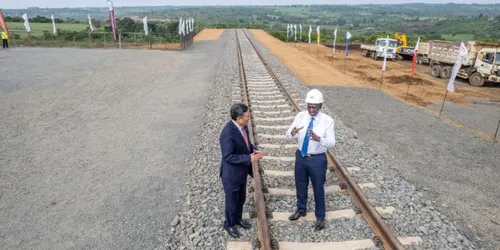
The Standard Gauge Railway (SGR) extension, connecting Kisumu to Malaba, was launched by President William Ruto and his Ugandan counterpart, Yoweri Museveni last week.
This infrastructure project, known as the Naivasha–Kisumu–Malaba SGR extension (Phase 2C, 107 km), is a key initiative to unlock Western Kenya’s economic potential, reduce road congestion, and establish Kenya as a regional logistics hub.
The final phase of the Standard Gauge Railway (SGR) project, which will establish the link to Uganda, is estimated to cost Sh650 billion and is anticipated for full completion by June 2027.
The railway is set to traverse four counties: Vihiga, Siaya, Kakamega, and Busia. While the initial plan placed the station in Siaya, the latest proposal has shifted the location to Yala, a decision that bypasses the major commercial center of Luanda. Despite being bypassed by the station, Luanda Sub-County in Vihiga is a key area impacted by land acquisition for the project.
Land Acquisition and Community Concerns
The National Land Commission (NLC) is overseeing the land acquisition process, which affects at least 19 households in Em’maloba Sublocation. Concerns exist among some residents regarding compensation and the lack of land ownership documents.
Local leaders have criticized the new railway alignment, which runs from Naivasha through Kisumu to Malaba. Their main objection is that it bypasses a community with nearly a century of deep historical ties to the railway. Despite this criticism, the government has given assurances that all land-related concerns will be addressed appropriately.
 Luanda MP Dickson Maungu has led the charge against the realignment, terming it a calculated move to strip Luanda Town of its rightful place on the modern rail network.
“For generations, Mwibona has been more than just a stop,” Maungu lamented. “it was the pulse of the region.”
Mwibona has been synonymous with railway travel with traders planning market days around the train timetable, families bid emotional goodbyes at its platforms, and agricultural produce from Luanda, Emuhaya, and beyond flowed seamlessly to Kisumu and Nairobi via this modest but iconic stop.
Today, Maungu warns that heritage stands on the brink of being wiped out.
“Mwibona is not just a place, it is our identity. It has been our railway home for 80 years. Why erase our history now?” the MP questioned passionately.
Speaking while disbursing bursary cheques worth Sh65 million to over 13,000 students, Maungu accused project planners of pushing through the SGR realignment without meaningful public participation.
 He noted that Luanda hosted the colonial-era meter-gauge railway station for over eight decades, and excluding it from the new line is an injustice to locals.
“Mwibona is not just a point on the map; it is our history, our identity, and our economic anchor,” he declared. “For over 80 years, Luanda has hosted a railway station. How can we suddenly be excluded from the new SGR line without justification?”
Mr Maungu said the station transformed the once sleepy village of Mwibona into a commercial hub and carried many children through school.
The anxiety among residents is palpable, with the local economy hanging in the balance.
The bustling Luanda Market, a lifeline for traders, thrives on the movement of goods and people, a movement that was long fueled by the rhythm of the old railway line.
As the government gears up for the construction of Phase II of the SGR launched at Kibos in Kisumu at an estimated cost of Sh122.9 billion residents of Luanda are now asking a simple question: What happens to the town that helped build the railway’s legacy?