
|
Getting your Trinity Audio player ready...
|
By Jasmine Atieno
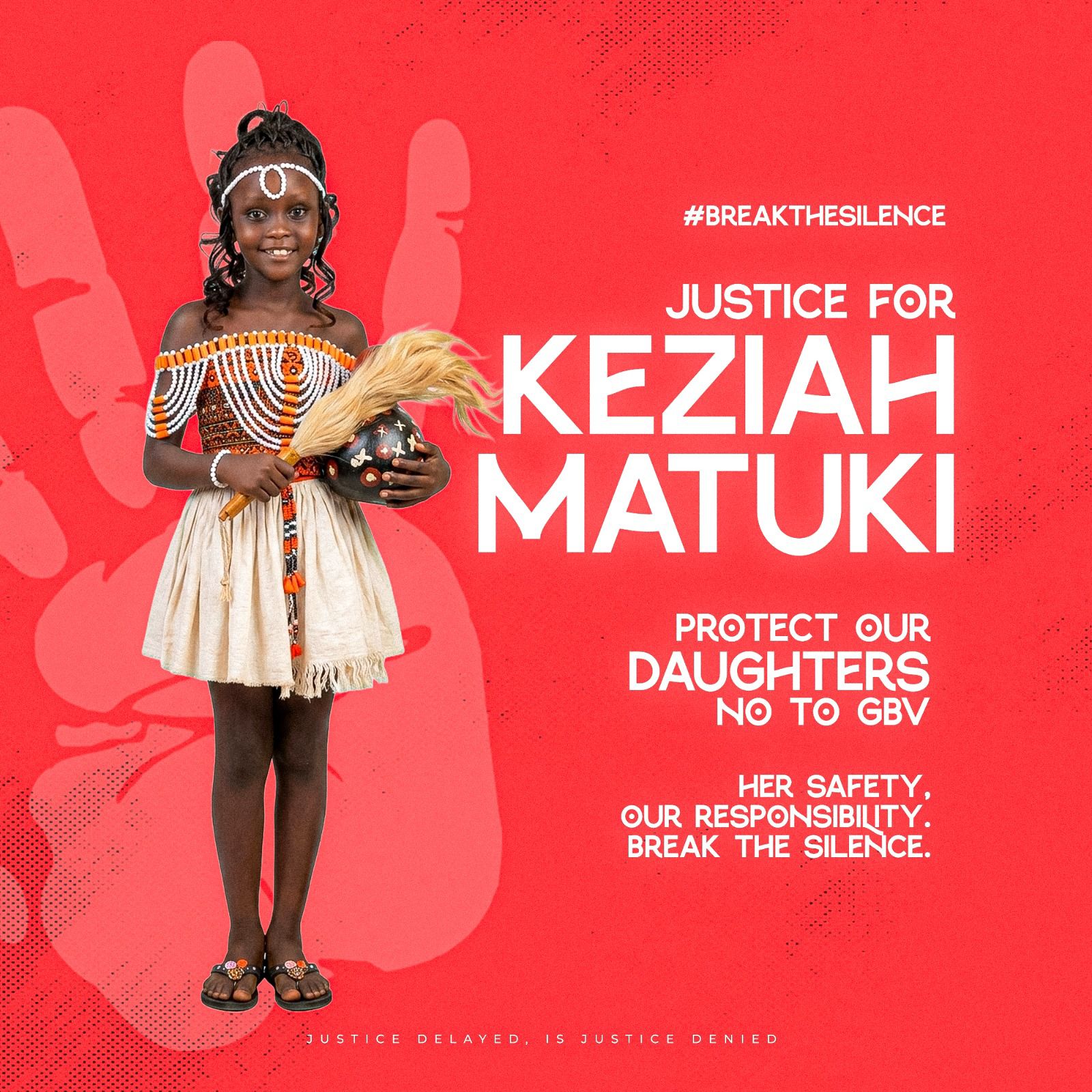
On Sunday, 7-year-old Keziah Matuki of Tezo, Kilifi County, was strangled, defiled, and murdered. A child died fighting a rapist off her frail body. My heart is shattered. I am a bleeding mess today. Totally broken, because: how did she deserve this? What kind of world allows little babies to be preyed upon? Where is our humanity when children are not spared from the menace of gender-based violence and femicide?
Keziah is not alone. In March, nine-year-old Faith Mwende from Machakos was reported missing after school and later found dead in a thicket, with her neighbor accused of the crime. In February, eleven-year-old Brian Otieno from Kisumu was abducted while playing football; his body was discovered near a sugarcane plantation. Late last year, six-year-old Mary Achieng from Homa Bay was defiled and killed by a relative. These names are not statistics. They are children who should be alive, in school, and playing with friends—not buried under the weight of impunity and silence.
The data is an indictment. Kenya’s 2019 Violence Against Children Survey found that nearly one in six girls experienced childhood sexual violence, and 62.6 percent of them suffered it multiple times before age 18. Around one in two young adults in Kenya experienced violence as a child. Physical violence affects nearly two out of five girls. Certain forms of physical and sexual violence among adolescent girls aged 13–17 have even increased in the past year. The 2022 Kenya Demographic Health Survey shows that 13 percent of women and girls have experienced sexual violence, with Bungoma at 30 percent, Murang’a at 24 percent, and Homa Bay at 23 percent. Globally, UNICEF estimates over 370 million girls and women alive today—one in eight—experienced rape or sexual assault before age 18. Every seven minutes, an adolescent is killed by violence.
Impunity and silence are at the core. In Kenya, fathers commit most incest cases, followed by uncles and stepfathers. Yet stigma shifts blame to children: “Why were you there?” Gaps deepen the crisis. Kenya has only 54 operational GBV shelters in 18 of 47 counties, with just two run by the government, while one in three Kenyan women experiences physical or sexual violence. National helplines exist, but most parents and children don’t know them. Violence is normalized: Two in three children globally face violent punishment at home. In Kenya, one in four children under five live with a mother who is a victim of intimate partner violence. Poverty magnifies risk: 55 percent of Kenyan children are multidimensionally poor. Drought forces girls to walk hours for water, exposing them to rape and forced marriage.
Justice is delayed and denied. Globally, only one percent of adolescent girls who experienced sexual violence reached out for professional help. In Kenya, survivors face hostile police, endless adjournments, and communities that negotiate with perpetrators. The UN High Commissioner warns that only around a tenth of killings lead to full accountability.
This must end. Kenya must declare femicide of children a national emergency and fund it. The Ministry of Interior, ODPP, and Judiciary must create fast-track courts for defilement and murder of children, with no bail for suspects. Every county needs a government-run safe house. GBV helplines must be resourced and publicized in schools, churches, mosques, and chiefs’ barazas. Communities that banish survivors should lose access to NG-CDF bursaries and social protection. Complicity must be made costly. Safe schools and communities must be enforced. The WHO-UNICEF INSPIRE package—parenting programs, safe school environments, and targeted response services—should be implemented. All teachers, boda riders, and health workers must be vetted and trained.
And now Parliament and the Judiciary must answer the hardest question: will Kenya enforce the death penalty for those who rape and murder children? The law retains it, but executions have not been carried out since 1987. If there is any crime that demands the ultimate punishment, it is this. If there is any moment to show that the state values the lives of children, it is now. If there is any deterrent left to try, it is this.
The time for half-measures is over. The blood of Keziah, Faith, Brian, and Mary cries out from the soil. Their killers should not walk free, should not negotiate, should not be shielded by families or communities. Parliament must legislate. The Judiciary must enforce. Kenya must decide whether it will continue to bury its children without justice or whether it will finally confront its war on children with the strongest possible measures.
I write this as a gender reporter, as an advocate, as a Kenyan. World Press Freedom Day 2026 calls us to “Shape a Future at Peace.” There is no peace while 7-year-olds die fighting rapists. There is no peace while survivors are punished for speaking. Keziah deserved homework, hide-and-seek, and her eighth birthday. She deserved a state that saw her as worth protecting.
We are broken. Let that break us open to action.
The writer is a Gender Reporter and Vice Chairperson of the Mombasa Press Club.