Kisii County, Kenya: At the age of 10, Nyaboke’s (not her real name) life took a devastating turn when she was forcibly subjected to female genital mutilation (FGM) in Kenya’s Kisii County.
Then a Class Four pupil in a rural primary school, Nyaboke was excited when her parents asked her to visit her grandmother during a school holiday. But what began as an innocent trip soon turned into a nightmare.
“We were four girls at my grandmother’s home when an elderly woman arrived,” Nyaboke recalls. “She introduced herself as a doctor, gathered us in a hut, and announced that she was going to ‘cut’ us to make us adults. That’s when I realized we were about to undergo FGM.”
The woman sharpened her blade and began circumcising the girls one by one. The hut echoed with screams, sobs, and the sight of blood. Locked inside, the girls had no means of escape.
“It was the most traumatic experience of my life,” Nyaboke says. “I was just a girl with dreams of finishing school and building a better future for my family. After that day, I felt like all my hopes had been shattered.”
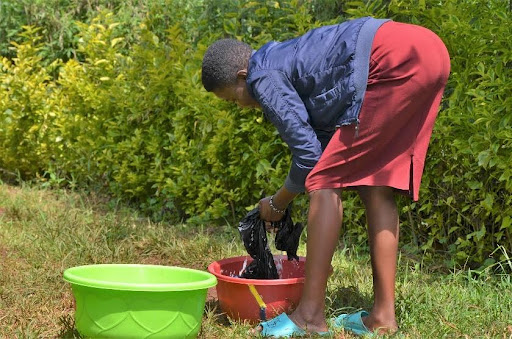
Nyaboke washing clothes at her home in Kisii County, Kenya.
While the other three girls healed within a month, Nyaboke bled continuously for over three months. Her grandmother’s herbal remedies proved futile, and the prolonged pain forced her to miss school.
Returning home brought no relief. Her family, struggling with extreme poverty, could not afford medical care or even basic necessities like food and sanitary towels.
“My father, our sole breadwinner, was left immobile after a road accident. My mother was overwhelmed trying to provide for eight children,” Nyaboke explains.
Desperate to help her family, she eloped, hoping marriage would bring financial stability. But the decision only worsened her plight—until Joseph, an anti-FGM champion trained by the Kisii County government in partnership with UNICEF, World Vision, and CECOME, intervened and rescued her from child marriage.
“I’m proud to be an anti-FGM champion,” Joseph says. Through training, I learned how harmful this practice is. I once believed FGM was necessary, but now I understand its devastating effects, which is why I had to save Nyaboke.”
In Kenya, anti-FGM champions like Joseph play a vital role in ending the practice by raising awareness, advocating for change, and supporting survivors. They work within communities to shift social norms, promote education, and provide alternative rites of passage.
Joseph, who also serves on the Kisii County Anti-FGM Steering Committee under the Department of Youth, Sports, Culture, Arts, and Special Services, has since educated Nyaboke’s parents on the dangers of FGM.
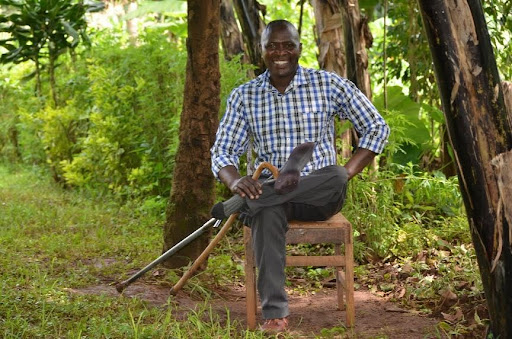
Joseph, a member of the Kisii County Anti-FGM steering committee who rescued Esther from Child marriage in Kisii County.
“I, too, was cut as a girl,” Nyaboke’s mother admits. “I was told it was a rite of passage. Though painful, I believed it made me a ‘real woman.’ I had no idea it would harm my health.”
Now, she and her husband have vowed not to subject their other daughters to FGM. “I’m also urging other women in our village to abandon this harmful tradition,” she adds.
Today, Nyaboke is safely back home and determined to rebuild her life. She is pursuing her secondary education with dreams of becoming a nurse. In her free time, she educates her peers about the dangers of FGM and child marriage.
Female Genital Mutilation (FGM) is still practiced in several communities in Kenya, despite being illegal under the Prohibition of Female Genital Mutilation Act (2011). The prevalence varies by ethnicity and region, with some communities having higher rates than others.
While Nyaboke’s story is one of resilience, FGM remains prevalent not only in Kisii but also among many other communities. Somali, Rendille, Samburu, and Maasai communities in Kenya, highlighting the urgent need for continued advocacy and intervention.
We use cookies on our website to give you the most relevant experience by remembering your preferences and repeat visits. By clicking “Accept”, you consent to the use of ALL the cookies.
This website uses cookies to improve your experience while you navigate through the website. Out of these, the cookies that are categorized as necessary are stored on your browser as they are essential for the working of basic functionalities of the website. We also use third-party cookies that help us analyze and understand how you use this website. These cookies will be stored in your browser only with your consent. You also have the option to opt-out of these cookies. But opting out of some of these cookies may affect your browsing experience.
Necessary cookies are absolutely essential for the website to function properly. These cookies ensure basic functionalities and security features of the website, anonymously.
Cookie
Duration
Description
cookielawinfo-checbox-analytics
11 months
This cookie is set by GDPR Cookie Consent plugin. The cookie is used to store the user consent for the cookies in the category "Analytics".
cookielawinfo-checbox-functional
11 months
The cookie is set by GDPR cookie consent to record the user consent for the cookies in the category "Functional".
cookielawinfo-checbox-others
11 months
This cookie is set by GDPR Cookie Consent plugin. The cookie is used to store the user consent for the cookies in the category "Other.
cookielawinfo-checkbox-necessary
11 months
This cookie is set by GDPR Cookie Consent plugin. The cookies is used to store the user consent for the cookies in the category "Necessary".
cookielawinfo-checkbox-performance
11 months
This cookie is set by GDPR Cookie Consent plugin. The cookie is used to store the user consent for the cookies in the category "Performance".
viewed_cookie_policy
11 months
The cookie is set by the GDPR Cookie Consent plugin and is used to store whether or not user has consented to the use of cookies. It does not store any personal data.
Functional cookies help to perform certain functionalities like sharing the content of the website on social media platforms, collect feedbacks, and other third-party features.
Performance cookies are used to understand and analyze the key performance indexes of the website which helps in delivering a better user experience for the visitors.
Analytical cookies are used to understand how visitors interact with the website. These cookies help provide information on metrics the number of visitors, bounce rate, traffic source, etc.
Advertisement cookies are used to provide visitors with relevant ads and marketing campaigns. These cookies track visitors across websites and collect information to provide customized ads.