|
Getting your Trinity Audio player ready...
|
By Jackson Okata
Nairobi, Kenya: Stakeholders within the East African Community have called for the harmonisation of trade policies to unlock the trade of agroecologically produced goods within the bloc.
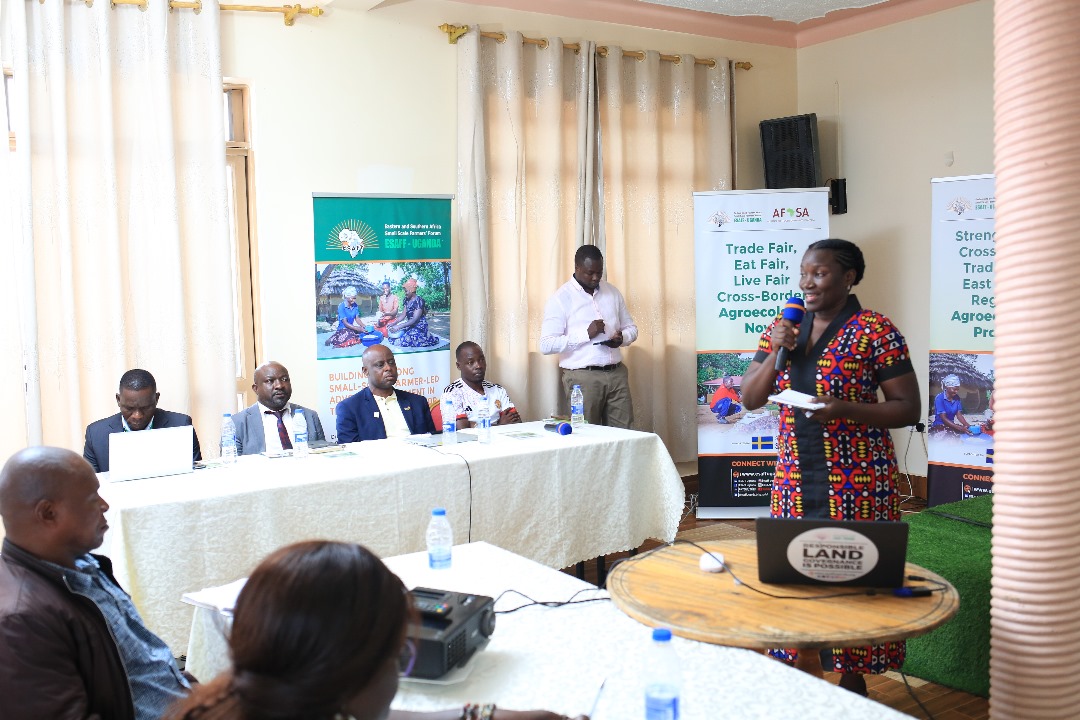
The stakeholders, including farmers, policymakers, private sector players, and traders, argue that strengthening cross-border trade in organic produce will boost national revenues while lifting millions of farmers out of poverty. They spoke in Uganda’s Bugiri District during the National Multi-Stakeholder Meeting on Intra-EAC Trade in Agroecological Produce, convened by ESAFF Uganda in partnership with the Alliance for Food Sovereignty in Africa (AFSA).
During the meeting, participants deliberated on how to unlock inclusive, sustainable trade in agroecological products and services within the EAC region.
The meeting came after the validation of a major study by the Alliance for Food Sovereignty in Africa (AFSA) on intra-EAC agroecological trade, conducted at four key border points — Busia (Uganda–Kenya), Mpondwe (Uganda–DRC), Namanga–Tarakea (Kenya–Tanzania), and Rusumo (Rwanda–Tanzania). The study found that while trade in agroecological produce is vibrant, it remains constrained by systemic challenges.
According to the study at the Busia border point, maize (146.9 tons) and beans (92.6 tons) dominated trade, followed by groundnuts (34.6 tons), sorghum (35 tons), and cassava (17.3 tons). In Mpondwe, rice led with 100,000.3 tons, while beans, tomatoes, onions, and cabbage were also significant. Overall, cereals, legumes, bananas, vegetables, and medicinal plants were the most in-demand products across all borders.
The study highlighted barriers, including unharmonized standards, high transport costs, multiple taxes, certification hurdles, and poor border infrastructure, all of which restrict agroecological trade and limit smallholder farmers and traders from tapping into growing regional and global markets.
Sir Bob Sunday George, Agroecology Focal Person at Uganda’s Ministry of Agriculture, warned that without formalisation and regulation, adulterated products will continue to erode market confidence.
“We must mainstream and regulate farmers and traders to rid the system of adulterated products,” said Sunday. “Certification is key, because once you are certified, you address market concerns. We also need dedicated markets for agroecology and organic products.”
Hakim Baliraine, Chairperson of ESAFF Uganda’s Board of Directors, stressed the need to bridge the gap between producers and markets to secure fair prices for agroecological produce. He also urged the standardisation of regional seed quality assurance to guarantee consumers high-quality products.
“The origin of everything we do in the market starts with a seed. If we do not ensure quality at this stage, the final products in the market will inevitably be of poor quality,” said Baliraine.
At the same time, Baliraine called for unified standards and certification of agroecologically produced products to address the issues of traceability, which he says would guarantee consumer confidence and boost farmer incomes
“We must be able to know who is producing conventionally and organically’’
ESAFF Uganda’s National Coordinator, Nancy Mugimba, called for greater investment in value addition to tackle post-harvest losses in Uganda and Kenya. She stressed the need to close gaps in certification, packaging, branding, and marketing to protect both consumers and farmers. “Proper labelling of agroecological products will help consumers appreciate premium prices, good prices that can lift farmers out of poverty,” she said.
Alex Nakajjo, the trade advisor at AfCTA, echoed calls to scale up production and embrace digital innovations.
“The global demand for agroecological products is increasing. Let’s widen the scope and position ourselves to produce more agroecological products to feed these markets, and also embrace digital marketing.”
David Erulwe, Chairperson of Busia Cross-Border Traders, noted that many traders have limited knowledge of agroecological practices and urged more training for both farmers and traders.