
|
Getting your Trinity Audio player ready...
|
By Ruth Kadide Keah
Mombasa, Kenya: Kenya’s coastal tourism is experiencing growth as cruise tourism steadily gains momentum, extending beyond the traditional ports of Mombasa and Lamu to include the newly constructed Shimoni Port in Kwale County.
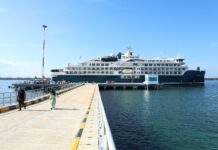
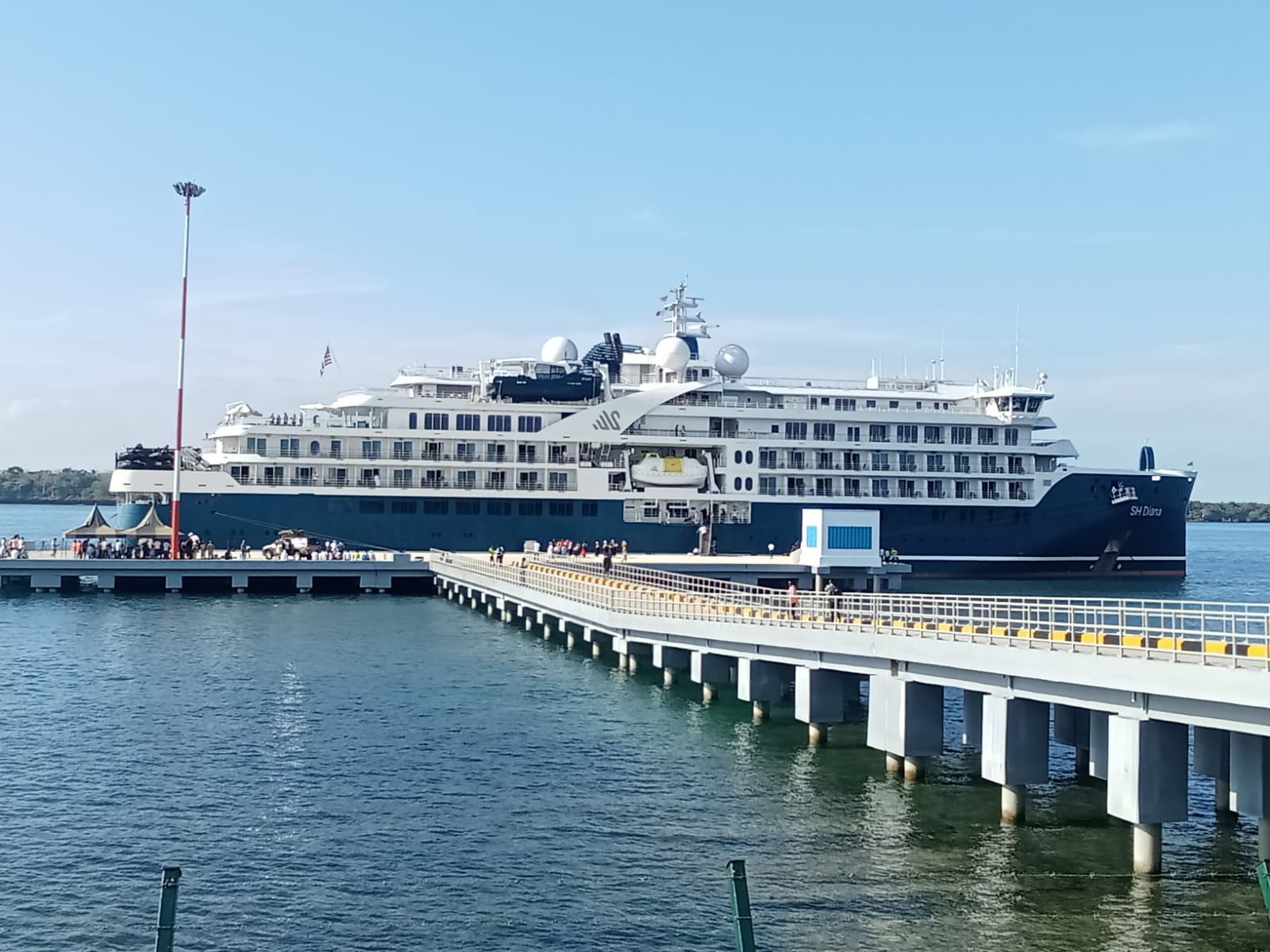
The newly Shimoni Port received its first-ever cruise call on 27 October 2025, as luxury expedition vessel SH Diana docked with 240 tourists on board. The Kenya Ports Authority said the ship arrived from Victoria, Seychelles, marking the official start of the 2025/26 cruise season and signalling fresh momentum for coastal cruise tourism following the port’s completion in June 2025.
The Sh2.6 billion facility, hosted passengers on excursions to Kisite–Mpunguti Marine National Park and the Wasini Island boardwalk.
The Ship’s Captain Jaanus Hannes said it’s the third time that the SH Diana, a luxury expedition cruise ship was coming to Kenya having docked in Mombasa in 2023 and in Lamu in 2024.
The SH Diana, operated by Swan Hellenic and Nisomar Shipping Lines, measures 124 metres in length with a draft of 5.7 metres and features state-of-the-art hospitality facilities.
On 29th October 2025, the vessel docked at the Kenya Ports Authority Mombasa. The Kenya Tourism Board (KTB), represented by acting CEO Alan Joroge, expressed great pride as Kenya welcomed it to its shores.
“For us, this marks the beginning of our cruise season this year,” said Joroge. “We are excited to position cruise tourism as one of the ways we diversify our tourism product, showcasing what Kenya has to offer beyond the traditional beach and safari experience.”
According to Kenya Ports Authority (KPA) Managing Director Captain William Ruto, this is the first time a cruise ship has spent four days in Kenya, a sign that the country’s appeal to international cruise lines is on the rise.
“In 2020, we received only 656 cruise passengers the whole year. Last year, that number jumped to 6,577,” said Captain Ruto. “This year, we have already welcomed our seventh vessel and we have not even reached the peak season yet.”

But while the new port and the surge in cruise tourism promise great economic potential, they also bring new realities for the artisanal fishing communities in Mkwiro and Wasini who have depended on the coastal waters for generations.
The new Shimoni Port, features a 135-metre-long jetty, 30 metres wide and 75 metres deep. Its completion was celebrated as a gateway for greater tourism, trade, and investment in southern Kenya.
According to Mwatuwe Keah, the permanent secretary of Mkwiro Beach Management Unit (BMU), the cruise ship visits have both positive and negative impacts.
“Tourism creates opportunities for our youth as guides, boat operators, and in other support activities. But for the fishers, we have some worries,” he explained.
“When these big ships start coming in regularly, they might require dredging. Dredging can disturb the sea floor, raise sediments, and drive away fish. It can also threaten breeding grounds,” He added.
Beyond environmental destructions, Keah said there’s another risk that has raised eyebrows, the attraction of large predatory fish, including sharks, to the cruise vessels.
“Big ships often attract big fish,” said Mwatuwe. “Sometimes sharks follow these ships because of the movement and the waste they release into the water. This could bring them closer to our fishing areas and pose risks to local fishermen who use small boats.”
While Kenya’s fisheries authorities have strict environmental and marine safety regulations, the communities in Shimoni say they have not yet received formal training or awareness sessions on how to handle the possible dangers that come with increased marine traffic.
“So far, we have not received any safety education or awareness on this issue,” Mwatuwe said. “There is a need for training. Our fishers must understand how to stay safe if these ships become a regular part of our waters.”
Joshua Wambugu, a social science PhD researcher, Wageningen University and Research, working in the Shimoni seascape said the triple call by the cruise ship at different ports along the coastal line is a positive milestone in Kenya’s marine tourism.
He said while it brings good revenue returns to the tourism sectors, it’s important to remember possible negative effects, especially towards subsistence fishers in the shallow reef next ports.
“There is a need for both national and county government agencies to create awareness on risk associated with cruise ship such as big predatory fish that follow them and may attack fishers who might not be aware of their presence.” He said.
Nasser Shee, the chairperson of the Wasini Youth Boat Operators, said the arrival of the ship brought expectations of good business for local residents.
“When the ship came, we saw it as a good sign that our community would benefit,” he said. “But unfortunately, we didn’t gain much.”
According to Shee, the tourists used their own boats instead of hiring local ones. That meant most boat operators on Wasini Island, who rely on such opportunities, missed out on potential income.
Shee urged future visiting cruise ships to work closely with the local community so that residents can also earn from the tourism activities.
“The only people who gained a little were the women’s groups who showcased mangrove conservation on Wasini Island, next time, we hope the ship can stay for more than one day and allow tourists to use our community boats to visit Kisite Marine Park and Wasini Island,” he said.
His sentiments were echoed by Mohammed Shebwa, the assistant chairperson of the Kisite Community Boat Operators.
“As boat operators and tour guides, we didn’t really benefit, about six local youth were chosen to share the history of Wasini Island and were paid, that’s the only way we benefited,” He said.
Mohammed emphasized that for future visits, both the county and national governments should ensure that local communities are more involved.
“If another ship like that comes, let it stay three to five days,” he suggested. “That way, tourists can use our boats to explore Kisite and Wasini Island. When they use their own boats, we gain nothing.”
On the issue of safety, especially concerning possible marine risks like sharks that might be attracted by large ships, the boat operators admitted they haven’t received any training.
“We’ve never dealt with such large ships before. If there are such risks, we’d appreciate being trained on how to handle them,” He concluded.
Judy Gona, the Team Lead at Sustainable Travel and Tourism Africa (STTA), a Pan-African organization championing a sustainable future for Africa’s tourism described the recent docking of a cruise ship in Shimoni as a significant boost for tourism in Kwale County.
She emphasized the need for county tourism stakeholders to work together to ensure they benefit from the emerging cruise tourism sector. According to Gona, local operators must be sensitized on how the cruise industry functions and how to tap into its potential.
“By nature, cruise tourism is quite exclusive. If not well managed, it can yield minimal benefits for micro, small and medium enterprises (MSMEs) in the destination,” she noted.
“This is why deliberate training and empowerment for MSMEs are critical. There are existing models of community inclusion in cruise tourism that Kwale can learn from. For instance, Mombasa County has successfully developed models for MSMEs inclusion that could offer valuable lessons for Kwale,” She concluded.
Building on this perspective, Joshua Wambugu, a social science PhD researcher at Wageningen University and Research, emphasized that such initiatives must be guided by sustainability principles.
“Importantly, sustainable and responsible tourism practices must be adhered to, to ensure local communities benefit more rather than merely serving as curtain raisers and to safeguard fragile marine ecosystems, particularly coral reef ecosystems,” he concluded.