|
Getting your Trinity Audio player ready...
|
By Diana Chiyangwa
Johannesburg, South Africa: The right to a basic education in South Africa is universal, extending to both citizens and foreign nationals, regardless of their documentation status. However, a viral X post creates a false dichotomy, claiming that while South Africans must navigate online portals and provide extensive paperwork, “illegals” can enroll with no documentation. This claim is PARTLY FALSE.
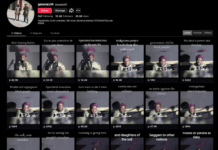
On 15 October 2025, X user @FreeInduna posted that “South Africans must apply using these online portals and supply all their documentation and proof of address, funds, etc. Illegals can pitch up at the school with nothing, don’t need to provide anything, and can demand education under the protection of Siviwe. Haibo.”
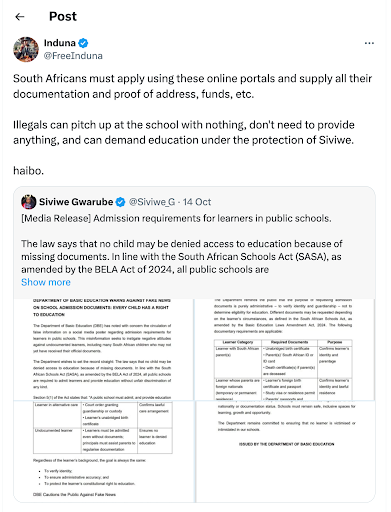
TalkAfrica has found out that South Africans must enrol using an online portal, they must supply all the documentation, and provide proof of address. However, they are not required to show proof of funds as claimed. Foreigners and South African nationals are required to provide certain documentation to verify identity and guardianship. Those who do not have the right documentation, whether they are foreigners or South African nationals, have the right to access quality basic education.
School admission requirements for learners whose parents are foreign nationals (temporary or permanent residence) include: the learner’s foreign birth certificate and passport, study visa or residence permit, and parents’ passports and visas/permits.
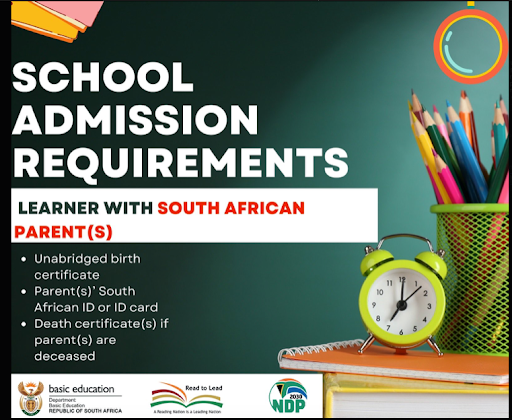
School admission requirements for learners with South African parent(s) include an unabridged birth certificate, parent(s) South African ID or ID card, and death certificate(s) if parent(s) are deceased. All learners use online portals to enrol in public schools.
Department of Basic Education Minister Siviwe Gwarube has clarified the claims on the admission requirements for learners in public schools. On 14 October 2025, Gwarube released a statement detailing the South African Schools Act (SASA), as amended by the BELA Act of 2024, which states that all public schools are required to admit learners and provide education without unfair discrimination of any kind. It also counters circulating “misinformation” that claims strict requirements prevent entry.
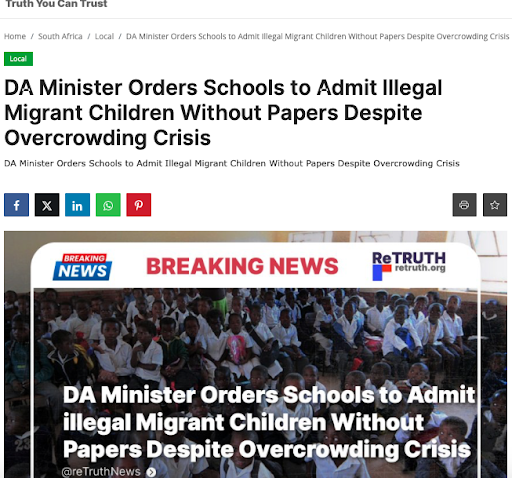
On 15 October 2025, a website, ReTruth, also wrote a headline, “BREAKING: Education Minister Orders Schools to Enrol Undocumented Migrant Children Despite Overcrowding Concerns”. The same post attached a picture captioned the same as the headline.
On the same day, Gwarube posted more information clarifying fake news circulating about the admission requirements between South Africans and foreign nationals. In the statement, the minister emphasised a fundamental principle: no child may be denied access to education due to missing documents.
Vigilante group Operation Dudula has started a campaign barring undocumented migrant children from enrolling in public schools for 2026. The campaign has already drawn criticism from Parliament and rights groups.
Section 29 (1) of the Constitution states that everyone has the right (a) to a basic education, including adult basic education; and(b) to further education, which the state, through reasonable measures, must make progressively available and accessible.’ Page nine of the Bela Act states that South African Schools Act (SASA), as amended by the BELA Act of 2024, all public schools are required to admit learners and provide education without unfair discrimination of any kind.
TalkAfrica examined an X post claiming South Africans must enrol into school using online portals and supply all their documentation and proof of address, while illegals don’t need to provide anything, and found it to be PARTLY FALSE.
This fact-check was produced by TalkAfrica as part of the African Fact-Checking Alliance’s (AFCA) incubation programme. It was produced with peer-mentorship from Code for Africa’s fact-checking initiative, PesaCheck, with financial support from Norway. AFCA mentorship respects the journalistic independence of the researchers, offering access to advanced techniques and tools. Editorial decision-making remains with Name of Newsroom. Want to learn more? Visit: https://factcheck.africa/