
|
Getting your Trinity Audio player ready...
|
By Winnie Kamau
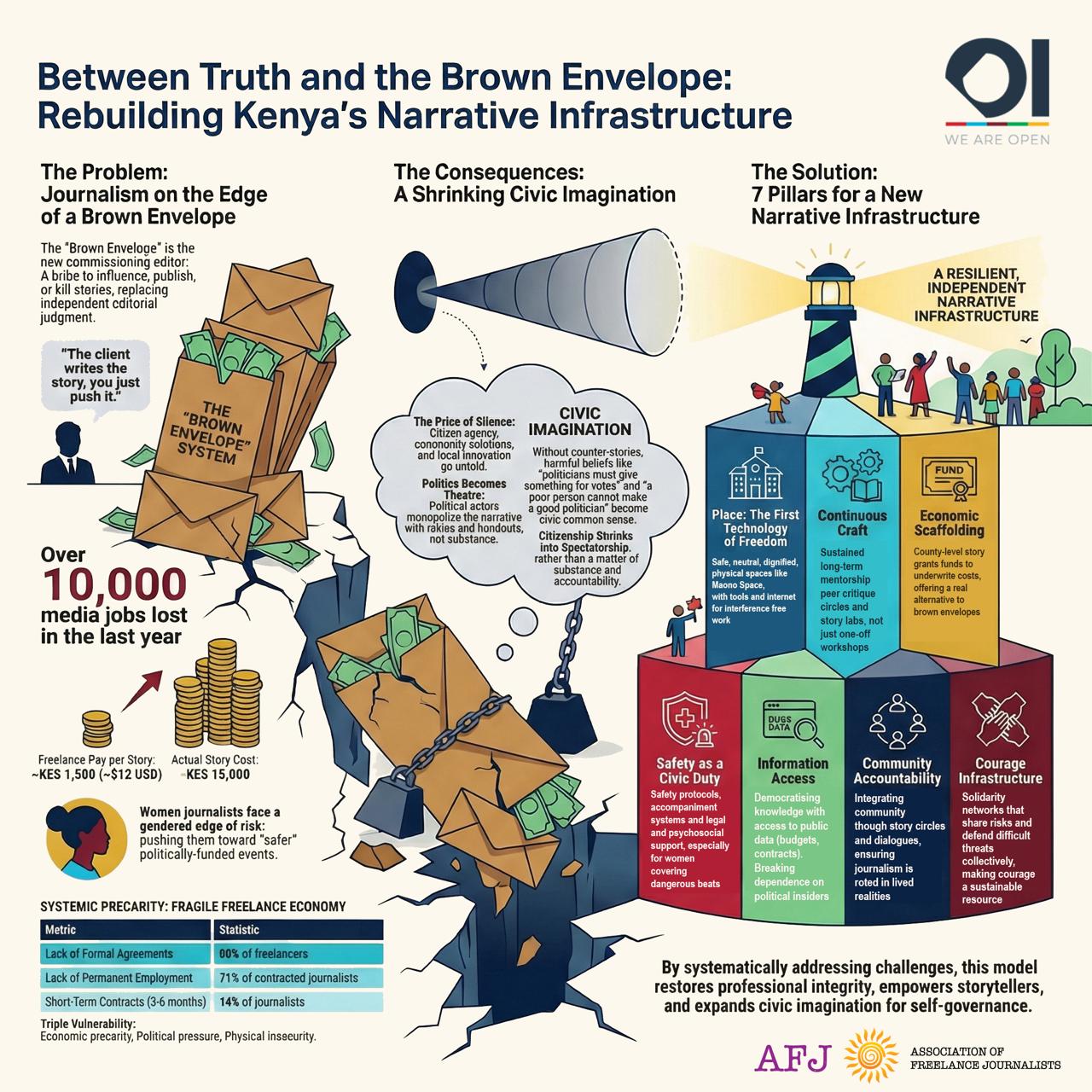
Nairobi, Kenya: Why should we care about ‘Brown Envelope Journalism’? We recently wrote a Reflection Paper, Al Kags and I dubbed “Between Truth and the Brown Envelope: Rebuilding Kenya’s Narrative Infrastructure” speaks directly to the lived reality of many Journalists within Kenya’s media ecosystem. The brown envelope is no longer an occasional ethical lapse whispered about in newsroom corridors, it has hardened into a system.
A system where economic survival replaces editorial independence, where the source increasingly determines the narrative, and where widespread job cuts have left newsrooms hollowed out and journalists working at the margins of sustainability.
Just last year 800 jobs were lost with many going for 7 months without salaries or delayed payments. Lack of contracts that are binding are bedelving many Journalists and especially Freelancers.
 A brief research exercise conducted with OSINT Mount Kenya University and Daystar University highlights a significant and widening imbalance in the communication sector. Despite the ongoing trend of media houses downsizing and newsrooms shrinking, the number of graduates entering the communication field continues to rise.
Data from these two institutions demonstrates this contradiction:
Mount Kenya University (School of Journalism and Media Studies)
| Year | Number of Graduates | Notes |
| 2023 | 196 | |
| 2024 | 544 | A significant increase |
| 2025 | 461 | Majority from the Public Relations department |
These figures encompass graduates across PhD, postgraduate, graduate, bachelor’s, diploma, & certificate levels.
Daystar University (School of Communication)
| Year | Number of Graduates |
| 2023 | 444 |
| 2024 | 396 |
| 2025 | 466 |
These figures encompass graduates across PhD, postgraduate, graduate, bachelor’s & diploma
The combined figures from these universities expose a stark contradiction: the supply of newly trained communicators is rapidly expanding, while the available opportunities within the traditional, shrinking media industry are in decline. The pipeline for talent is growing, but the stability of the sector is not keeping pace.
At the heart of this crisis is the structural erosion of journalistic integrity. When a freelance journalist is paid KES 1,500 for a story that costs KES 15,000 to produce, the system is fundamentally broken. A 700-word article may earn between KES 300 and KES 500. A photo might fetch KES 250 to KES 500, if well negotiated. Even an exclusive video clip may bring in only KES 1,000 to KES 5,000. These amounts come after a full day, sometimes several days of reporting, often followed by long delays before payment is processed via bank transfer or M-Pesa.
Under such conditions, integrity is not merely challenged; it is economically punished.
When journalists, particularly women face the combined pressures of political interference, financial insecurity, and physical risk, the consequences extend far beyond personal hardship. They become a civic cost.
It was a rude shock during a recent engagement with journalists in Kiambu County, in collaboration with the Kenya Union of Journalists, to learn that only two female journalists are currently active in the entire county. Such imbalance signals more than a workforce issue, it signals a narrowing of whose voices shape our public narrative.
And when journalism shrinks, our civic imagination shrinks with it.
Without independent storytelling, citizen agency weakens. Politics becomes performance. Public discourse turns into spectacle rather than substance. Accountability becomes optional. Democracy erodes quietly.
Yet this moment is not only a crisis it is also an invitation to rebuild. We propose seven pillars for a resilient and independent narrative infrastructure in Kenya.
- The First Technology of Freedom . There’s an urgent need for safe, neutral, and dignified physical and digital spaces where journalists can work without intimidation or interference.
- Continuous Craft -We need long-term mentorship, peer learning, and story labs that strengthen skills and ethical grounding beyond one-off workshops.
- Economic Scaffolding. We need sustainable funding models, a Talk Africa Media fund, story grants, and innovation funds that cover the real cost of reporting and reduce dependence on political patronage.
- Safety as a Civic Duty is imperative. We need structured safety protocols, legal aid, and psychosocial support, particularly for those covering high-risk beats and for women facing gendered threats.
- Information Access by democratizing access to public data, budgets, and contracts so journalism is grounded in verifiable facts rather than insider leaks. Access to Information.
- Community Accountability anchoring journalism in lived realities through dialogue spaces and community story circles.
- Courage Infrastructure solidarity networks that ensure journalists do not stand alone when facing threats, making courage collective and sustainable.
Together, these pillars move us beyond critique toward construction. They represent a commitment to rebuild the architecture of truth in Kenya to restore dignity to storytellers, to create viable pathways for the growing number of graduates entering the field, and to expand the civic imagination necessary for self-governance.
This is not simply about saving journalism. It is about safeguarding democracy.