|
Getting your Trinity Audio player ready...
|
By Jasmine Atieno
Mombasa, Kenya: In Kenya’s race toward a digital future, millions are being left behind. While the country boasts one of Africa’s most dynamic tech scenes, a 2021 report revealed that only 29% of Kenyans have basic digital literacy—hampered by uneven access, high costs, and slow adoption.
Nowhere is this divide more visible than in Mombasa.
Here, fewer than one in five households own a computer, compared to one in three in Nairobi. Internet penetration drops below 10% in rural coastal wards. For the region’s youth, these aren’t just statistics—they’re barriers to opportunity.
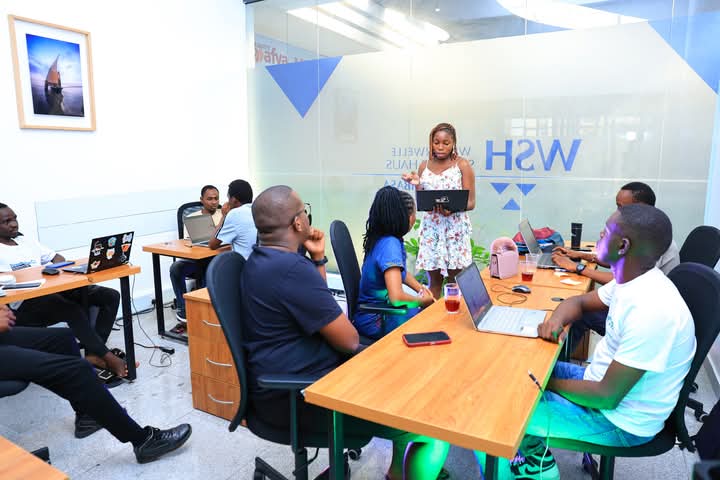
But in a bright, collaborative space at Westerwelle Startup Haus Mombasa, a quiet revolution is taking shape. Young innovators aren’t just learning digital skills—they’re applying them to real market needs, turning constraints into ventures, and slowly rewriting what’s possible for the Coast.
Sarah Kiiru, a fourth-year IT student at the Technical University of Mombasa, knew the frustration well. “I had the technical skills, but no clue how to turn them into solutions that actually mattered,” she recalls.
That changed at the Ubunifu Hackathon, where she joined 34 other developers to tackle real problems faced by local entrepreneurs. Her team created AFRIMOTE—a digital tool designed to help tutors bridge education gaps. What began as a classroom concept is now being tested with real tutors, shifting from a complex prototype to a lean, user-focused solution.
“It’s not about building something impressive,” Sarah says. “It’s about building something that works for people.”
For Ken Gitonga, founder of the AI-powered retail platform StockApp, the challenge wasn’t innovation—it was growth.
“We were so busy adding features, we forgot to grow our business,” he admits. His team struggled with pricing, marketing, and financial planning—common hurdles for tech startups far from Nairobi’s ecosystem.
Then came the ENEA Programme at Westerwelle Startup Haus. Through dedicated mentorship, Ken restructured operations, refined his business model, and focused on customer acquisition. The results were swift: a 30% revenue jump in Q3 2025, expansion into Tanzania, and a coveted spot in Safaricom’s Spark Accelerator—making StockApp the only coastal startup in the cohort.
The Mentorship Effect: From Ideas to Enterprises
Musa Sharif, an innovator at Kenya Coast National Polytechnic, used to believe a great idea was enough. “I didn’t understand design thinking or business modeling,” he says. “I built things without knowing if anyone needed them.”
Nearby, Stephen Caloo, Lead Editor of Mwangaza Magazine, was undercharging for his services, jeopardizing his magazine’s sustainability. “I was overlooking basic pricing factors—I just wanted to get clients.”
Both joined Westerwelle’s programs—Musa in ENEA, Stephen in DigiTalents—where mentors helped them shift from building products to delivering solutions. Musa learned to start with problem statements. Stephen rebuilt his pricing strategy. Today, both run more resilient, market-aware ventures.
A Blueprint for Inclusive Growth
These stories reflect a broader coastal reality. According to the Kenya National Bureau of Statistics, over 60% of micro-enterprises in the region struggle with pricing, market access, and regional trade integration.
“For many, the challenge isn’t innovation—it’s survival,” says Mercy Mukulu, Country Director of Westerwelle Startup Haus.
That’s why in 2025, the hub launched two flagship initiatives: ENEA, a seven-month accelerator, and DigiTalents, a digital skills incubator for youth. Both prioritize women and young entrepreneurs—groups often sidelined in formal economic spaces.
“We’re intentionally creating pathways for those traditionally left out,” Mukulu explains. “When women and youth lead, the whole ecosystem benefits.”
The Ripple Effect
The impact is spreading. Sarah’s AFRIMOTE is now used by tutors across Mombasa. Ken’s StockApp serves retailers in two countries. Musa speaks about design thinking at local polytechnics—Stephen’s magazine champions coastal startups.
“Our goal is to expand market opportunities, drive growth, and strengthen trade across East Africa,” says Mukulu. “And we’re just getting started.”
Future plans include larger cohorts, alumni networks, and ventures in climate tech and fintech—all supported by partners like the Friedrich Naumann Foundation.
From Sarah’s education tools to Ken’s retail platform, a new story is being written in Mombasa. What was once a region defined by limited access is becoming a gateway for homegrown innovation.
The digital divide hasn’t closed—but across the Coast, a generation is building bridges over it. They are proof that when skills meet mentorship, and creativity meets opportunity, the future isn’t something you wait for.