|
Getting your Trinity Audio player ready...
|
By Juliet Akoth
Turkana, Kenya: As the golden sun rises over Kakuma, its light illuminates the arid plains of northwestern Kenya. The settlement gradually awakens; women in vibrant lesos exchange greetings, shopkeepers open their stalls, and children’s laughter fills the dry wind.
For years, darkness enveloped this area after sunset. However, a transformation is now underway. Solar power is redefining possibilities in the heart of Kenya’s refugee settlements. This is a story about light, not only in the literal sense but as a symbol of resilience, opportunity, and progress.
It is about people who refused to wait for the national grid to arrive, finding in the sun a new way to live, work, and dream. This is because according to a 2025 report by the Kenya National Bureau of Statistics (KNBS), 91% of households in Turkana County are not connected to the national electricity grid, meaning roughly 9% are grid-connected. This underlines why off-grid solutions are essential.
Lighting Up Businesses and Homes
When the midday heat presses down on Highland Village in Kakuma, Christine Emanikor sits beneath the shade of her small shop, her solar lantern beside her as it charges her phone and plays soft music from its inbuilt radio.
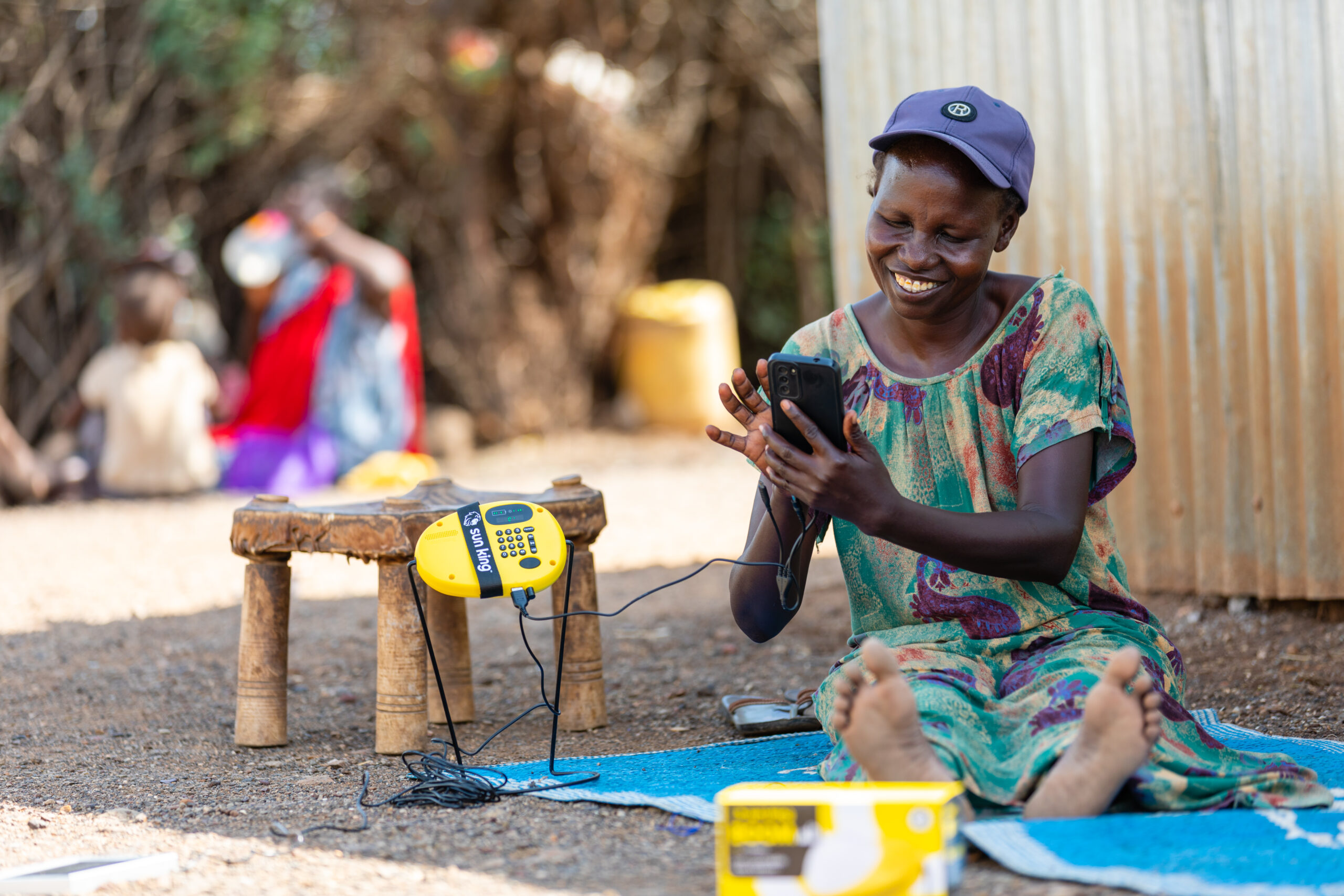
Around her, children laugh, goats bleat, and the steady rhythm of village life continues. To an outsider, it might seem like an ordinary day, but for Christine, that small lantern represents something far greater: independence, progress, and the power to shape her own future.
The mother of five, runs a small shop that doubles up as a vegetable kiosk that sustains her family. For years, she relied on candles to light her shop and home in the evening, closing early to save on costs.
“Before this, I used to close my shop by 8 p.m.,” she said, recalling the time before solar energy reached her. “The candle would finish, and I couldn’t afford to buy more than one every day.”
Her turning point came when a Sun King company agent introduced her to an affordable solar product that allowed her to pay in small daily installments. The promise of flexible payments convinced her to try it.
She began with a deposit of 450 shillings through mobile money, receiving the compact solar lantern that also functioned as a radio and phone charger. At the time, the agent explained to Emanikor how to use the light and soon her shop glowed well past dusk. But she had to pay daily contributions of 15 shillings for 448 days to keep the light on which she found manageable.
“Sometimes when business was good, I would pay fifty or even a hundred shillings,” she says. “That meant I could use the lantern for days without worrying.”
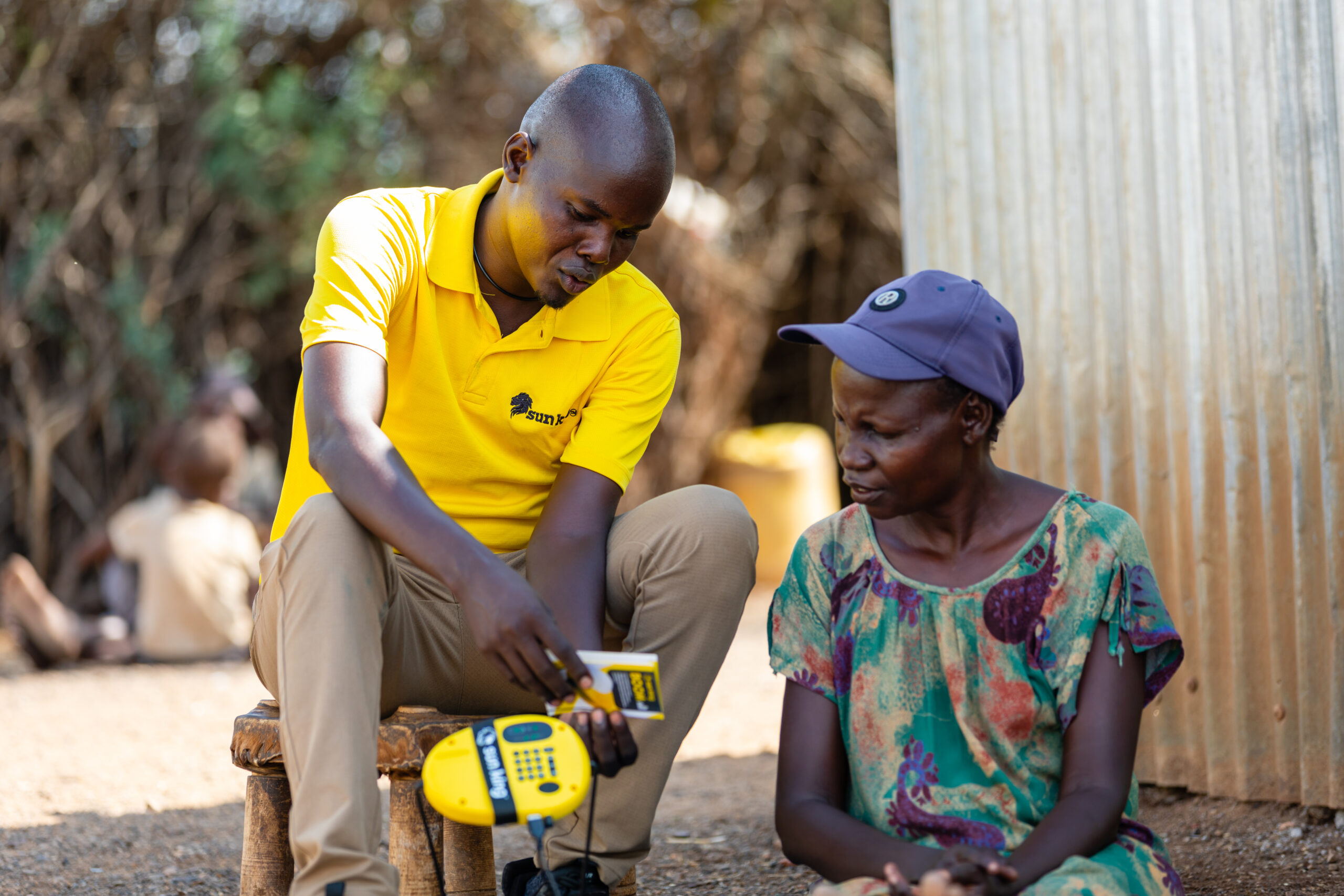 Encouraged by how much her life had changed, Christine later upgraded to a home system that powered three lamps: one for her house, one for the shop, and one for the outdoor compound. The results were immediate.
“Now I work until 10:30 at night,” she said proudly. “I can charge my phone at home, my children do their homework here, and I even earn more.” Her daily income grew from about 8,000 to as much as 13,000 shillings, a boost she attributes to the longer hours of operation and the steady flow of customers drawn to her brightly lit shop.
For her, the most significant change is not just the increase in income but the sense of independence. “Life has changed,” she said. “My children can study at night, I can run my business longer, and we no longer live in darkness.”
Christine’s experience mirrors a growing movement across Turkana. In Nabulon village in Naduat, about an hour and a half by road from Kakuma, 24-year-old shopkeeper Moses Ekai Lomuria remembers when light and refrigeration were rare luxuries. His small shop once depended on cheap solar bulbs that lasted barely an hour at night. “I used to charge them at a neighbour’s house and pick them up later,” he said. “But they would go off after one hour. It was not sustainable.”
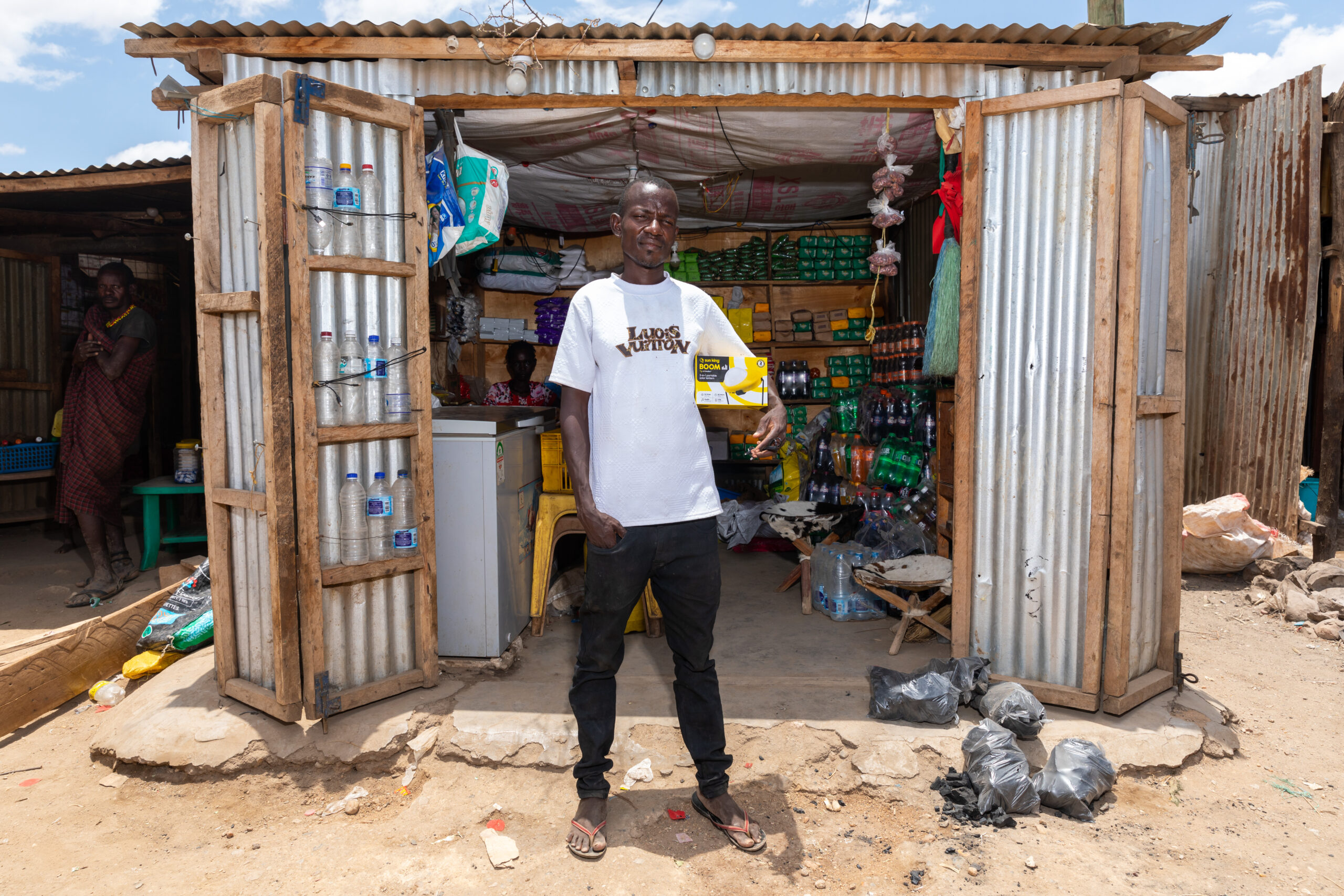
Water scarcity and lack of electricity are part of daily life in Naduat. Yet, Lomuria saw opportunity where others saw limitations. Determined to grow his business, he invested in a solar inverter system by the same company capable of powering lights, a television, and a freezer.
“With this system, I’m able to keep my soft drinks cold, and customers keep coming,” he said. The result was immediate: an increase in sales, longer working hours, and a reliable source of power that kept his shop open until past midnight. “Since I got this system, I sell up to 1 a.m. on some nights because I have reliable light.”
His payment plan, a deposit of 8,000 shillings followed by thirteen weekly payments of 6,300 each is manageable. What matters more is what the system represents: stability. “Before, the business was not doing well,” Moses said. “Now, it has improved so much that I can support my family comfortably with from as little as 500 shillings a day to about 3000 shillings in my pocket a day.”
A Refugee’s Journey to Empowerment
While solar power has illuminated homes and businesses, it has also created new livelihoods. When Ejikon Collins fled war in the Democratic Republic of Congo (DRC) in 2021, he arrived in Kakuma with his wife and seven children, unsure how to start over. He worked odd jobs, including digging pit latrines and hauling water to survive.
These jobs barely earned him 7,000 shillings a month. “No one leaves their country when it’s in the right state,” he said quietly. “I had to do it for the sake of my family.”
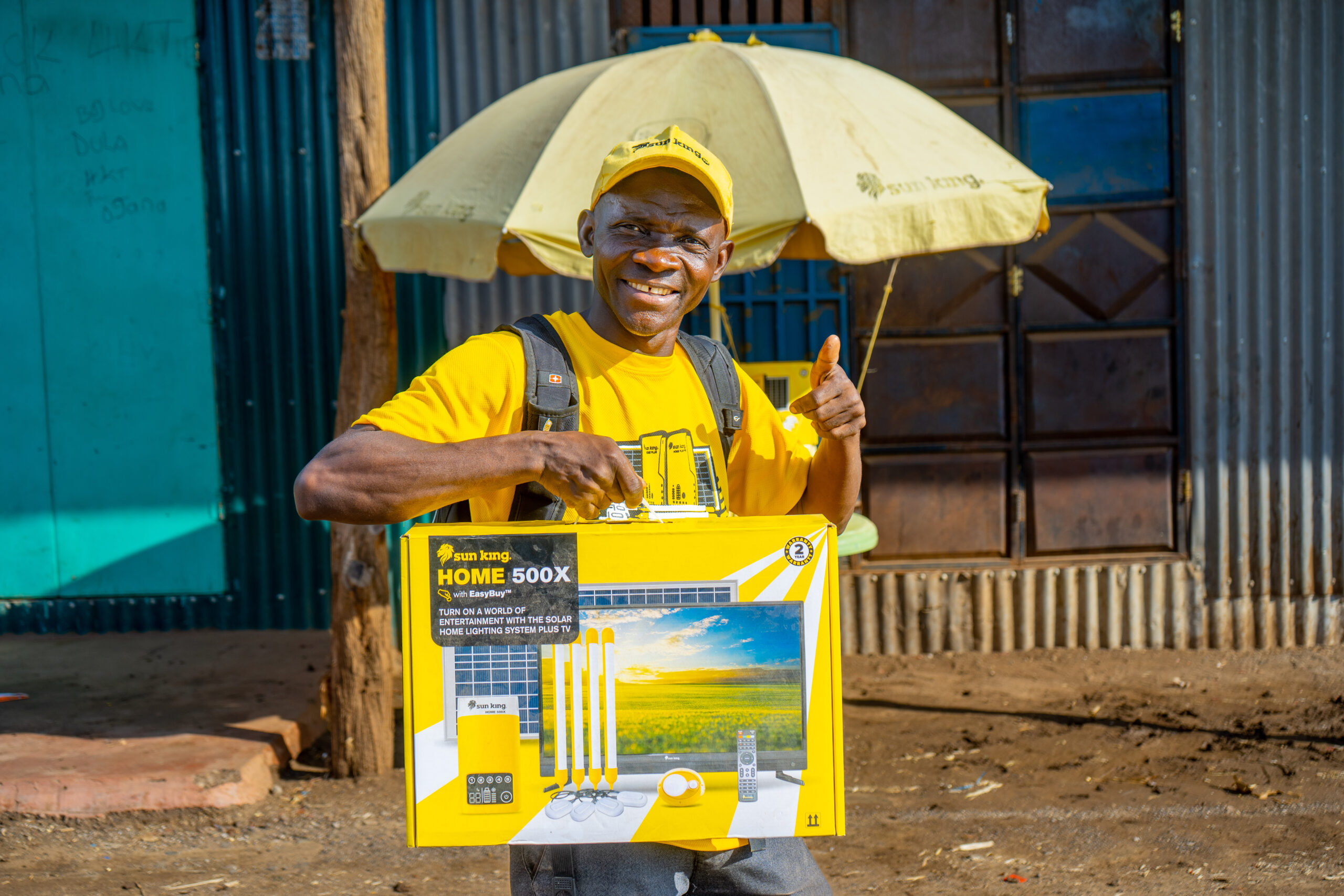
However, his life changed when he met an agent selling solar systems around the refugee camp. Curious, Ejikon bought his first small home system using savings from his labor jobs. Impressed by its reliability, he began helping the agent find new customers. His hard work paid off when he was trained as a scout and, later, promoted to a full-time sales agent.
Today, Ejikon earns an average of 30,000 shillings a month, four times what he made before. “The difference is huge,” he said. “Now I can plan my life, feed my family, and pay school fees for my children.”
The income has allowed him to build a separate house for his children and bring stability to his family. “Before, all of us used to sleep in one small house provided by the Kenyan Government. Now, my children have their own place. That alone gives me peace.”
But the job has its risks. Agents often walk long distances, climb roofs for installations, and occasionally face theft or insecurity. Even so, Ejikon takes pride in his role. “Without this work, I don’t know where I would have been,” he said. “Today, my children are in school, and I’m building a future here.”
Behind the Scenes of a Solar Network
Behind these personal stories is a network of dedicated field agents and managers who keep the system running. In Kakuma, area manager for Sun King Gabriel Nanok oversees close to a hundred agents. On most days, his team traverses the dusty expanse, visiting customers and addressing their needs.
“Many people have benefitted because electricity has not reached the camp,” Nanok explained. “Our agents walk long distances in the heat to serve clients, and when there are problems, they respond quickly.”
The company’s structure encourages mentorship. New recruits start as scouts, shadowing experienced agents before they are allowed to sell independently. “We first do background checks and ensure they are genuinely interested,” said Nanok. “After a month or so, they can become agents.”
The performance-based reward system keeps motivation high, with top earners making up to 40,000 shillings in bonuses.
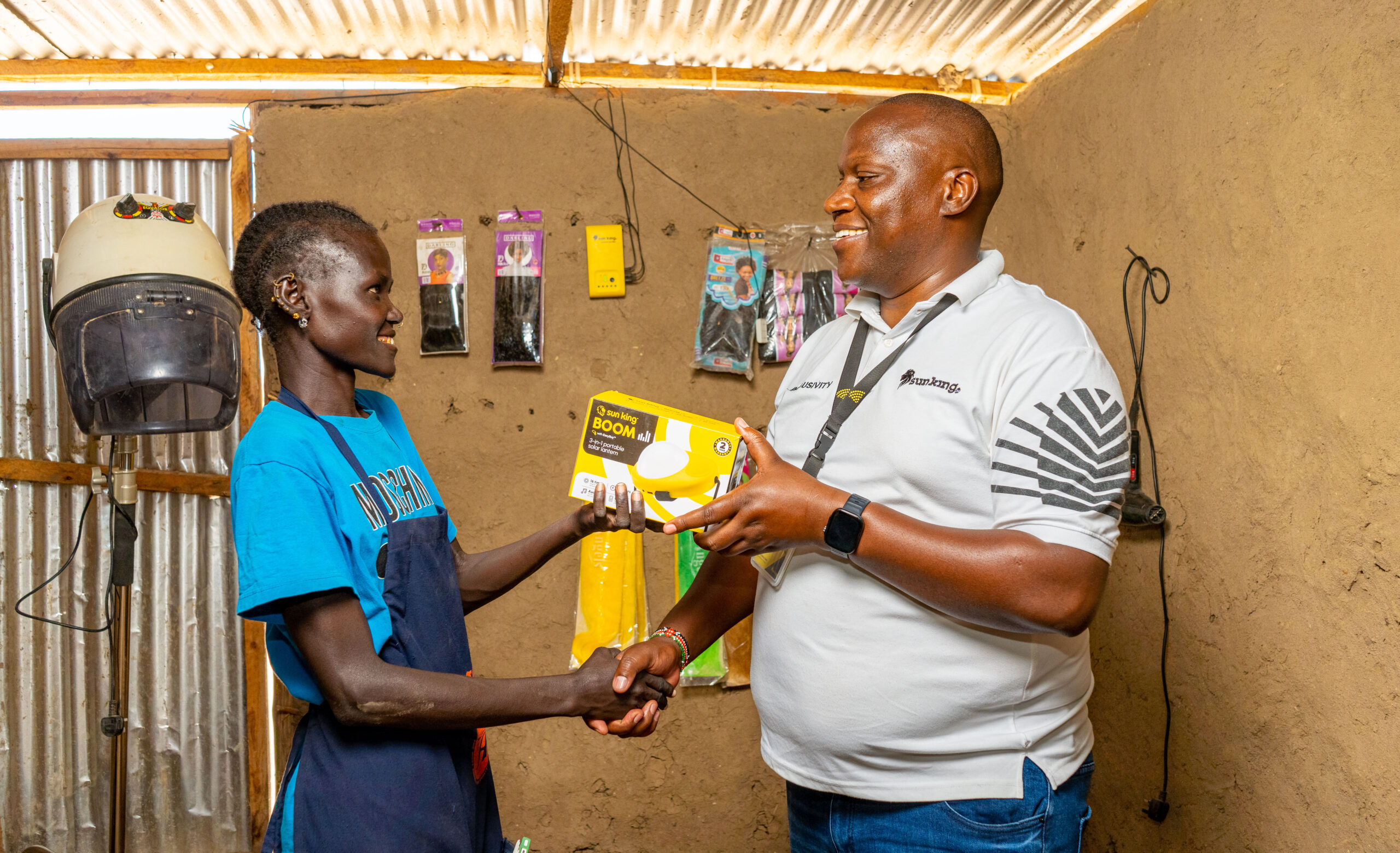
Patrick Henry Ewoi, who now manages the Lodwar office, started as one of those agents in 2019. Using a mobile app for customer registration and payment tracking, he learned to balance sales with service.
“When you get a client, you take their phone number, full name, and ID number and forward it through the Angaza system,” he said. For Patrick, the job has been more than just work, but also a ladder out of uncertainty.
“This work has helped me grow,” he said. “It gives people like us a chance to earn with dignity.”
Expanding Access, Creating Change
At the regional level, Sun King’s effort to expand solar access in northern Kenya is coordinated by Kenneth Koech, the regional business manager for the North Rift. Overseeing ten areas including Bungoma, Trans-Nzoia, West Pokot and Turkana (Kakuma and Lodwar), Koech has seen revenue double in two years. “When I took up this role, we were doing about seventy million shillings,” he said. “Today, we’re above one hundred and fifty million.”
Much of that growth comes from young field agents who sell and service products across remote towns and villages. “Most of our agents are under thirty,” he said. “They bring energy and ambition to the work.” Their success has helped drive Sun King’s “collection score”—a measure of customer repayment reliability—from 50 to around 70 percent. The pay-as-you-go model, which allows customers to make small daily payments through mobile money, has also helped the company scale rapidly in communities that could not otherwise afford large upfront costs.
A major driver of this expansion has been the Kenya Off-Grid Solar Access Project (KOSAP), a government program funded by the World Bank and implemented through the Ministry of Energy and the Rural Electrification and Renewable Energy Corporation.
The initiative which started in 2017 targets fourteen marginalized counties, offering clean, affordable power where grid electricity remains out of reach. Through the program, households received discounts of about 10% on solar home systems, and private companies are reimbursed based on verified installations.
However, the official records by the World Bank show that the closing date of the project was May 31, 2025. But KOSAP’s collaboration with Sun King ended in July 2025.
“The partnership really helped us to open 27 shops in KOSAP counties in remote areas like Lodwar, Ortum, and Kakuma,” Koech said. “It also helped us with staffing and logistics.” Yet challenges remain. Turkana is vast and difficult to navigate, with rough roads and long distances between settlements. “From Lodwar to Kakuma is 110 kilometers,” he explained. “Sometimes the roads are barely passable.”
To overcome these barriers, Koech’s team provides transport allowances for high-performing agents and rewards them with airtime and travel support. Nearly a third of the agents have even bought their own motorcycles to reach distant clients. “Our work is about access,” he said. “We can only make progress if we reach people where they are.”
The region’s logistical obstacles are matched by the importance of trust. Many customers are first-time buyers of modern energy systems, and reliability is essential. Koech emphasizes customer support and flexible replacement plans even for products technically out of warranty.
“We prefer to agree on a small payment plan and replace the product rather than leave someone in darkness,” he said.
The company’s new customer management system, Kazi Plan, has also streamlined operations. Built internally, it allows instant troubleshooting and tracking of sales, replacing older third-party platforms.
A new payment plan called EasyBuy (initially pay-as-you-go) lets clients pay in small installments, while the Pay and Save More option rewards early payments with discounts. “If a customer clears the balance early, they only pay the cash price,” Koech explained. “It encourages responsibility and makes ownership easier.”
Lighting the Way Forward
Beyond the numbers, Koech’s favorite part of his job is witnessing how light changes lives. He recalls meeting a young agent in West Pokot who started with nothing but determination.
“That man now owns five acres of land, has livestock, and built his own house,” he said. “It’s more than a job, it’s a livelihood.”
He also remembers visiting Naduat, where a small shopkeeper’s success with a solar-powered freezer led to a chain of referrals.
“That one customer brought in fifteen more,” he said. “When people see the impact, they spread the word.”
For Koech, the future is clear. “We are planning to open a new shop in Lokichar,” he said. “The goal is to reach every household, every business, every school still in darkness. The sun shines on all of us. Our job is to make sure its power does, too.”
As evening falls over Kakuma, the glow from hundreds of solar lanterns flickers to life. Children huddle over books, traders tally their sales, and families gather outside their homes. The hum of life continues, powered not by the grid but by the sun itself. In the heart of Kenya’s refugee heartland, light has become more than illumination. It is hope made visible.