
|
Getting your Trinity Audio player ready...
|
By Henry Owino
Nairobi, Kenya: Media remains the most trustworthy organization ever known among several institutions for its consistency in producing journalism related to the public interests.
This is because the core role of media and journalists across the world is to inform, educate and entertain the masses culminating to agenda setting for the society.
Media therefore, significantly influences public opinion through the information it disseminates and the narratives it constructs. This way, media influence shapes perceptions on various issues, from political events, health matters, education problems, agriculture sector, transport industry to cultural trends among others.
These common entities are usually occupied by respective workers or employees and represented by trade unions when problems arise with employers. The trade unions negotiate and advance the workers rights with employers and if it fails, leads to industrial actions.
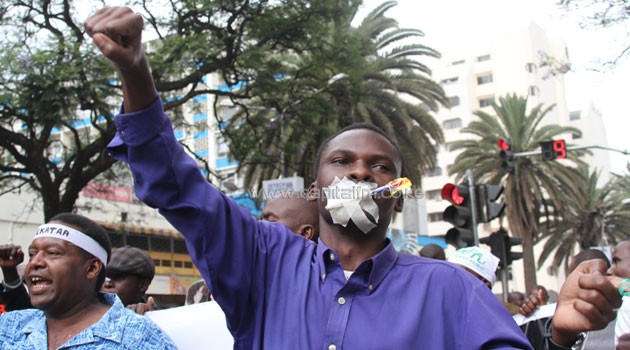
It is journalists who highlight grievances to the public including covering industrial actions normally propelling employers and policy makers to respond. The outcome of such protests by employees generally benefits membership of the trade union excluding journalists for the task played.
Journalists Are Workers
Journalists are workers too just like any other professionals. They earn wages or salaries from services they render to their employers and media owners. Majority of journalists however, are paid peanuts notwithstanding poor working conditions among other rights denied by employers.
According to Antony Githinji, journalists can only realize these rights among other benefits when they are organized through a trade union to advance their dilemma. As individual media houses, it is not easy and most of the time leads to victimization.
“Why do journalists fight for other workers’ pay increment and benefits yet with themselves are poorly paid, work more hours without pay, dismissed unprocedural, among other rights denied and remain silent,” Githinji posed.
Githinji, is the Head of Industrial Relations at Central Organisation of Trade Unions (COTU-K). He made these remarks while training a team of young journalists in Nairobi County on trade unionism and recruitment strategies.
The trade union expert said it is high time, journalists come together and join in numbers. Kenya Union of Journalists (KUJ) already exists and is recognized to push against oppression by media employers.
“Many trade unions have benefited and achieved their goals through media in terms of free coverage; providing visibility, mileage and reporting on damage, losses, and other impacts of downing tools of trade,” Githinji recalls.
Unfortunately, media and journalists who work on such stories and reports do not belong to any unions. Until the journalists join KUJ to help negotiate and advance their rights, protect their interests, and improve the conditions of their employment in the workplace, the employer will continue to maximize profit at the expense of their hard work.
Githinji alluded that for a trade union to defend its members, membership must be made up of workers. Journalists are workers too hence need just numbers from all press clubs, associations and organizations across the country to join KUJ forming one big force for the media industry.
Functions of Trade Union
Most trade unions have three core functions to its members; Collective Bargaining Agreement (CBA), securing benefits for workers and fostering solidarity among employees. The pivotal role therefore includes; advocating for workers’ rights and ensuring fair treatment in the workplace.
The purpose of a trade union is to defend, or improve the conditions of employment. For instance; attaining better wages or salaries, improving working conditions, improving health and safety standards, more off or leave days, among other numerous benefits.
Silas Kiragu, the KUJ Secretary for Labour affirmed the trade union was established in 1962 to represent journalists in Kenya. Its main mandate is to champion free and responsible media, the other is collective bargaining agreement among its members in the media industry.
Kiragu stated apart from KUJ safe guarding press freedom, it seeks to improve the working conditions of journalists. He however, said these can only be done when journalists are organized and united for purpose
“Let’s unite, learn, and build a stronger voice for all journalists. KUJ is here for all journalists across the country to join whether formally employed, correspondent, independent or freelance, the union accommodates irrespective of the status,” Kiragu encouraged.
Louis Thomasi, Director International Federation of Journalism (IFJ) Africa Regional Office, stated trade unionism is a reality and it exists. It is every worker’s first priority to be a member of a trade union that affiliates to their profession.
For journalists operating in Kenya, KUJ is the appropriate union for media practitioners to be a member. Currently, KUJ is the only union in Kenya, again it accommodates all journalists including Freelance Journalists across the board without any discrimination.
“Trade union is a fundamental human right that most employers will say is a privilege. Apart from the right to life and freedom of expression, freedom of association is a guarantee to every worker,” Thomasi emphasized.
Membership Basis of Trade Unions
In Kenya’s context, freedom of association is a guarantee to every worker and it is enshrined in the Constitution 2010, Article 36 to protect it from abuse. International Labour Organization (ILO) 87 guarantees freedom of association and the right to organize.
Thomasi affirmed ILO Convention No. 87, also known as the Freedom of Association and Protection of the Right to Organize Convention, 1948, is a key international treaty focused on the legal regulations of unions and associations.
He therefore alluded to Regional Convention and Protocols supersedes countries’ laws hence employers cannot manipulate or meddle with it to punish employees who join a union.

Erick Oduor, KUJ Secretary General said it is only unions allowed to negotiate with governments or employers on behalf of its members not associations.
Strong trade unions are powerful when it comes to pushing for any agenda. The numbers matter a lot when it comes to representation in negotiating for better services, elective posts among other benefits.
“This is the reason why KUJ is inviting journalists to become its members and form a formidable union just like the media is powerful,” Oduor explained. Our strength as a union relies on our membership numbers,” he added.
In conclusion Thomasi urged Kenya journalists to join KUJ and become ambassadors in their various organizations they work for. He cautioned working independently as individuals dwindle numbers thus profiting the employer.
So, journalists are hereby called upon to join KUJ not waiting for problems to arise, or until one is dismissed unceremoniously then launches complaints. Employers are never happy when employees are members of a union because of the benefits it comes with.