
|
Getting your Trinity Audio player ready...
|
By SHABAN MAKOKHA
Kakamega, Kenya: The rising cost of farm inputs is being addressed in Kakamega County through a free maize distribution program, aiming to benefit over 10,000 small-scale farmers and enhance food production.
Spearheaded by County Woman Representative Elsie Muhanda, with funding from the National Government Affirmative Action Fund, this initiative targets vulnerable, low-income, and small-scale farmers across all 60 wards of Kakamega.
Typically scheduled to align with the rainy seasons, the program ensures better access to essential farming inputs, which is crucial for boosting yields and sustaining local livelihoods. Maize is the primary agricultural activity and staple food in Kakamega.
As a result of this enhanced food security push, the county’s maize production has seen a notable increase, rising from 2.8 million 90kg bags in 2022 to 3.5 million bags in 2025.
“This program is designed to support vulnerable farmers across all the 60 wards, aiming to increase maize production and address food shortages” said Muhanda.
The increase is driven by initiatives that are supported by politicians and the subsidized seeds and fertilizer program.
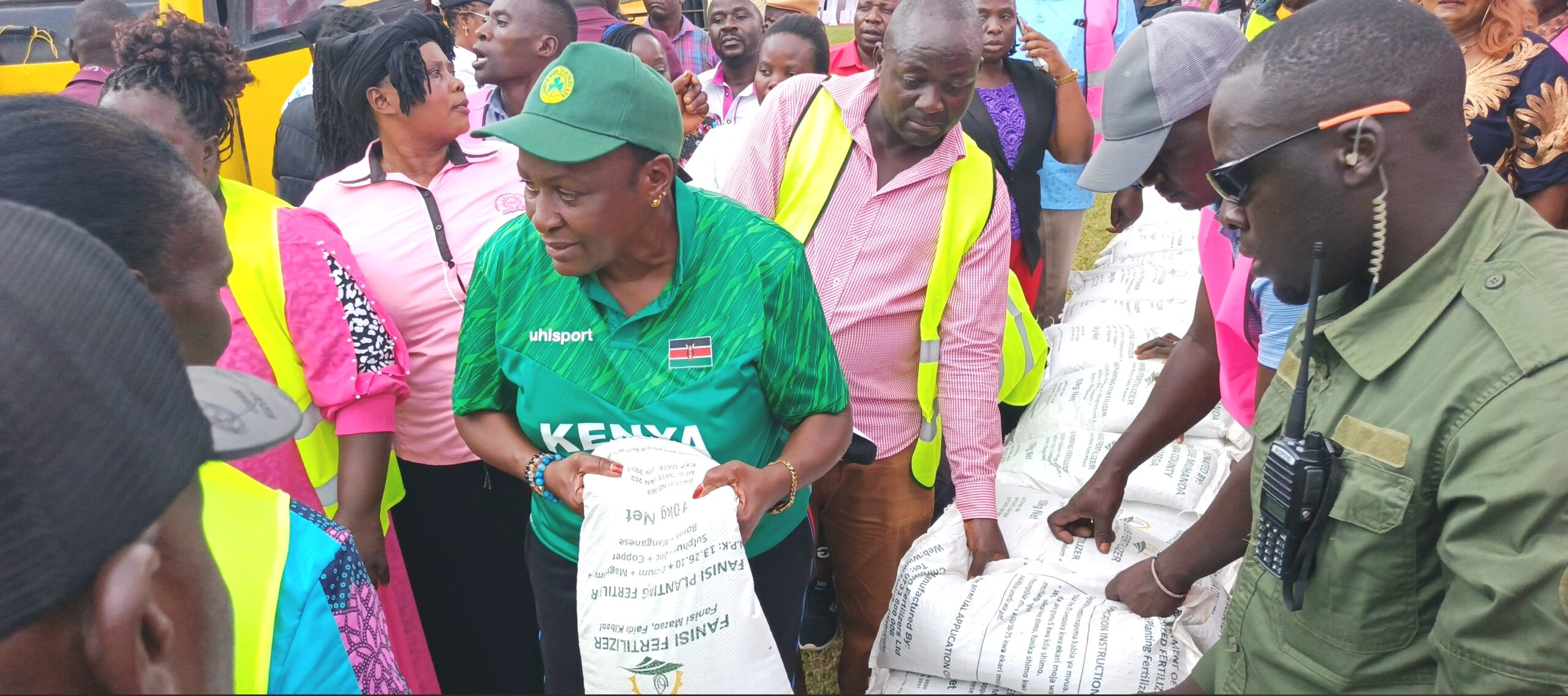
Launching the free maize seeds and fertilizer distribution program at Buchenya Ground in Butere, Ms. Muhanda pledged her continued support for farmers. This initiative aims to increase farmers’ earnings and help the county achieve food security.
“I therefore urge fertilizer and maize seed dealers to supply farmers with certified farm inputs during this planting season,” she said.
This initiative strengthens food security, economic resilience, and inclusivity prioritizing PLWDs and vulnerable households.
She also challenged the leadership of the county government to put more emphasis on quality control and offer improved agricultural practices, soil testing and drought-tolerant early maturing seed varieties to the locals.
In 2024, farmers in Kakamega faced a severe distress after losing their savings and faced a potential crop failure after a major scandal involving the distribution of fake fertilizer with hundreds of bags containing sand and stones instead of nutrients hit the county.

The counterfeit product was discovered to be part of a wider syndicate that was organised targeting farmers ahead of the planting season.
Following numerous complaints from farmers in Kakamega’s Ikolomani, Mumias, Matungu, and other sub-counties, the Directorate of Criminal Investigations (DCI) has confiscated several bags of suspected counterfeit fertilizer in Malava. The farmers reported purchasing a product, packaged in bags, that was effectively useless for planting as it was merely a combination of soil and small stones.
“This time round, we want dealers of fertilizer and seeds to give farmers certified seeds. It is very embarrassing when farmers use their savings to purchase seeds and fertilizer but end up getting conned with fake inputs,” said Ms Muhanda.
She said her initiative of free maize seed and fertilizer distribution and support for farmers has enhanced food security and increased agricultural productivity because she offers quality items.
“Seeing the enthusiasm and hope in the eyes of our farmers today reminds me of the profound impact these efforts can have,” she explained.
This comes at a time the high cost of living has significantly affected farming with farmers staring at strategic support to achieve crop production.
The county woman rep noted that the inability to afford certified seeds was a major bottleneck to achieving food security.
“For all the years I have been distributing farm inputs to farmers, I always link up with Kenya Seeds Company for the supply of certified maize seeds and this helps in countering the distribution of fake seed in the county, which has in the past affected production,” she said noting that the provision of certified seeds and fertilizer boosts maize production.
“We want farmers to have genuine seed to plant in the expected ongoing rains. With certified seeds, the production is expected to be high thus contributing towards food security,” she stated.
Each farmer is set to get one packet of two kilograms of certified maize seed, eight kilograms of planting fertilizer and another eight kilos of top dressing fertilizer.
Recent studies by IITA-CGIAR emphasize the need to re-evaluate key technologies for overcoming poor crop yields. For a successful maize revolution, the report argues that smallholder farmers must have access to and be able to afford a combination of improved varieties and essential accompanying inputs.
Furthermore, it stresses the importance of managing land in ways that enhance, rather than deplete, its quality over time. The report ultimately calls for the delivery of climate-smart agricultural technologies to millions of farmers and the establishment of an environment that fosters market-driven economic development.