|
Getting your Trinity Audio player ready...
|
By Lenah Bosibori
Nairobi, Kenya: Data-driven storytelling is gaining ground in Kenya, with more journalists embracing its power to shape narratives and influence policy. However, when the 2021 Time Use Survey was released by Kenya National Bureau of Statistics (KNBS) in 2023, many lacked the skills to interpret and report the findings effectively.
According to Florence Machio, the Regional Communications and Advocacy Advisor for Africa at Data2X, she says the media coverage after the release of the survey findings showed limited understanding of what the data meant or how it related to development.
“We realized that although KNBS published the findings, most media coverage fell short in explaining what the data revealed or how it linked to broader development issues,” said Machio during a recent Data2X Time Use media roundtable in Nairobi.
She added that the limited reporting prompted Data2X to begin county-level training sessions for journalists to help them grasp the significance of time use data and its implications for gender and development.
“Our goal is for journalists not just to report on time use, but to deepen their skills in interpreting and communicating all forms of gender data,” said Machio. “We want them to ask sharper questions, identify stronger story angles, and use statistics to strengthen accuracy and accountability in their reporting.”
According to her, numbers tell stories and when journalists don’t understand the data, facts become easier to dispute or ignore.
Why Time Use Data?
Time use data tracks how people spend their time on daily activities, including paid work, unpaid care, leisure, and commuting. It is especially useful in uncovering the often-invisible burden of unpaid care work disproportionately carried by women.
According to Heba Katoon, Senior Communications Manager at Data2X, Kenya’s 2021 Time Use Survey revealed that women in the country spend five times more hours on unpaid care work than men. Yet this crucial insight received little in-depth coverage.
“Time use data reveals the invisible truth about unpaid care work,” said Katoon. “If we don’t use this data to inform policy, we miss the chance to support those most affected, especially women and girls.”

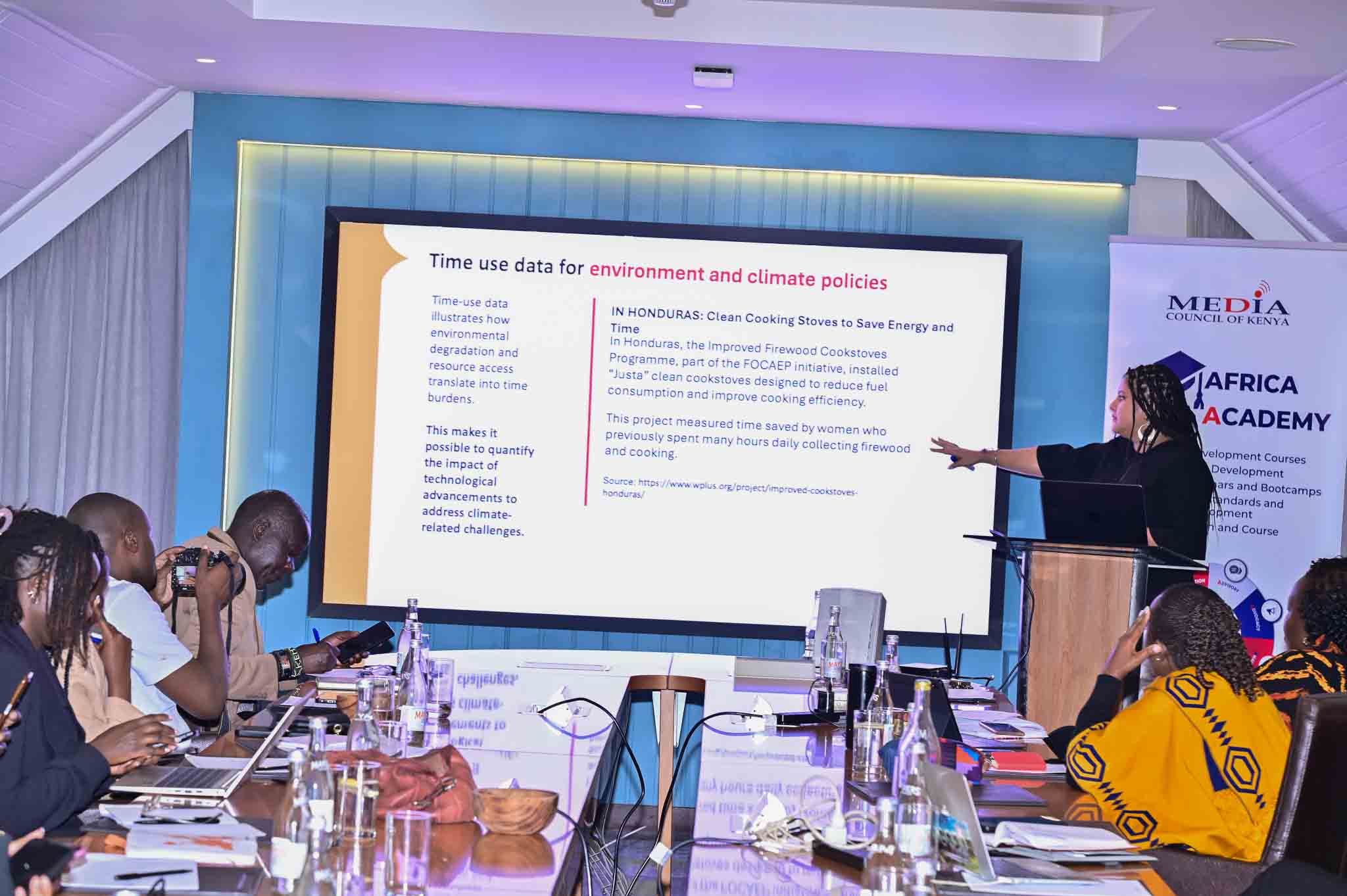
Katoon spoke during a media roundtable in Nairobi that brought together journalists and media stakeholders. The event is part of a broader project funded by the Generation Foundation, which features global case studies from Kenya, Senegal, South Korea, and Mongolia examining how time use data is collected and applied to inform policy decisions
“Kenya’s experience stood out,” said Katoon. “The methodology and engagement were exemplary; it is a story that other countries can learn from.”
Beyond training sessions held in Mombasa, Kisumu, and now Nairobi, Data2X is scaling its efforts. In August 2025, during the Women in Data Summit, the organization will launch a one-year Gender Data Journalism Fellowship for African Journalists.
“This fellowship is about deepening knowledge,” said Machio. “It’s not just about reporting on time use but also about equipping journalists to understand all forms of gender data and to use it to hold leaders to account.”
The fellowship will provide mentoring, training, and support to help journalists produce long-form stories, investigations, and multimedia projects focused on gender equality and development.
“It’s not about the number of journalists trained,” Machio noted. “Even if only a few go on to transform how gender is reported in their newsrooms, that’s success.”
More expansion
Data2X is also expanding its work beyond time use data. According to Katoon, the organization is concerned about the lack of gender-inclusive datasets in artificial intelligence (AI) systems.
“Missing gender data leads to missing solutions,” she said. “We are advocating for ethical AI models that are inclusive and representative,” she noted. “We are also restoring data points that have been erased or excluded from mainstream datasets.”
The organization has also released a report on data and democracy, underlining the importance of open, accessible data in strengthening governance and public accountability.
On the climate front, Data2X is advocating for gender-responsive climate policies that consider how climate change disproportionately affects women more especially in vulnerable regions like northern Kenya.
“Climate shocks affect women’s ability to access food, education, and income,” Katoon said. “That’s why we use platforms like the annual United Nations Climate Change Conference, (COPs), United Nations General Assembly (UNGA), and Women Deliver to push for equitable recovery and climate justice.”
Connecting Global Conversations to Grassroots Voices
One key question raised during the Nairobi roundtable was how these global conversations reach rural communities in areas like Marsabit and Turkana.
“We work closely with the Gender Data Network (GDN), a coalition of grassroots advocates across Africa,” Katoon explained. “They co-create our reports, guide our messaging, and bring the realities of their communities into national and global spaces.”
This connection to local voices ensures that Data2X’s work remains grounded in lived experience, not just theory or statistics.
“I used to fear numbers,” Machio admitted. “But when I got into development, I realized that without data, I couldn’t challenge policies or ask meaningful questions,” adds Machio. “I went back to school to study statistics and it transformed how I work.”
“Data isn’t just numbers. It’s a mirror of people’s lives. If we want better policies, we need better data and we need journalists to tell those stories,” Reiterated Katoon.