


|
Getting your Trinity Audio player ready...
|
By Henry Owino
Nairobi, Kenya: Media stakeholders and Public Relations & Communications Organizations have condemned brown envelope journalism among media practitioners, terming it as illegal, unethical and as having no basis in professional standards.
It is extremely shocking that brown envelope practices within the media industry are gaining ground, compromising journalistic integrity and public trust. Journalists have become lazy in their production and no longer dedicated to balanced reporting.
As a result of the downplay, instead of serving the public interest, news content is usually influenced by personal gain, ultimately watering down facts and undermining credible journalism.
These revelations emerged during a roundtable consultative meeting convened to discuss a reflection paper on the impact of brown envelope practices in the media. The discussion was held under the theme: ‘Between the Truth and the Brown Envelope: Reflections on Kenya’s Narrative Crisis.’
The half day media event was organized by the Association of Freelance Journalists (AFJ) and Open Institute sponsored by Ford Foundation, held in Nairobi.

According to Al Kags, Executive Director at Open Institute (OI), “Brown envelope journalism” is the unethical practice of journalists accepting bribes to shape or suppress news coverage. The practice compromises media integrity, weakens public trust, and results in biased or incomplete reporting.
Al Kags said the bribes often come from news sources seeking to influence how stories are framed and presented. Their main aim is to shape coverage in their favor highlighting positive angles, downplaying criticism, or suppressing damaging information.
“The cash payments are mostly from politicians, government officials, national leaders or elites to journalists for coverage, positive spin, or silence. This goes beyond facilitation; it is about influence and control,” Al Kags clarified.
For example, organizing for a press conference, it would cost an event convenor KES 25,000, and another budget of KES 60,000 for media facilitation. They claim the money acts as an assignment desk, transport and risk compensation.
This way, depending on the number of functions attended, journalists can earn KES 5000 in a day just for attending an event. It has become the primary business model in many countries.
Again, the client writes the story while the journalist amplifies it. In other words, the bribe determines whose truths circulate.
 Winnie Kamau, President AFJ, reiterated that brown envelope is no longer an occasional ethical lapse whispered about in newsroom corridors; it has hardened into a system.
A system where economic survival replaces editorial independence, where the source increasingly determines the narrative, and where widespread job cuts have left newsrooms hollowed out and journalists working at the margins of sustainability.
Winnie regretted that just last year (2025) 800 jobs were lost with many going for 7 months without salaries or delayed payments. Lack of contracts that are binding are bedelving many Journalists and especially Freelancers.
“A brief research exercise conducted with OSINT Mount Kenya University and Daystar University highlights a significant and widening imbalance in the communication sector,” Winnie stated. Adding, despite the ongoing trend of media houses downsizing and newsrooms shrinking, the number of graduates entering the communication field continues to rise.
Impact
“Winnie observed that at the heart of this crisis lies the structural erosion of journalistic integrity. When a freelance journalist is paid KES 1,500 for a story that costs KES 15,000 to produce, the system is fundamentally broken.
“A 700-word article may earn between KES 300 and KES 500. A photograph might fetch KES 250 to KES 500, if well negotiated. Even an exclusive video clip may bring in only KES 1,000 to KES 5,000,” Winnie disclosed.
She noted that these amounts are earned after a full day, sometimes several days of reporting, often followed by lengthy delays before payment is processed through bank transfer or M-Pesa. Under such conditions, integrity is not merely challenged; it is economically punished.

The consequences of all these, instead of the media acting as watchdogs, compromised journalists become tools for propaganda or public relations. Over time, audiences lose confidence in the press, and democracy suffers because citizens cannot rely on accurate, impartial information.
Combating brown envelope journalism requires better pay, stricter ethical standards, transparency, and strong newsroom leadership committed to integrity.
It is a system of physical, economic, intellectual and moral support that determines whose stories survive and whose agency becomes visible.
Communication stakeholders present at the media event concurred with the reflection paper on the impact of brown envelope practices in the media industry. Members reinforced these concerns with examples from different counties, where some journalists allegedly exploit news sources through brown envelope practices.
A representative from a government ministry who spoke anonymously lamented the manner in which she is frequently heckled and pressured by so-called ‘brown envelope journalists’ to hand out money.
“Persistent harassment and intimidation by the journalists demanding monetary handouts is totally shameful and unacceptable. In fact, it is disgraceful and undermines the integrity of the profession,” anonymous decried.
Economic Scaffolding
Al Kags, the Executive Director at Open Institute, called for stronger ethical standards, greater transparency, and better pay structures in newsrooms to help address the situation. He expressed concern that bribery has undermined rigorous investigative reporting and well-researched feature stories.
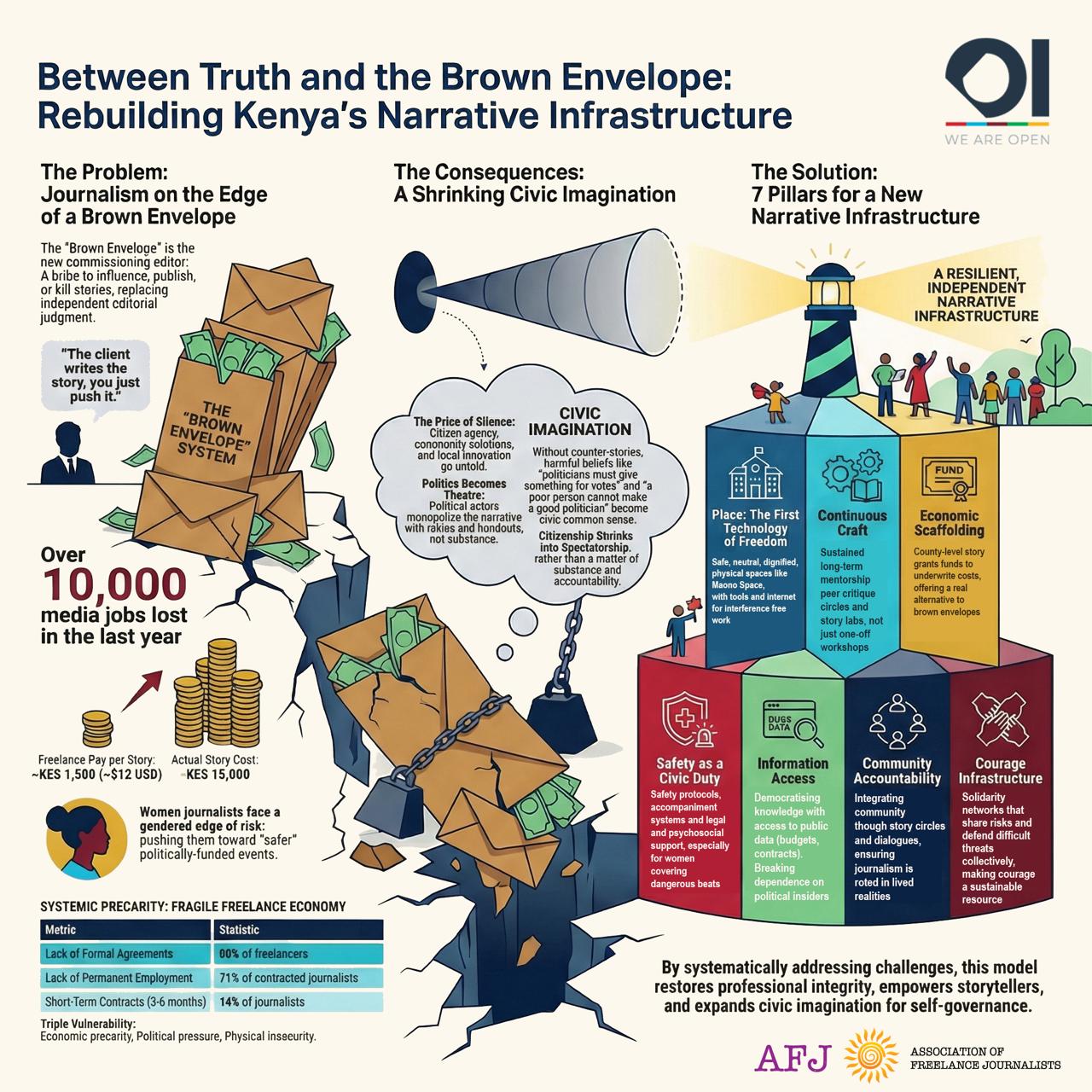 Al Kags disclosed that thousands of journalists graduate from various training institutions each year, and are all competing for limited opportunities in a handful of media houses. At the same time, these outlets are forced to lay off staff due to financial constraints and shrinking revenues, worsening job insecurity in the industry.
“In the last three to four years, over 10,000 journalists have lost their jobs due to newsroom downsizing, media closures, and declining revenues,” he noted.
The OI Executive Director challenged media and communication stakeholders to reflect on where displaced journalists turn after losing their jobs. Many may not be absorbed by the sources in respective organizations owing to this unethical practice.
He encouraged media professionals to consider alternative income streams or side hustles alongside their newsroom roles to supplement salaries that are often insufficient.
“Gone are the days, especially in my years when journalists earned KES 5,000 for a 300-word story and KES 20,000 for a 700-word centre spread, enough to comfortably pay rent. Feature stories fetched between KES 50,000 and 70,000, a stark contrast to today’s significantly lower rates,” Al Kags observed.
Leo Mutisya of Media Council of Kenya (MCK) said plans are underway to provide journalists in the vast counties with Landcruiser to help them navigate the terrain. He disclosed that journalists in such vast counties rely on politicians’ vehicles or county government vehicles forcing journalists to comply with given narratives.
Mutisya also revealed MCK will soon roll out media-hubs in the vast counties to assist journalists compile their stories easily without relying on the news-sources offices.
“At MCK we are concerned with the professional welfare of the journalists not just providing press-cards but to be productive in their careers. We are asking media owners also to play their part for better payment and remain independent,” Mutisya stated.
The team in one accord agreed to organize for yet another meeting of the same to discuss the subject matter in-depth with all concerned stakeholders.














Hey would love you guys to publish my stories. On environment
Greetings, kindly send them via mary41044@gmail.com.
Regards.