
|
Getting your Trinity Audio player ready...
|
By William Abala
Nairobi, Kenya: The UrbanBetter Nairobi Cityzens’ Hub, as part of its Pumzi ya Nairobi activation, convened residents at John Michuki Memorial Park to rally for the protection of urban forests and highlight the urgent issue of air pollution.
For Maryam Wangeshi, the Hub’s coordinator, the event was nothing short of transformative.
“The impact of today’s event is amazing to say the least because people are aware that if they had concerns about what’s happening in Nairobi, they are not on their own,” she said. “Other people are concerned as well — that’s why they came out on a Saturday morning to show up, make some noise for our forests and for cleaner air.”
Running for Evidence, Not Just Fitness
But this was not an ordinary fitness event. Alongside footsteps and chants for the environment were wearable air quality sensors strapped to young participants, gathering data in real-time. The runners and walkers measured air quality as they moved from the green cover of Michuki Park toward denser, traffic-choked corridors leading to Parklands and Karura.
“We wanted to see the contrast between areas with less greenery and more greenery,” explained Wangeshi. “We also used a smartphone application to collect environmental data — what we were seeing, both positives and negatives. That way, when we advocate, we have evidence to back our concerns.”
The evidence is mounting. According to the UNEP’s 2022 report, Nairobi records PM2.5 concentrations nearly five times higher than WHO’s safe guideline. A city once celebrated for its green reputation is choking under the twin pressures of rapid urbanization and deforestation.
“We might have our green spaces now, but it’s not guaranteed if things continue as they are,” Wangeshi cautioned. “Nairobi is one of the greenest cities in the world with a national park inside it. Let’s protect it. It’s not for anyone else to do — it’s for us to show up, ten people, twenty people, and prove we are watching and we care.”
A Youthful Force Steps In
The event spotlighted young people not just as participants but as leaders in climate action. Children as young as 12yrs strapped on sensors, recorded observations, and shared stories about their environment.
“If we are trying to shape a better urban future, who better to have in these spaces than the people who are going to inherit it?” said Wangeshi. “It would be futile if we didn’t include the younger ones.”
The day was also enriched by storytelling. Run leaders and community members narrated what they saw and felt, weaving together personal experiences and scientific data. For Wangeshi, this was deliberate:
“As much as there’s all this data and scientific jargon, that doesn’t touch people where it needs to. Storytelling makes it tangible. That’s why we’ll use the data from today, review it, and then run a digital campaign to help people appreciate it in a real way.”
A Community Organizer’s Call
Among those who joined the movement was Samuel Ochieng, a community organizer from Mathare and founder of Informers Network Organization, a youth-led CBO focusing on waste management.
For Ochieng, the event was not just symbolic but deeply connected to ongoing grassroots struggles.
“Today was significant for air pollution, but also for the need to restore our environment,” he said. “Just as Michuki did here, in Mathare we were also affected by demolition of riparian land. We mobilized youths and organizations to restore it by planting trees and doing urban farming. That way, we saw the need to better our air.”
His concern is the growing encroachment on Nairobi’s green spaces.
“Look at Karura Forest — hotels are going up. Ngong Forest — malls are rising. Why are we doing this while speaking about restoration?” he asked. “No one will speak for us. It’s time we, the youth, bring our ideas together and strongly say we stand with restoring dignity through environment.”
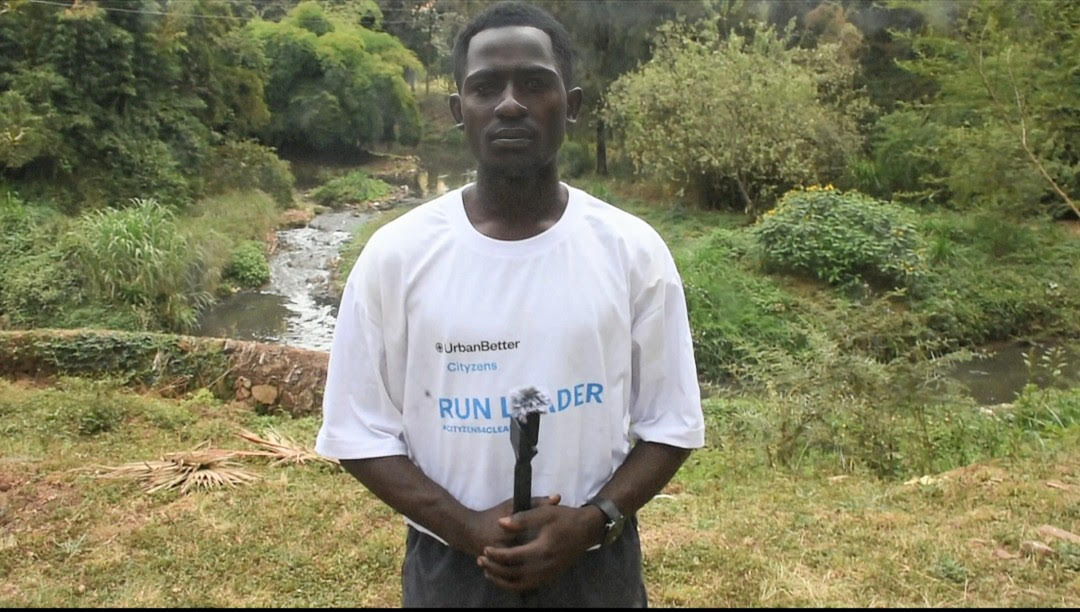
Ochieng was blunt about the threats Nairobi faces. Waste management vehicles spew pollutants, deforestation chips away at carbon sinks, and planning decisions tilt toward profit instead of sustainability.
“Our air has been polluted. It’s high time we come together — young and old, Gen Zs and beyond — to restore our dignity through environment,” he said.
The Role of Youth in Policy
While Ochieng is convinced youth are the backbone of climate action, he is not satisfied with their current involvement.
“Youths are the number, but not all are being involved in environmental issues,” he said. “I’d ask the county and national government to promote local groups in informal settlements. These youths are the right people to make this dream come true.”
For him, inclusion is not charity — it’s necessity.
“If we, the youth, are not part of policy-making and participation in the environment, how do you expect the coming generation to advocate for it?” Ochieng posed. “We don’t have to beg for dignity or inclusivity. All we want is to be part and parcel of making development — and a clean, green Nairobi.”
For Ochieng, the next step is urgent action.
“I’m advocating for SDG 13 — climate action. Youths should not wait for government. Let’s do things that can be seen. If they are seen, government will comply with us,” he said, pointing to Mathare’s transformation of a demolished riparian site into the Mathare Community Park. “We championed it ourselves. Now it’s green.”
Beyond Nairobi: A Continental Movement
The UrbanBetter Initiative is not confined to Nairobi. As Wangeshi explained, it is an Africa-led global initiative, with hubs already active in Accra, Lagos, and Nairobi.
The hub model allows replication across other African cities, ensuring grassroots ownership. “We really look forward to partnering with organizations that align with our mission to make cities better places,” Wangeshi said.
The Pumzi ya Nairobi run/walk is part of UrbanBetter’s Cityzens for Clean Air campaign, blending movement, storytelling, and science to engage citizens in reimagining healthier African cities. The initiative has gained traction amid growing alarm over Nairobi’s deteriorating air quality. Studies by AirQo and UNEP have shown Nairobi’s air pollution contributes to nearly 19,000 premature deaths annually in Kenya, with vulnerable populations most at risk.