|
Getting your Trinity Audio player ready...
|
By Roseleen Nzioka
Nairobi, Kenya: The National Integrity Alliance (NIA), a coalition of anti-corruption civil society organizations in Kenya, has called for the immediate enforcement of the Conflict of Interest Act, 2025, whose implementation commences today, 19th August 2025.
The law presents a critical opportunity to confront entrenched state capture, insider dealing, and abuse of public office, said the anti-corruption alliance, adding that the law risks being reduced to another symbolic gesture without urgent and decisive action from relevant oversight and enforcement institutions.
Kenya’s struggle with conflict of interest is not new; it can be traced back to the 1971 Ndegwa Commission Report, which controversially recommended that public servants be allowed to engage in private business while holding public office. This legitimised dual loyalties and opened the floodgates for the entrenchment of state capture, patronage networks, and abuse of office. This position was further reinforced by Sessional Paper No. 5 of 1974, which operationalised the Commission’s recommendations, effectively institutionalising conflict of interest in the country’s governance framework,” said NIA.
Today, 50 years later, the Conflict of Interest Act, 2025, presents an opportunity to reverse this legacy, but only if enforced rigorously and universally, said the anti-corruption alliance, adding that “this law must either mark the beginning of a new era of accountability or become another failed promise in Kenya’s anti-corruption journey. The success of this law depends on ethical and decisive leadership, credible investigations, and uncompromising enforcement.”
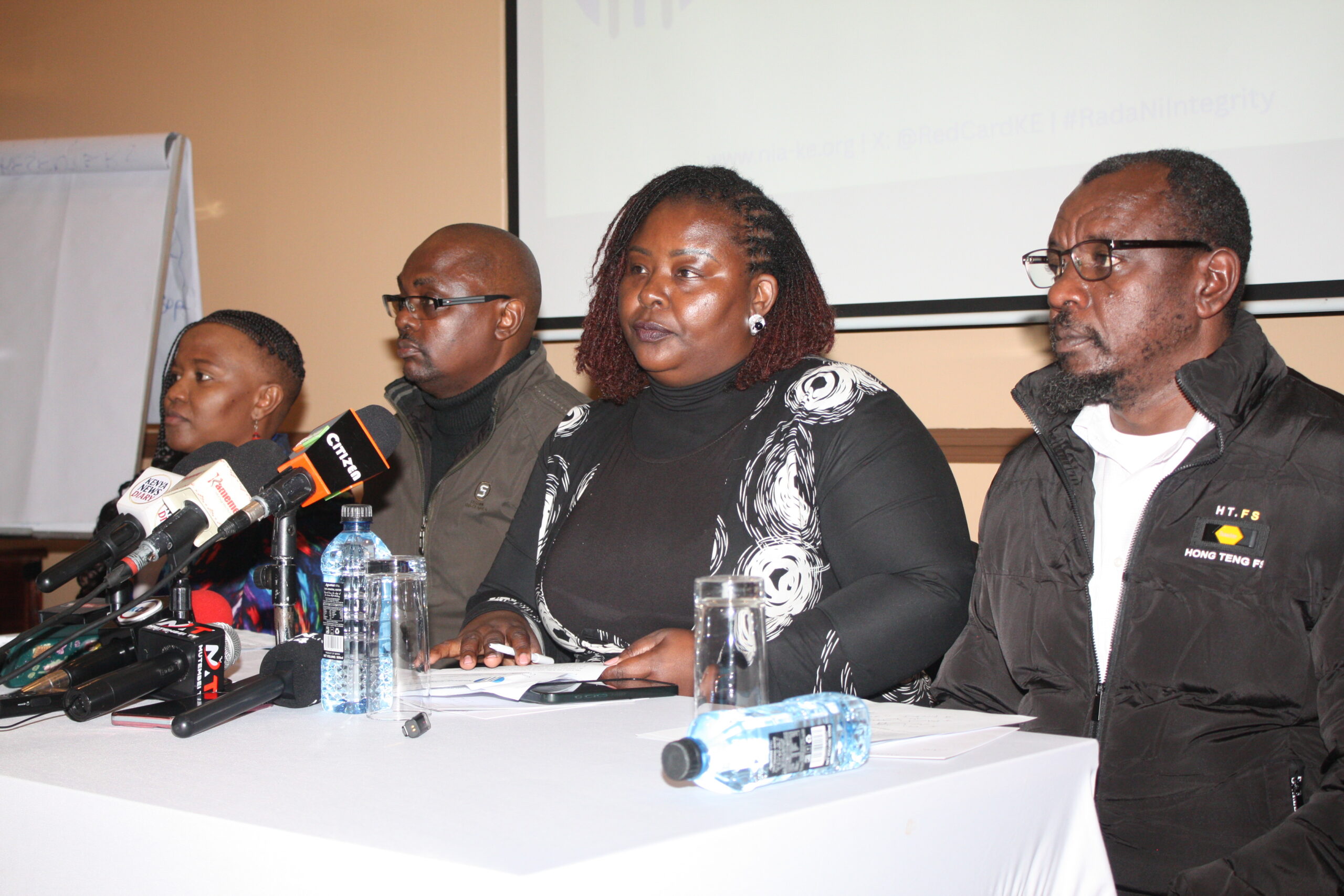
Addressing a press conference in Nairobi on the actual day of the commencement of the Conflict of Interest Act, 2025, the NIA stated that the provisions of the Act establish clear legal standards, requiring declarations of private interests, prohibiting preferential treatment, and banning public officials from directly or indirectly benefiting from government contracts.
“We call on the President and all public officers to demonstrate political will by subjecting themselves and their offices to the provisions of the law and refraining from any conduct, including symbolic or personal projects, that could be construed as misuse of public office,” said NIA adding that procurement entities should be required to disclose contract awardees, and their ultimate beneficial owners, and any politically exposed persons linked to them. This will enhance scrutiny and prevent covert enrichment through proxy companies.
The NIA stated that the call to fully enforce the Conflict of Interest Act, 2025, is made more urgent by the recent scandals and official audit findings that have uncovered widespread conflict of interest violations, including but not limited to seven scandals totaling Kshs158 billion:
- The Kshs. 45 billion NTSA deal: The Daily Nation newspaper revealed a KShs. 45 billion public-private partnership between NTSA and a private firm allegedly linked to statehouse, which is riddled with conflict of interest, lack of transparency, and undue political interference This points to potential violations of the Conflict of Interest Act on failure to declare private interests, granting unlawful preferential treatment and prohibiting public officers from benefiting from or having interests in contracts with their entities
- Report of the Auditor General on national government ministries, departments, and agencies for the year 2023/2044: The recent Auditor-General’s reports exposed irregular procurement practices involved in the SHA’s smart system, including a lack of transparency and accountability in the procurement of a healthcare system that costs taxpayers Kshs. 104 billion, alongside the troubling fact that the State does not own the health system’s intellectual property. These actions likely contravene the provisions of the Act, especially if public officials or their associates are linked to the consortium controlling the system or benefiting from the deal.
- The Auditor General’s report on the e-citizen platform: 5 In March 2025, the Auditor General released a report revealing the loss of Kshs. 9 billion on the eCitizen platform, showing troubling gaps in governance, transparency, and financial accountability. The lack of a centralized accountability mechanism has allowed billions to move through shadowy channels. If public officials were involved in selecting or benefiting from financial service providers without disclosure, this would breach the provisions of the Act. These risks demand immediate investigation and accountability.
- Construction of a church in State House: Most troubling is the proposal to construct a multi-billion-shilling church at State House, presented as a private initiative by the President, but using public land and raising fundamental questions about the misuse of office and public assets for personal religious interests
*Insurance rip-off: The recent article in The Standard newspaper highlights another alarming corruption scandal involving rogue officials in the health sector, accused of colluding with insurance firms and brokers to suspend operations and pocket the premiums. This practice has effectively turned parts of the healthcare system into an insurance scam, directly demeaning citizens’ constitutional right to access healthcare. For instance, patients covered under the Social Health Insurance Fund (SHIF) are being turned away or forced to pay out-of-pocket, even though premiums are deducted, but many cannot access treatment when needed.
- Extortion by parliamentarians: Recent revelations have further exposed the depth of conflict of interest permeating Parliament, where Members of Parliament, particularly those serving on oversight committees, have allegedly been demanding bribes from the Executive, governors, and ministers to produce or withhold reports, effectively turning committee work into a transactional affair that breaches the provisions of the Conflict of Interest Act, 2025, by granting unlawful advantages.
- Kshs. 4.1 billion CDF bursaries cash cannot be traced: An audit by the Auditor General in the fiscal year of 2023/2024, revealed that Kshs. 4.1 billion from 125 constituencies reported as bursary payments through the National Government Constituency Development (NG-CDF) fund cannot be accounted for, which puts members of Parliament on the spot for mismanagement of the Kitty.
The Alliance demanded that the Conflict of Interest Act, 2025, must be prioritized by the Ethics and Anti-Corruption Commission (EACC), per Section 5 of the Act, and supported by all arms of government. “This includes mandatory declaration of interests, enforcement of penalties, and proactive compliance checks across ministries, departments, and agencies. The enforcement of the law must also be prioritized at the county level, where serious concerns have emerged over the misuse of public funds, including governors and senior officials awarding contracts to companies owned by relatives, associates, or proxies.”
“EACC must act decisively and proactively and respond to persistent public allegations of bribery, impropriety, and gross misconduct by MPs, to safeguard the sovereign interests and resources of the Kenyan people, their ultimate employers. Otherwise, public statements, including the President’s repeated claims, risk remaining mere rhetoric aimed at appeasing the public rather than genuine accountability,” said NIA.
Among other demands made by the Alliance were:
The full implementation and public accessibility of the Beneficial Ownership Register, as required under the Companies Act, Beneficial Ownership Information (BOI) amendment regulations, 2022, and the Companies (Beneficial Ownership Information) Regulations, 2020, is essential for detecting hidden interests by public officials in companies receiving state contracts. Linking this registry to procurement systems would expose conflicts of interest in real time.
The ongoing digitization of public procurement through the E-GP platform, such as eProcurement, spearheaded by the Public Procurement Regulatory Authority (PPRA), must be fast-tracked and fully integrated with integrity checks. The platform should include automated red flags for conflict of interest risks, mandatory interest declarations, and real-time public access to procurement data.
As outlined under the Public Procurement and Asset Disposal Act, all awarded contracts must be published on a central, accessible platform. Compliance with these disclosure requirements is fundamental to public oversight, transparency, and accountability.
Public officers and their associates must refrain from participating, directly or indirectly, in any public tendering or procurement process that presents a conflict of interest.
The law must be applied without fear or favor in MP extortion claims. The EACC should investigate the allegations, and any MP or bribe giver found culpable must be prosecuted. Bribes allegedly issued by the Executive to influence legislation should also be probed.
The EACC must report publicly on the status of credible investigations and prosecutions and uncompromising enforcement actions regarding previous audit findings, including the SHA, eCitizen, and other irregular procurements flagged by the Auditor General.