|
Getting your Trinity Audio player ready...
|
By Winnie Kamau
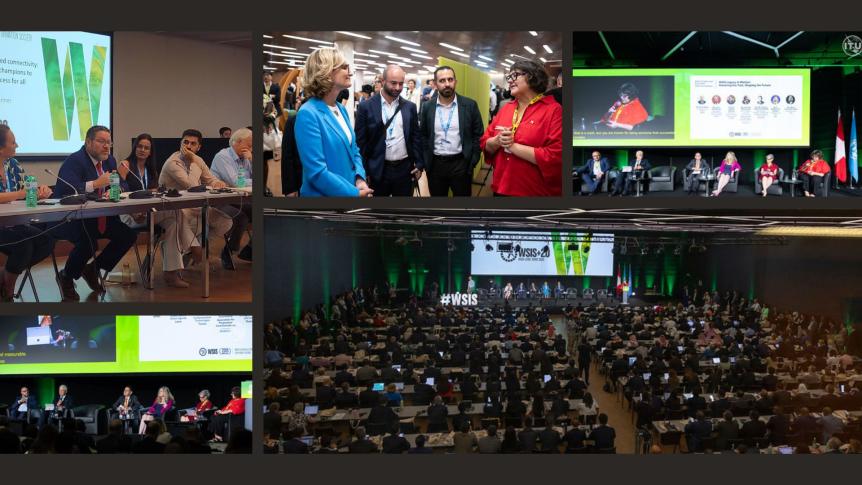
Nairobi, Kenya: Ambassadors Ekitela Lokaale (Kenya) and Suela Janina (Albania) have been appointed as co-facilitators for the United Nations General Assembly’s comprehensive review of the World Summit on the Information Society (WSIS) outcomes. This meeting was held with the ongoing Global WSIS meeting held in Geneva last week.
The first Preparatory Meeting and Stock-taking Session for the WSIS+20 review have officially begun, guided by an elements paper. These sessions will set the stage for negotiations leading up to a high-level meeting scheduled for December 2025.
The Co-facilitators Ambassador Ekitela and Ambassador Suela outlined their dual objectives to delegations from various Member States: “to hear the expectations of Member States on the scope and priorities of the WSIS+20 outcome document, and to gather inputs that will inform an elements paper.”
Amb. Ekitale emphasized that “This process is fully grounded in UNGA resolution 79/277, which re-affirms the leadership of member-states while encouraging the meaningful participation of all relevant stakeholders including civil society, the private sector, and the technical community.”
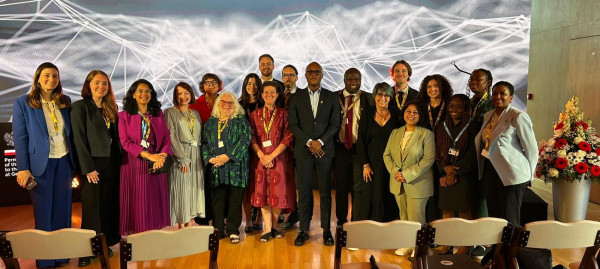
The WSIS+20 review, a significant virtual gathering, marks two decades since its inception in Geneva in 2003 and Tunisia in 2005. This occasion moved me to record the powerful sentiments and conversations shared.
Diverse Perspectives on Digital Governance and the Global Digital Compact
During the virtual WSIS+20 Review Elements Paper discussion, the Group of 77 (G77 + China) was among the participating delegates who shared their reviews.
Established in 1964 within the United Nations, the G77+China is a coalition of over 130 developing nations. Its primary objective is to promote the collective economic interests of its members and enhance their negotiating power.
The Government of the Republic of Iraq delivered a statement on behalf of the G77 + China. “The Group firmly rejects the application of unilateral coercive measures, such actions that undermine international law and the charter of the United Nations, seriously hinder scientific cooperation, restrict access to technology and obstructs access of developing countries to achieve inclusive and sustained development” said the Iraq delegate
Adding “There’s a need to uphold the principles of digital sovereignty, equity and the right to development in the digital era. The outcomes of this review should also give impetus to implement the recent commitments contained in the Global Digital Compact.”
The EU proposed several key points, including strengthening the multistakeholder governance model of the Internet, supporting governance sandboxes, and advocating for a permanent IGF beyond 2025.
The European Union delegate affirmed, “We are committed to actively protecting the widespread availability and integrity of the Internet as a global, interoperable network. This commitment reflects the significance of the multistakeholder model of Internet governance, as outlined in the Tunis Agenda and reinforced in the Global Digital Compact (GDC). We believe that effective Internet governance should be inclusive, participatory, action-oriented, and consensus-driven, involving a diverse range of stakeholders including the public and private sectors, civil society, the technical community, academia, and regional and international organizations.”
Lithuania added that the 2016 Internet Assigned Numbers Authority (IANA) transition within Internet Corporation for Assigned Names and Numbers (ICANN) addressed the core issue of no single state having exclusive oversight over critical internet resources, emphasizing the need for continued debate on the public policy component of internet governance. They also highlighted the critical need for synergies and complementarity between WSIS+20 and the Global Digital Compact, especially amidst the current liquidity crisis.
“The IANA transition within ICANN in 2016 addressed the root cause of this process – ensuring that no particular state government has an exclusive oversight role over critical internet resources. Debate about the public policy component of internet governance must be continued, instead” said the Lithuania delegate.
 Finally, Iran asserted that dominant ICT states should not use advancements for coercive measures, including limiting or blocking targeted countries, stating, “The states which have monopoly and dominance in the ICT environment including Internet shall not use ICT advances as a tool for economic, political or any other types of coercive measures including limiting and blocking measures against targeted countries.”
North-South Fault-Lines Re-Emerge
During the WSIS+20 Review Elements Paper, eleven countries including Nepal, Cuba, South Africa, Uganda, Indonesia, China, Philippines, Brazil, Uruguay, Morocco, and United Arab Emirates. These nations echoed the sentiments of the G77+China bloc, aligning with the statement delivered by the Iraq delegate on their behalf.
The Cuban delegate reiterated, “We reiterate that unilateral coercive measures including those targeting telecommunications and digital infrastructure undermine the development of the ICT capacities in affected countries.”
Adding “The Global Digital Compact does not replace the World Summit on Information Society. It constitutes a further effort to achieve goals proposed at WSIS. The review should look at how to reconcile both processes. We do not favor new mechanisms or processes for the implementation of follow-up of WSIS and the Global Digital Compact.”
The Ugandan delegate emphasized, “It is important that existing platforms such as the International telecommunications Union, the Internet Governance Forum, the STI Forum of the ECOSOC and the Commission on Science and Technology and Development remain relevant.”
The South African delegate noted, “The Global Digital Compact and WSIS are mutually reinforcing blueprint documents,” expecting the WSIS review to align with the GDC. The Indonesian delegate stated, “We support the implementation of commitments from the Pact for the Future and the Global Digital Compact in synergy with the WSIS architecture to ensure the unified approach to digital cooperation.”
The Chinese delegate highlighted, “To uphold multilateralism and create synergies the U.N. should play a coordinating role in international development cooperation, step up its leadership, coordinate the implementation of the WSIS outcomes, the Global Digital Compact, and relevant G8 resolutions on AI.”
The United Arab Emirates delegate noted, “We need to foster the multistakeholder approach. It is essential that we create action-oriented partnerships across all sectors, including the private sector, civil society, and academia. This multistakeholder model will help ensure that the future of the digital World is shaped by diverse perspectives and expertise.”
The Moroccan delegate raised several subjects for consideration: “Notably, how to govern the Internet and digital technologies and standards, structures and values that have to be adopted to adapt and tailor the current action framework. Amendments can also be made to technology’s infrastructure to remedy the unequal distribution of IT infrastructure. The action lines can also reflect how the situation has evolved, such as in trust and security.”
Shared Emphasis on Multi-stakeholder Collaboration and IGF
Japan emphasized the necessity of multi-stakeholder cooperation to tackle the digital divide, advocating for the continuation of the WSIS framework beyond 2025 as a “highly valuable platform.” They specifically acknowledged the IGF as a “time-tested forum” recognized in the GDC. Colombia echoed this sentiment, stating that “cooperation through WSIS, multi-stakeholder mechanisms enhanced by the strategic direction of the Global Digital Compact is vital.” The Netherlands also affirmed that the “WSIS architecture has contributed to bridging the digital divides” through multi-stakeholder participation.
The United States strongly advocated for extending the IGF’s mandate, praising its role in ensuring that all stakeholders, including engineers, entrepreneurs, and innovators, participate in global Internet discussions. They believe this is “critical to endure the vibrancy and impact of the Internet does not fall victim to top-down governmental regulation and bureaucratic inertia.” Australia, on behalf of Canada, and the United Kingdom similarly called for a permanent mandate for the IGF and stronger recognition of national and regional IGFs, seeing it as a cornerstone of “collaborative and multi-stakeholder digital governance.”
Divergent Views on WSIS and GDC Integration
While there is broad agreement on the importance of the IGF and multi-stakeholder model, opinions diverge on the relationship between WSIS and the GDC.
The Netherlands supports strengthening the connections between the GDC and WSIS commitments, emphasizing a global, interoperable, and secure Internet. They are committed to proactively defending the Internet’s general availability and integrity, reflecting the importance of the multi-stakeholder model reaffirmed in the GDC. They also endorsed the EU multi-stakeholder sounding board proposal.
The United Kingdom also supported integrating GDC initiatives into the WSIS process to avoid duplication and reaffirmed the multi-stakeholder model.
In contrast, the United States asserted that the “WSIS+20 review as an independent framework should focus on the review of the implementation of WSIS outcomes not on the connection to other processes.”
They explicitly stated that “The U.S. will no longer affirm the 2030 Agenda for Sustainable Development and the Sustainable Development Goals as a matter of course.”
Australia, also on behalf of Canada, viewed the GDC and WSIS as “two clearly distinct processes that complement each other,” allowing for reflection on challenges to preserving fragile Internet infrastructure. They emphasized the ongoing relevance of the eleven WSIS action lines and the need for continued efforts toward multilingualism online. They also highlighted the NETmundiale+10 San Paolo multi-stakeholder guidelines as a solid foundation for harnessing technology’s benefits and mitigating its risks.
The Russian Federation took a strong stance against the GDC, advocating for a decade-long extension of the WSIS mandate to fulfill outstanding Summit decisions, particularly on Internet governance and bridging the digital divide. They explicitly stated it is “unacceptable to substitute the WSIS process with the implementation of the non-consensual Global Digital Compact.” They opposed any involvement of the U.N. Commission on Science and Technology for Development, the International Telecommunication Union, and WSIS in implementing the Compact, viewing it as an attempt to reshape the U.N. digital agenda to serve the objectives of a Compact drafted by economic actors from developed nations, which aims to facilitate their monopolization of global ICT markets.
The Russian delegate further argued that the GDC is neither legally binding nor universally accepted, citing several countries disassociating from its consensus and numerous procedural violations in its drafting. They stressed that the WSIS process, unlike the GDC, is a “consensually agreed foundation for fair ICT regulation” and holds a higher standing within the U.N. system. They concluded by emphasizing the importance of avoiding duplication of efforts among various U.N. entities by clearly delineating their responsibilities, ensuring that the GDC’s implementation does not infringe upon other mandates.
“The Global Digital Compact (GDC) is not legally binding or universally accepted, with several countries disassociating from its consensus due to procedural violations and selective consideration of states’ opinions. Unlike the GDC, the WSIS process is a consensually agreed foundation for fair ICT regulation and holds a higher rank within the U.N. system. It’s crucial to avoid duplicating efforts by clearly distributing responsibilities among entities like the ITU, CSTD, WSIS, and the GDC, ensuring the GDC’s implementation doesn’t interfere with other U.N. digital agenda mandates.” the Russian delegate said.