|
Getting your Trinity Audio player ready...
|
By Scovian Lillian
Nairobi, Kenya: Inconsistent animal feed quality and persistent climate stress have been constraints on livestock productivity in Kenya, where feed costs account for more than half of total production expenses for dairy, poultry, and pig farmers. But a newly commissioned animal feed facility in the Athi River, Machakos County, is an ambitious response to the challenges of providing animal feeds of consistent quality.
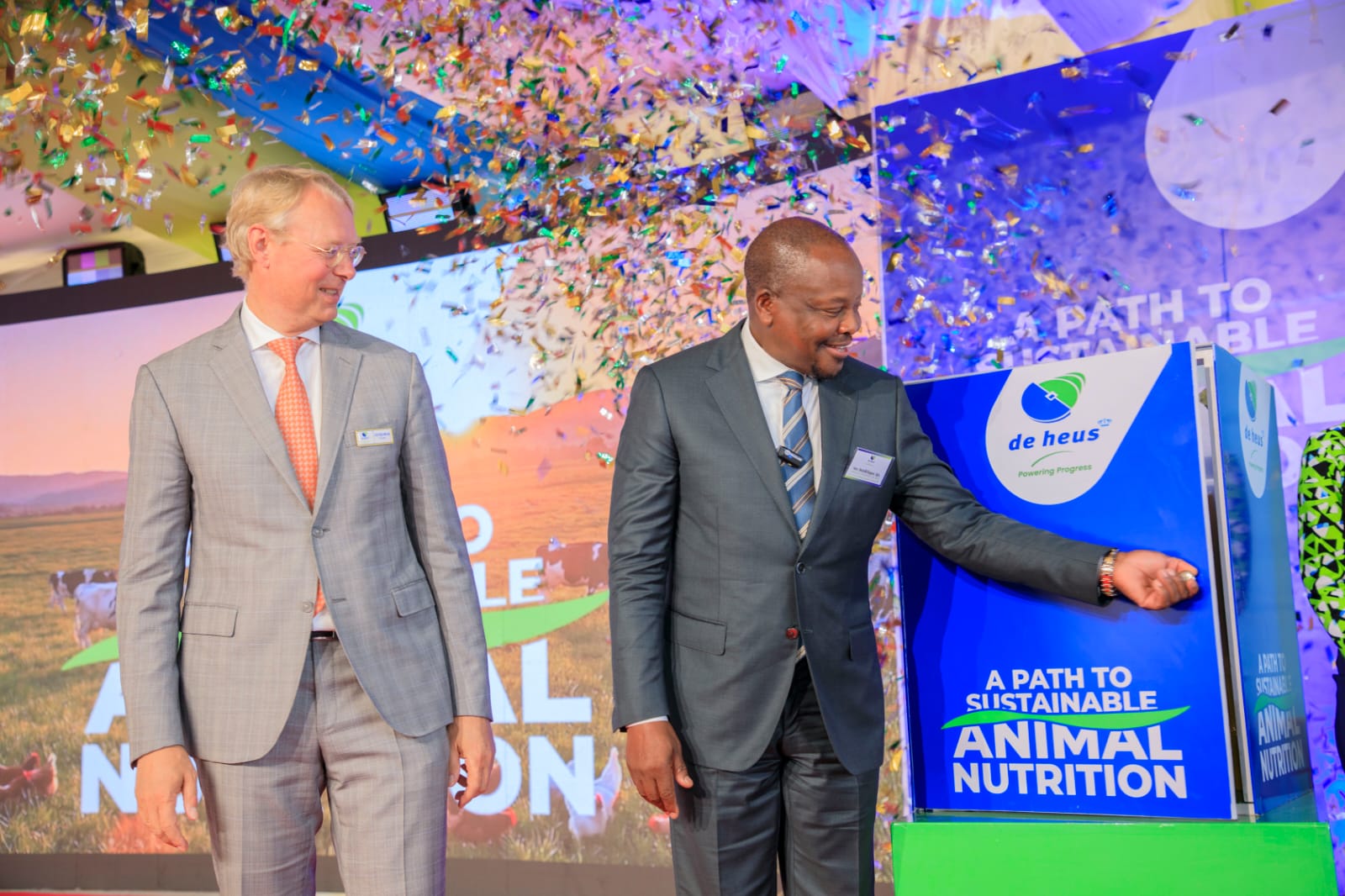
The KSh.3billion facility, launched on the 18th of February and operated by De Heus Company, has an estimated capacity of 240,000 metric tonnes per year and uses a fully automated system that meets international standards of accuracy and reliability concerning the nutrient content of the feed produced and the consistency of the feed batches produced at the Athi River facility.
In January 2023, the plant began providing livestock producers throughout Kenya and East Africa with a wide variety of animal feeds of consistently high quality.
Animal feed quality plays a vital role and significantly affects the biological processes associated with the growth and development of dairy cows, such as growth, reproduction, and the quantity of milk produced by the cows.
In his remarks at the facility’s opening, Agriculture and Livestock Development Cabinet Secretary Mutahi Kagwe stated that enhancing feed quality is a major objective of the Kenyan government, and that the government is committed to doubling annual milk production from about 5.2 billion litres to 10billion litres
“Feed accounts for between 60 and 70 percent of livestock production costs. If the quality is inconsistent, farmers lose productivity and income. Kagwe said, adding that animal feed security must be localized so that Kenya can reduce dependence on imports of key feed ingredients.
Although Kenya has ample agricultural capacity, dairy cow milk production in Kenya is still significantly below global averages. Policy-makers believe that the primary impediments to improving the productive capacity of the dairy industry in Kenya are related to low-quality livestock feeds and the costs associated with producing dairy feeds of consistent quality.
According to the company, all raw materials will undergo testing before their manufacture, and all finished products must be verified against pre-defined nutritional specifications for compliance. At the Athi River feed facility, laboratory testing, digital formulation systems, and controlled production lines are used to limit batch-to-batch variability in feed production
De Heus Chairman Mr. Co de Heus stated that the company’s approach to feed manufacturing includes an element of technical advisory services designed to provide improved on-farm outcomes.
“I believe that our genuine and continuous efforts to make local farmers successful. Our sustained commitment to helping local farmers succeed is not only by supplying high-quality feed but also by providing practical advice and useful services, which have been central to our success”, De Heus said.
The Athi River facility is also anticipated to affect local economies through job creation and agricultural supply chains, with suggested estimates of approximately 280 direct jobs within the plant and more than 1,000 indirect jobs generated from the transporting, distributing, and supplying inputs for the feed plants.
The facility at Athi River is anticipated to serve the regional markets of Uganda and Tanzania, where the demand for commercial livestock feed is also increasing as both the dairy and poultry industries continue towards intensification.
The expansion of the industry to produce animal feeds will be included as part of a broader shift towards evidence-informed management of livestock in the country, with officials forecasting that achieving sustained gains in productivity will require not only an increase in manufacturing capacity but also a substantial focus on improving farmer education, enforcing standards, and enhancing the resilience of farmers to climate-related shocks.